Table of Contents
- 1. Hissing or Bubbling Sounds From the AC Unit
- 2. AC Not Blowing Cold Air
- 3. Rising Energy Bills and Declining Cooling Capacity
- 4. Ice Buildup on Evaporator Coils and Copper Tubing
- 5. Sweet or Chemical Smells Around the Air Handler
- 6. Increased Humidity, Uneven Cooling, and Water Damage From AC Unit
- 7. AC Condensate Drain Line Cleaning and Clog Checks
- 8. Cost of AC Refrigerant Recharge and What Affects It
- Frequently Asked Questions
Last Updated: September 12, 2026
1. Hissing or Bubbling Sounds From the AC Unit
A hissing or bubbling noise coming from your air conditioner is one of the clearest early signs of a leaking AC unit. That sound means pressurized refrigerant is escaping through a small hole or a failing soldered joint in the copper tubing.
Refrigerant circulates as a gas under pressure, so when it escapes through a pinhole leak, you hear the rush of gas. Bubbling points to moisture mixing with refrigerant, often near the evaporator coil. The U.S. Department of Energy’s guide to home cooling systems notes that a refrigerant charge should never drop under normal operation, so any loss points to a leak.
Most homeowners miss this because the sound is faint at first. A common mistake is dismissing it as normal thermal expansion. It usually isn’t.
Ignoring a hissing sound lets refrigerant escape for weeks. That drives up compressor strain and can turn a repairable leak into a full system replacement.
2. AC Not Blowing Cold Air
When your AC runs but the air feels warm, low refrigerant is one of the most common causes. A leaking AC unit loses the refrigerant that absorbs heat from your home, so the blower keeps moving air without actually cooling it. The system sounds like it is working, which is exactly why this sign gets ignored for weeks.
Before you assume a leak, rule out the cheap explanations in this order:
- Thermostat mode and batteries. Confirm it is set to COOL, the fan is on AUTO (not ON), and the setpoint is at least 3 degrees below room temperature.
- Air filter. A filter loaded with dust chokes airflow across the evaporator coil. Hold it up to a light, if you cannot see through it, replace it. Most manufacturers call for a change every 1 to 3 months, more often with pets or during heavy pollen season.
- Supply and return vents. Check that no register is closed, blocked by furniture, or covered by a rug.
- Outdoor unit. Confirm the disconnect switch is on, the breaker has not tripped, and the condenser fan is spinning. A tripped breaker that resets and trips again points to a compressor or electrical fault, not a leak.
If all four check out and the air is still warm, you are most likely looking at a refrigerant leak, a failing compressor, or a restricted metering device. That is where the DIY path ends and the professional path begins, and it helps to know what the professional is actually doing, because it explains the service cost.
What a technician actually uses to find a leak
A technician does not “top off” refrigerant and call it fixed. A proper leak search uses several tools in sequence:
- Electronic refrigerant leak detector. A handheld heated-diode or infrared sensor that sniffs for refrigerant vapor and alarms when concentration rises. This is the fastest way to sweep a coil, line set, and braze joints.
- UV dye and blacklight. A fluorescent dye is injected into the system, the unit runs for a period of days to weeks, and the technician scans with a UV lamp. Oil-and-dye trails mark the leak point, which is useful for slow leaks that a sniffer misses.
- Nitrogen pressure test. The system is isolated, charged with dry nitrogen, and monitored with a gauge manifold. A pressure drop over time confirms a leak even when no single point is obvious.
- Soap bubbles. The oldest method, still used to confirm a suspected joint. A bubble that grows is a leak.
- Electronic vacuum gauge and micron reading. After the repair, the system is evacuated and held under deep vacuum. A vacuum that will not hold indicates moisture or a remaining leak.
That tooling, plus the EPA Section 608 certification required to legally handle regulated refrigerants, is the reason a leak search costs more than a filter change (the EPA). It is also the reason a “cheap recharge” that skips detection is money you will spend again.
Never add refrigerant to a system without locating the leak first. Topping off a leaking system masks the problem, drives up compressor strain, and is illegal for technicians to do as a stand-alone fix under EPA regulations.
If the air is warm and the basics are clean, stop running the system and get a leak search scheduled. Every hour of runtime on a low charge shortens compressor life.
3. Rising Energy Bills and Declining Cooling Capacity
A leaking AC unit forces the compressor to run longer to hit the same temperature. That extra runtime shows up as higher energy bills and weaker cooling capacity, even when nothing else in your home has changed.
Watch for a bill that climbs steadily across two or three months while the outdoor temperature stays similar. Many businesses and homeowners find that a slow refrigerant loss hides behind the excuse of “a hot summer.” Compare year over year, not month to month.
4. Ice Buildup on Evaporator Coils and Copper Tubing
Ice on the evaporator coil or copper tubing is a strong signal of a refrigerant leak. Low refrigerant drops the coil temperature below freezing, and condensation on the coil turns to ice.
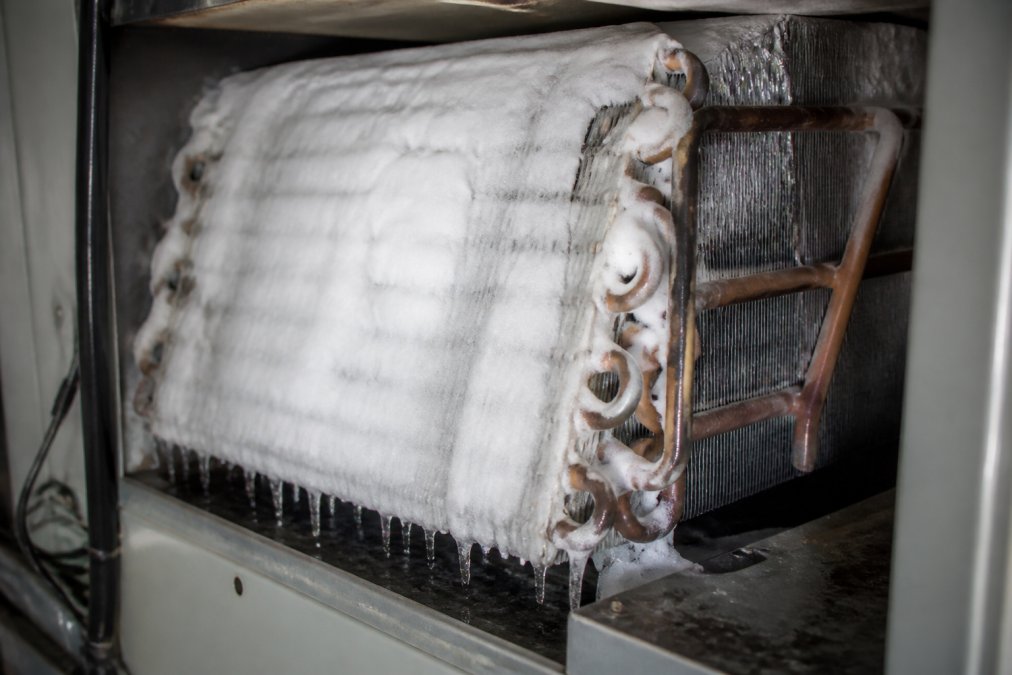
Frozen coils restrict airflow, which makes the system work harder and can send cold refrigerant back to the compressor. That is how a small leak becomes an expensive repair. Turn the system off and let the ice melt before anyone inspects it. Persistent moisture issues often indicate deeper mechanical failures that require a professional evaluation of common AC repair signs to prevent total system breakdown.
5. Sweet or Chemical Smells Around the Air Handler
A sweet, chemical odor near the air handler is a safety concern, not a nuisance. Refrigerant has a faintly sweet smell, and some blends carry a nail polish remover scent when they leak.
If you notice this smell, ventilate the area and leave the space. Refrigerant displaces oxygen and can cause toxic exposure in a closed room. Do not run the system to “clear it out.”
A sweet or chemical smell near the air handler means you should stop using the system and call a professional. This is the one sign you should never troubleshoot yourself.
6. Increased Humidity, Uneven Cooling, and Water Damage From AC Unit
Water damage from an AC unit often starts with a leak you cannot see. When an AC loses refrigerant, it removes less moisture from the air, so indoor humidity climbs and rooms cool unevenly.
Signs to watch for:
- Sticky, clammy air even with the AC running
- Rooms near the air handler staying warmer than the rest of the home
- Water stains on ceilings or walls below the air handler
- Musty odors in crawlspaces or attics
If you find wet ceilings, staining, or standing water, that moisture can feed mold within a short window. This is where the EPA’s guidance on indoor mold and moisture becomes relevant: mold needs moisture, so the leak has to be fixed and the area dried. At Aquaflame Restores it, our IICRC-trained technicians handle the drying and mold remediation side so the water damage does not become a second problem.
7. AC Condensate Drain Line Cleaning and Clog Checks
AC condensate drain line cleaning is a simple maintenance task that prevents many “leak” calls. The drain line carries condensation away from the air handler. When algae, dust, or debris clog it, water backs up and overflows.
A basic check you can do yourself:
- Locate the condensate drain line near the air handler.
- Look for standing water in the drain pan.
- Check the outdoor end of the line for flow.
- Clear minor clogs with a wet/dry vacuum on the line’s access point.
If water keeps returning after you clear the line, the issue may be a refrigerant leak or a cracked pan, not a clog.
8. Cost of AC Refrigerant Recharge and What Affects It
The cost of an AC refrigerant recharge depends on the refrigerant type, how much the system needs, and whether the technician must first find and repair the leak. Pricing varies by region, system size, and refrigerant availability, so always get a written quote that separates the leak search, the repair, and the recharge line items.
Refrigerant type is the biggest cost driver
Two refrigerant families dominate the installed base, and they behave very differently at the parts counter:
- R-22 (HCFC-22). Used in systems manufactured before roughly 2010. R-22 is an ozone-depleting substance regulated under the Montreal Protocol and the Clean Air Act. It has been phased out of new production in the U.S., so the only supply is reclaimed or stockpiled material. That scarcity is why R-22 per-pound pricing has climbed sharply over the past decade and why a recharge on an older system can rival the cost of a new unit.
- R-410A and newer blends (R-32, R-454B). Used in systems built after the phase-out. These are not ozone-depleting, but they are still regulated greenhouse gases under the EPA’s AIM Act, which directs a phasedown of HFC production. Supply is stable today, but pricing is trending upward as the phasedown tightens.
A technician cannot legally mix R-22 and R-410A, and R-410A operates at roughly 50 to 70 percent higher pressures, so the two systems use different components. You cannot retrofit an R-22 system to R-410A without replacing the outdoor unit, indoor coil, and often the line set.
How system age tips the repair-versus-replace call
A useful rule of thumb many HVAC practitioners apply: if the system is under 10 years old and the leak is at an accessible braze joint or Schrader valve, repair usually makes sense. If the system is over 12 to 15 years old, uses R-22, and the leak is in the evaporator coil, the math often favors replacement.
Run the numbers on these four questions:
- What is the refrigerant? R-22 systems face rising per-pound costs and shrinking supply. R-410A systems are cheaper to recharge today.
- Where is the leak? An accessible line-set joint is a quick repair. A coil leak often means replacing the coil, and on an old system the new coil may not match the existing outdoor unit efficiently.
- How many other components are near end of life? A 15-year-old compressor, blower motor, and capacitor are all candidates for failure within a year or two of a coil repair.
- What is the efficiency gap? A new high-efficiency system can cut cooling energy use substantially versus a 20-year-old unit, which offsets part of the upfront cost over the system’s life.
What a written quote should separate
Ask for these line items individually so you can compare bids:
- Leak detection (electronic sweep, pressure test, or dye)
- Leak repair (braze, Schrader valve replacement, coil replacement)
- Vacuum and dehydration
- Refrigerant charge, priced per pound with the type stated
- Filter drier replacement (required any time the system is opened)
- Labor and any permit or disposal fees
Ask your technician to show you the leak location and the leak-detection reading before any recharge. A recharge without a documented repair is money you will spend again, and on an R-22 system, it may be the moment to price a replacement instead.
| Sign | Likely Cause | DIY Check | Professional Fix |
|---|---|---|---|
| Hissing or bubbling | Refrigerant leak | Listen near coils | Leak detection and repair |
| Warm air | Low refrigerant | Check filter, thermostat | Leak search, repair, recharge |
| High energy bills | Compressor strain | Compare past bills | System diagnostic |
| Ice on coils | Low refrigerant, airflow | Turn off, let thaw | Coil and charge service |
| Sweet smell | Refrigerant leak | Ventilate, leave | Emergency service |
| High humidity | Poor moisture removal | Check drain line | Drain and leak repair |
Frequently Asked Questions
How do I know if my AC is leaking water or refrigerant?
Water leaks leave puddles near the indoor air handler or drain pan, and you may see rust or moisture stains. Refrigerant leaks show up as hissing or bubbling sounds, ice on the evaporator coil, weak cooling, and sometimes a sweet chemical smell. If you see standing water, it is a condensate issue. If you hear hissing and the air is not cold, suspect refrigerant.
Can I still run my AC if it’s leaking?
Running a leaking AC unit can make things worse. A refrigerant leak forces the compressor to work harder, which can burn it out and turn a repairable issue into a full system replacement. A water leak can soak drywall, insulation, and flooring, leading to mold within 24 to 48 hours. Turn the system off and call a licensed HVAC technician for a proper diagnosis.
Is a leaking AC unit an emergency?
It can be. A slow refrigerant leak might give you a few days to schedule service, but active water leaking into ceilings, walls, or crawlspaces is urgent. Water damage from an AC unit can lead to structural rot and mold growth fast. If you see water pooling or dripping, shut off the unit and contact a restoration or HVAC professional right away.
Where are most AC leaks found?
Most refrigerant leaks occur at soldered joints, pinhole leaks in copper tubing, and the evaporator coil inside the air handler. Water leaks typically come from a clogged condensate drain line, a cracked drain pan, or a frozen coil that thaws and overflows. A technician uses leak detection tools like electronic sniffers and UV dye to pinpoint the exact spot.