Table of Contents
- Is Mold Removal Covered by Insurance?
- When Is Mold Remediation Covered by Homeowners Insurance?
- Water Damage vs. Mold Damage Insurance: Understanding the Difference
- Common Causes of Mold Growth and Coverage Implications
- How to File a Mold Insurance Claim: Step-by-Step Process
- Steps to Take When You Find Mold in Your Home
- Policy Exclusions and Limitations You Need to Know
- Post-Remediation Documentation and Insurance Implications
Last Updated: August 3, 2026
Is Mold Removal Covered by Insurance?
Whether mold removal is covered by insurance depends entirely on what caused the mold to grow. Most homeowners insurance policies cover water damage from sudden, accidental events like burst pipes or roof leaks, but mold remediation sits in a gray zone. Coverage hinges on the triggering event, not the mold itself. Understanding your coverage before you need it makes the difference between a covered loss and a financial setback.
The Short Answer
Your homeowners insurance covers mold remediation only when the mold results from a covered peril, typically sudden water damage from burst pipes, roof leaks, or accidental overflow. It does not cover mold caused by poor maintenance, slow leaks, flooding, or high humidity. Most policies include sub-limits on mold coverage, capping reimbursement at $5,000 to $10,000 even if remediation costs more.
When Is Mold Remediation Covered by Homeowners Insurance?
Coverage for mold remediation depends on the root cause of the moisture that allowed fungus to grow. A sudden pipe burst is treated entirely differently from a slow seepage problem that developed over months.
Sudden and Accidental Water Damage
A burst water pipe, a roof leak from a storm, or an overflowing water heater are examples of sudden and accidental water damage. When these events trigger mold growth, your homeowners insurance typically covers both the water damage and the resulting mold remediation, up to your policy’s sub-limit. The key word is "sudden." If the damage happened over time or resulted from lack of maintenance, coverage disappears.
For example, a pipe that freezes and bursts overnight qualifies. A pipe that has been slowly corroding for years and finally leaks does not.
Document the exact moment you discovered the water damage and take photos immediately. Insurers will ask how long the water was present before you noticed it; the faster you respond, the stronger your claim position.
Covered Perils vs. Excluded Causes
Your insurance contract lists "covered perils", specific events the policy will pay for. Water damage from sudden leaks, burst pipes, and storms typically appear on this list. Mold caused by those events is then covered under the water damage claim. However, mold caused by excluded perils, like flooding, seepage, or poor maintenance, is not covered.
Flooding deserves special attention. Standard homeowners insurance excludes flood damage entirely. If heavy rain causes water to seep into your basement or a river overflows onto your property, that’s a flood. Mold from flooding is not covered by standard homeowners insurance. You need a separate flood insurance policy through the National Flood Insurance Program (NFIP) or a private carrier.
Seepage is another excluded cause. If water slowly seeps through your foundation or walls because of poor drainage or cracks, that’s maintenance-related seepage. Mold from seepage is typically excluded because you should have maintained the foundation or improved drainage to prevent this.
Water Damage vs. Mold Damage Insurance: Understanding the Difference
Water damage and mold damage are often treated as separate coverage categories, even though mold grows from water. Your policy may cover the water damage but cap or exclude mold remediation costs.
Why Mold Claims Get Denied More Often
Mold claims face higher denial rates than other homeowners insurance claims for three reasons: causation disputes, sub-limits, and maintenance questions. First, insurers scrutinize the cause of the mold. Was it truly from a covered peril, or did poor maintenance create the conditions? Second, many policies include a sub-limit, a maximum dollar amount the insurer will pay for mold, separate from the water damage limit. Third, homeowners often wait too long to report mold, making it harder to prove the mold came from a recent covered event rather than chronic moisture issues.
According to the Insurance Information Institute, mold-related insurance claims have become increasingly scrutinized, with many insurers tightening language around what counts as a covered cause of mold growth.
Waiting to report water damage or mold discovery can destroy your claim. Insurers interpret delays as evidence that you failed to mitigate, your legal duty to prevent further damage. Report water damage immediately, even if you don’t yet see mold.
Sub-Limits and Policy Exclusions
A sub-limit is a cap on coverage for a specific type of loss. Many homeowners policies include a mold sub-limit of $5,000 to $10,000, regardless of the actual remediation cost. This means even if your water damage claim is fully covered, mold remediation costs above the sub-limit come out of your pocket.
Exclusions are losses the policy explicitly does not cover. Common mold exclusions include mold from flooding, seepage or slow leaks, condensation or high humidity, poor ventilation, and lack of maintenance. Read your policy’s exclusions section carefully. Some insurers offer mold coverage endorsements, add-ons that expand coverage beyond the standard sub-limit. These endorsements cost extra but can be worth the premium if you live in a high-humidity area or have aging plumbing.
Common Causes of Mold Growth and Coverage Implications
Not all mold is created equal in the eyes of an insurance adjuster. The cause of moisture determines whether remediation is covered.
Sudden Plumbing Failures vs. Maintenance Neglect
A burst pipe from freezing temperatures is a covered peril. A pipe that corroded slowly over five years and finally leaked is not. The distinction hinges on whether the homeowner could have prevented the failure through reasonable maintenance.
Sudden plumbing failures include pipes freezing and bursting in a cold snap, a water heater rupturing unexpectedly, or a fitting suddenly separating under normal water pressure. Maintenance neglect includes pipes corroding from age without replacement or ignoring a slow drip for months until it causes damage.
If your claim involves an old pipe, expect the adjuster to ask when the plumbing was last inspected and whether you ignored warning signs. These questions determine whether the failure is "sudden" or "foreseeable."
Roof Leaks and Seepage
A roof leak from storm damage is covered. A roof leak from years of deferred maintenance is not. Storm-caused roof leaks typically qualify for coverage, high winds tear off shingles, hail punctures the roof, or a tree falls on the structure. Mold that develops from a storm-caused roof leak is usually covered, though the sub-limit still applies.
Seepage, by contrast, is almost always excluded. Seepage occurs when water slowly enters through the foundation, basement walls, or crawlspace due to poor drainage, cracks, or hydrostatic pressure. Homeowners are expected to maintain gutters, downspouts, and grading to prevent seepage. Mold from seepage is not covered because the homeowner should have prevented it through maintenance.
Flooding and Moisture Control
Flooding is excluded from standard homeowners insurance. This includes heavy rainfall causing water to enter the home, rivers or streams overflowing, and groundwater rising due to heavy rain. Mold from flooding is not covered by homeowners insurance. You need flood insurance through the NFIP or a private carrier.
Moisture control failures, like a malfunctioning air conditioner dripping water or a humidifier left running, are also excluded. These are maintenance or operational issues, not covered perils. Mold from poor moisture control is your responsibility.
How to File a Mold Insurance Claim: Step-by-Step Process
Filing a mold insurance claim requires precision. One misstep, a delayed report, incomplete documentation, or statements that contradict the cause, can result in denial.
Document Everything: Proof of Loss Requirements
Your insurer will demand proof that the mold resulted from a covered peril and that the remediation costs are reasonable. Start documenting the moment you discover water damage or mold.
Immediate steps:
- Take photos and videos of all affected areas, including visible mold, water stains, and moisture
- Note the date and time you discovered the damage
- Write down exactly what you observed: color, location, extent of damage
- Preserve any materials that show the cause (a burst pipe, torn roof shingles, etc.)
- Do not throw away damaged materials until the adjuster has inspected them
Documentation for your claim:
- Photos of the water source and the mold growth
- Receipts for any emergency mitigation (extraction, drying, boarding up)
- A timeline of events: when the damage occurred, when you discovered it, when you reported it
- Maintenance records showing the property was well-maintained before the loss
- Contractor estimates for remediation (get at least two)
- Proof of payment for any work already completed
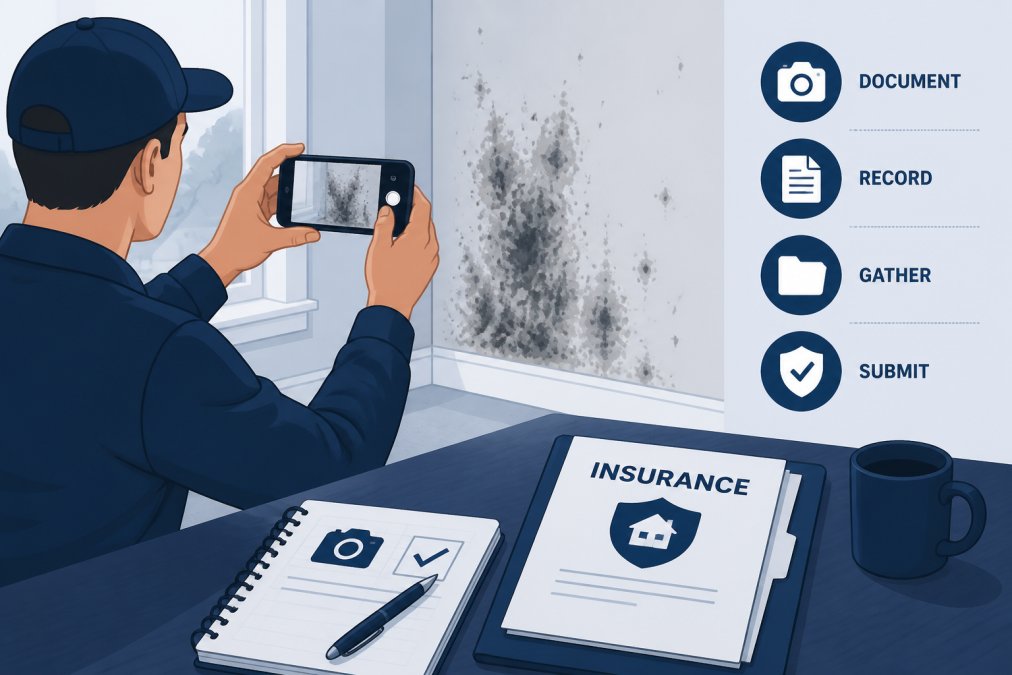
Your insurer will ask for a "proof of loss", a detailed written statement of what happened, when it happened, and how much it will cost to fix. Be specific. Don’t say "there is mold in the basement." Say "on July 15, 2026, a copper fitting on the main water line burst, flooding the basement. Mold began appearing on the drywall on July 22. The affected area is approximately 200 square feet."
Professional Inspection and Testing vs. Remediation Costs
Your insurer may require a professional mold inspection before approving remediation. Mold testing identifies what type of mold is present and measures spore levels. Testing costs $300-$800 and may be required by your insurer or your lender.
Mold remediation is the actual cleanup and removal of mold. Remediation costs depend on the extent of contamination, the materials affected, and whether structural components need replacement. Costs range from $2,000 for a small bathroom to $25,000+ for extensive crawlspace or attic remediation.
Your insurer will approve remediation costs up to the sub-limit, provided the cause is a covered peril. If remediation costs exceed the sub-limit, you pay the difference. Getting multiple contractor estimates matters, you want to document that the cost is reasonable and competitive.
At Aquaflame Restores it, we provide detailed estimates that break down labor, materials, and equipment costs. This transparency helps your claim adjuster understand the work scope and approve the estimate faster. We also handle direct billing with your insurer, so you’re not out of pocket while waiting for reimbursement.
Get a professional remediation estimate before filing your claim. Insurers expect contractor quotes, not DIY cost guesses. A detailed estimate from a licensed, IICRC-certified firm strengthens your claim.
Working with Your Adjuster
After you file a claim, your insurer assigns an adjuster to investigate. The adjuster’s job is to verify the loss is covered, determine the cause, and approve a fair payment.
When the adjuster calls:
- Be honest and detailed about what happened
- Provide a timeline of events
- Don’t speculate about the cause; stick to what you observed
- Have your documentation ready
- Ask the adjuster to explain any exclusions or sub-limits
During the inspection:
- Be present and point out all affected areas
- Provide access to walls, crawlspaces, and attics if needed
- Show maintenance records proving the property was well-maintained
- Ask the adjuster to explain their findings in writing
After the inspection:
- Follow up in writing to confirm what the adjuster said
- Request a written explanation if coverage is denied
- If you disagree with the adjuster’s assessment, hire an independent inspector
The adjuster’s report will either approve the claim, deny it, or approve it with limitations. If approved, the insurer will issue payment based on the estimate and the policy limits.
Your Duty to Mitigate Explained
Your insurance policy includes a "duty to mitigate", a legal obligation to take reasonable steps to prevent further damage. This duty kicks in the moment you discover water damage or mold.
Mitigation includes stopping the water source, removing standing water, preventing mold growth, and protecting undamaged property. Failure to mitigate can result in claim denial or reduced payment. Document your mitigation efforts with receipts for emergency services, photos of the steps you took, and notes on dates and times.
Steps to Take When You Find Mold in Your Home
The first few hours after discovering mold are critical. Your actions during this window determine whether you can file a successful insurance claim and prevent the mold from spreading.
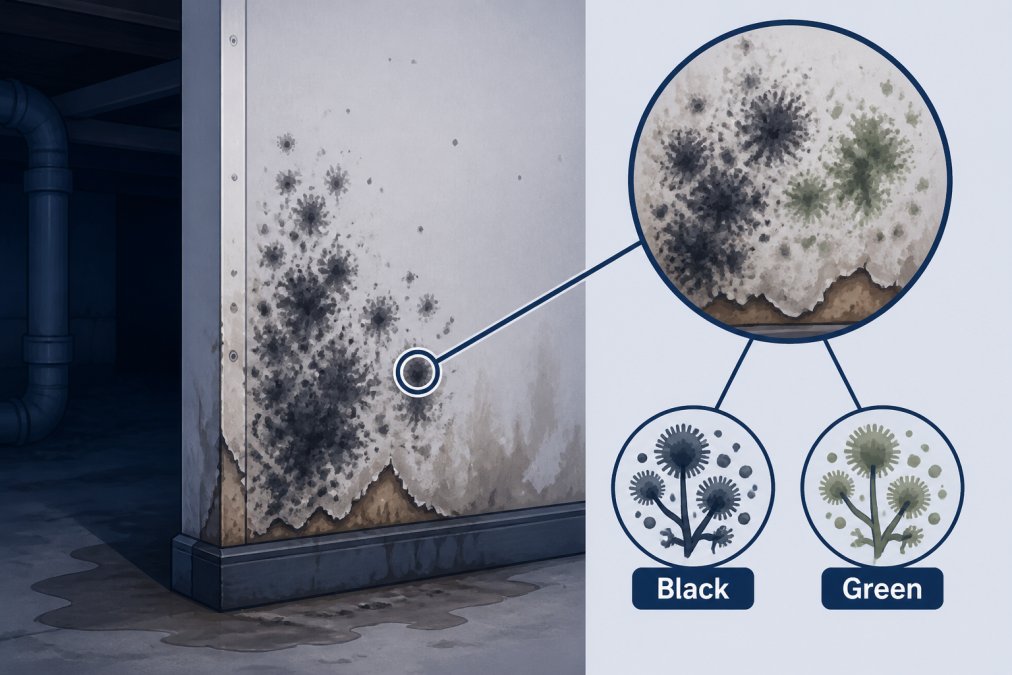
Immediate Actions to Protect Your Claim
Within the first hour:
- Stop the water source if it’s still running (shut off the main water valve, seal the roof leak, etc.)
- Take photos and videos of the mold and any water damage
- Note the date, time, and location of the mold
- Do not touch the mold or attempt to clean it yourself
- Ventilate the area by opening windows and running fans
Within 24 hours:
- Call your insurance company and report the water damage (not the mold; report the cause)
- Document the timeline: when did the water damage occur? When did you discover it?
- Move undamaged items away from the affected area
- If water is still present, hire a water extraction company immediately
- Run dehumidifiers to dry the area
Within one week:
- Get a professional mold inspection to document the extent of contamination
- Obtain contractor estimates for remediation
- Submit your claim with all documentation
- Do not begin remediation until your insurer approves the estimate
Your insurer needs to verify the cause before paying for remediation. If you hire a contractor and begin work before the adjuster inspects, you risk the insurer denying the claim or reducing payment.
Common Mistakes That Lead to Claim Denial
Mistake 1: Waiting too long to report.
Delays signal to the insurer that you failed to mitigate. Report water damage immediately, even if you haven’t seen mold yet.
Mistake 2: DIY cleanup before the adjuster inspects.
If you clean the mold yourself, the adjuster can’t verify the extent of contamination or confirm the cause. The insurer may deny the claim entirely.
Mistake 3: Admitting the property wasn’t maintained.
Never tell the adjuster "I’ve been meaning to fix that roof" or "I knew the basement was damp." These statements give the insurer ammunition to deny the claim as maintenance-related.
Mistake 4: Hiring a contractor without getting an estimate approved.
If you hire a contractor and they bill you $15,000, but your insurer only approves $10,000 (the sub-limit), you’re liable for the $5,000 difference. Get the estimate approved in writing before work begins.
Mistake 5: Throwing away damaged materials.
The adjuster may want to inspect the burst pipe, the moldy drywall, or the roof shingles. Keep these materials until the adjuster releases them.
Mistake 6: Assuming all mold is covered.
Mold from flooding, seepage, or poor maintenance is not covered. Read your policy’s exclusions before filing a claim.
Policy Exclusions and Limitations You Need to Know
Your homeowners insurance policy includes specific exclusions, losses it will not cover. Mold exclusions are among the most common.
Mold from Flooding
Standard homeowners insurance excludes all flood-related damage, including mold. Flooding includes water that enters the home from outside sources (heavy rain, overflowing rivers, storm surge), water that rises from the ground due to saturation, and water that enters through basement walls or foundation cracks due to external water pressure.
If your basement floods during a heavy rainstorm, that’s a flood. Mold from that flood is not covered by homeowners insurance. You need flood insurance, which is available through the NFIP or private carriers. Flood insurance has a 30-day waiting period; you cannot buy it and use it immediately. If you live in a flood-prone area, buy flood insurance well in advance.
Mold Caused by Poor Maintenance
Mold caused by the homeowner’s failure to maintain the property is excluded. This includes mold from slow leaks due to aging or corroded pipes, roof leaks due to deferred maintenance, seepage due to poor drainage, condensation due to poor ventilation, and high humidity due to lack of air conditioning or dehumidification.
The insurer’s logic is straightforward: you had a duty to maintain the property. If you failed in that duty, the resulting damage is your responsibility, not the insurer’s. Document your maintenance efforts with receipts, inspection records, and photos. This evidence helps prove you maintained the property reasonably.
Deductibles and Coverage Limits
Even when mold is covered, your deductible applies. If your deductible is $1,000 and your remediation estimate is $8,000, you pay the first $1,000 and the insurer pays $7,000 (assuming no sub-limit).
Most homeowners policies include a mold sub-limit of $5,000 to $10,000. If remediation costs $12,000 and your sub-limit is $10,000, you pay the $2,000 difference. Some insurers offer higher mold sub-limits or mold coverage endorsements for an additional premium. If you live in a high-humidity area or have older plumbing, these endorsements may be worth the cost.
Post-Remediation Documentation and Insurance Implications
After remediation is complete, your insurer may require clearance documentation proving the mold has been removed and the area is safe.
Clearance Certificates and Structural Integrity Verification
A clearance certificate is a written statement from a licensed professional confirming that mold remediation is complete and the area meets acceptable standards for occupancy. Clearance certificates typically include pre-remediation and post-remediation mold testing results, documentation of the remediation process, confirmation that the moisture source has been fixed, and confirmation that no visible mold remains.
Your insurer may require a clearance certificate before closing out the claim and issuing final payment. Some lenders (if you’re selling the home) also require a clearance certificate before approving the sale.
At Aquaflame Restores it, we provide comprehensive clearance documentation that satisfies insurance and lender requirements. Our IICRC-trained technicians ensure remediation meets industry standards, and we coordinate with inspectors to obtain clearance certificates that protect your claim and your home’s future insurability.
How Professional Remediation Affects Future Coverage
After a mold claim, your insurer may review your coverage at renewal. If the claim was large or the cause was maintenance-related, the insurer may increase your premium, impose a higher mold sub-limit or deductible, add exclusions specific to the type of damage you experienced, or non-renew your policy.
To protect your coverage, document that you completed professional remediation and fixed the underlying cause. If the mold resulted from a burst pipe, show that you replaced the pipe. If it resulted from a roof leak, show that you repaired or replaced the roof. Professional remediation also strengthens your claim. Insurers trust licensed, certified contractors more than DIY efforts.
Mold damage is one of the most disputed insurance claims because causation is complex and prevention is partly the homeowner’s responsibility. The difference between coverage and denial often comes down to timing, documentation, and understanding your policy’s specific language.
If you discover mold, act immediately. Stop the water source, document everything, and report to your insurer within 24 hours. Hire a professional remediation company that understands insurance claims and can provide the documentation your insurer requires. When mold remediation is handled professionally and reported promptly, most claims succeed.
National Association of Insurance Commissioners guidance on homeowners coverage provides state-by-state information on what homeowners insurance typically covers, including mold exclusions and sub-limits.
Aquaflame Restores it specializes in mold remediation for homeowners across metro Atlanta who need fast, professional response and direct insurance billing. Our IICRC-trained technicians document the remediation process thoroughly, obtain clearance certificates that satisfy lender requirements, and coordinate directly with your insurance adjuster. With our 30-minute arrival guarantee and 24/7 emergency service, we ensure your claim is handled right from the start. Contact Aquaflame Restores it for immediate assistance and a detailed estimate your insurer will approve.
| Scenario | Coverage Status | Key Requirement | Common Sub-Limit |
|---|---|---|---|
| Burst pipe causing mold | Covered | Sudden, accidental | $5,000-$10,000 |
| Roof leak from storm | Covered | Storm damage verified | $5,000-$10,000 |
| Slow seepage from poor drainage | Not covered | Maintenance issue | N/A |
| Basement flood from heavy rain | Not covered | Requires separate flood insurance | N/A |
| Mold from condensation/humidity | Not covered | Operational/maintenance issue | N/A |
| Slow pipe corrosion and leak | Not covered | Deferred maintenance | N/A |
Frequently Asked Questions
Does homeowners insurance cover mold removal in all cases?
No. Mold removal is covered only when mold results from a covered peril, such as a sudden plumbing failure or burst pipe. If mold develops from maintenance neglect, poor moisture control, or gradual leaks, your claim will likely be denied. Most policies also exclude mold from flooding unless you have separate flood insurance. Always review your specific policy exclusions and sub-limits before assuming coverage.
How much does mold remediation cost, and will insurance cover the full amount?
Mold remediation costs vary based on contamination extent, location, and structural damage but can range significantly. However, even if your claim is approved, most policies impose sub-limits on mold coverage, meaning they cap reimbursement at a specific amount (often $5,000-$10,000). Professional testing, documentation, and remediation are separate line items. You may need to cover costs exceeding your sub-limit out of pocket.
What is the 'Duty to Mitigate' and how does it affect my mold insurance claim?
Your Duty to Mitigate requires you to take reasonable steps to prevent further damage once you discover mold. This means stopping water sources, improving ventilation, and contacting your insurance company promptly. Failure to mitigate can result in claim denial or reduced reimbursement. Documentation of your immediate actions strengthens your claim and shows the adjuster you acted responsibly to protect your property.
How do I document mold damage for an insurance claim?
Photograph all visible mold, affected areas, and water damage sources from multiple angles. Keep receipts for any emergency mitigation work. Document the date you discovered the mold and when damage occurred. Obtain a professional mold inspection report if possible. Create a detailed written account of events leading to mold growth. Provide your insurance company with all photos, reports, receipts, and a timeline. This proof of loss is critical to avoid claim denial or disputes over coverage.
This article was written using GrandRanker