Table of Contents
- What to Expect When You Call for Emergency Board Up Services in Atlanta
- Residential Board-Up and Commercial Property Securing After Damage
- Roof Tarping Services: Protecting Your Home From Further Storm Damage
- Filing an Insurance Claim for Board Up Services: What You Need to Document
- DIY vs. Professional Board-Up: Safety Risks and Material Standards
- Cost Transparency: What Affects Emergency Board Up Pricing
- Frequently Asked Questions
Last Updated: September 16, 2026
What to Expect When You Call for Emergency Board Up Services in Atlanta
A broken window at 2 a.m. leaves your home exposed to rain, looters, and further structural damage with every passing hour. Emergency board up services at Atlanta properties exist to close that gap fast: crews secure openings, tarp damaged roofs, and stabilize the structure so restoration can begin. At Aquaflame Restores it, we run this process around the clock because we know the first night after a fire, storm, or break-in decides how expensive the recovery becomes.
The 24/7 Dispatch and 30-Minute Arrival Process
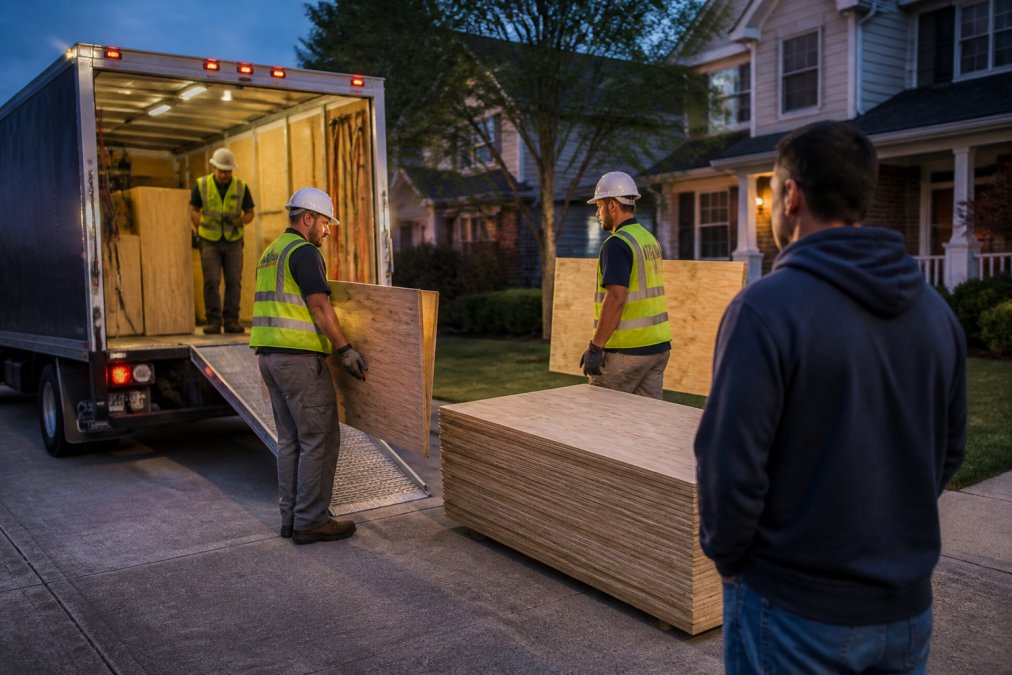
Dispatch starts with three questions: your address, what happened, and whether anyone is still in danger. From there, a crew is assigned and routed to you. Aquaflame Restores it backs its 24/7 emergency service with a 30-minute arrival guarantee across metro Atlanta, and the dispatcher stays on the line to tell you what to avoid touching before the truck pulls up.
Site Assessment and Property Securing Priorities
The crew’s first job is a property assessment, not a repair. Technicians walk the exterior and interior to rank every opening by risk: which ones let in water, which ones let in people, and which ones threaten structural integrity.
Priorities typically follow this order:
- Exposed roof sections, because water travels down and ruins ceilings and insulation
- Ground-floor windows and doors, the most common entry points
- Second-story or rear openings that are harder to monitor
- Garage doors and outbuildings
Residential Board-Up and Commercial Property Securing After Damage
Homes and businesses need different plans. A house has one family to protect and a finite set of openings. A commercial property has tenants, inventory, liability exposure, and a clock running on lost revenue. The material and fastening choices diverge just as sharply.
Window Boarding and Door Reinforcement for Homes
For residential board-up, standard practice is to cut exterior-grade plywood panels to fit each opening, fasten them into the framing rather than the glass, and seal edges against wind-driven rain. Door reinforcement means more than a board across the frame: exterior doors get braced so they can’t be pushed in, and sliding doors get vertical blocking that prevents the panel from being slid aside.
- Exterior-grade (Exposure 1) plywood, water-resistant adhesive between plies, rated for repeated wetting. This is the correct choice for any opening that will face rain before permanent repairs.
- Interior-grade plywood, interior glue that delaminates when wet. It may look fine on day one and fall apart after a storm.
Minimizing Business Downtime for Commercial Properties
Commercial property securing is a scheduling problem as much as a construction one. Storefronts, restaurants, and offices often need to reopen or at least look operational while restoration continues, and the security standard is higher because the building may hold inventory, cash, or regulated records.
- Storefront glass, plywood panels fastened into the mullion framing, with the panel sized to overlap the frame rather than sit inside it.
- Security film, a clear, shatter-resistant film applied to intact glass that holds fragments together and slows forced entry. It is often used on windows that are not yet broken, so the building keeps its daylight and street presence while adding a layer of protection.
- Roll-down or panel systems, for repeated exposure or high-crime locations, some property managers install reusable panel tracks so future board-ups take minutes instead of hours.
Ask the crew to photograph each secured opening from the inside and outside before they leave. Those images become the “before” half of your claim file, and they’re much harder to collect a week later.
Roof Tarping Services: Protecting Your Home From Further Storm Damage
Roof tarping services install a heavy-duty cover over damaged roof sections to stop water intrusion until permanent repairs are possible. After a storm, this tarp-over is often the single highest-value step you can take, because a small leak becomes a ceiling collapse, mold growth, and insulation replacement within days.
How Tarp-Over Prevents Water Damage and Structural Weakening
Water doesn’t stay where it lands. It follows rafters, soaks drywall, and pools in places you can’t see. A properly installed tarp sheds that water off the roof and away from the building envelope.
- Polyethylene tarps, the common blue or silver covers sold at hardware stores. They are lightweight and inexpensive but degrade under UV exposure and tear at grommets under wind load. They are a short-term patch, not a mitigation standard.
- Reinforced poly tarps, woven polyethylene with a scrim layer and reinforced grommets. Heavier, more tear-resistant, and the usual choice for emergency roof covering.
- Canvas or vinyl-coated tarps, heavier still, with better puncture resistance, often used on commercial roofs or where the cover will stay in place for weeks.
Never let anyone walk a storm-damaged roof without fall protection and a second person on the ground. Wet shingles and compromised decking are the leading cause of injury during storm damage mitigation, and a fall turns a repair job into a medical emergency.
What to Check Before the Crew Leaves
A tarp-over is only as good as its weakest anchor. Before the crew packs up, walk the perimeter and confirm:
- The tarp extends past the ridge and past the eaves on every covered slope
- Battens or furring strips are screwed into sound decking, not into the damaged section
- No fasteners penetrate the tarp where water can pool
- Debris has been cleared from under the cover
- Photos of the finished tarp exist from at least two angles
Filing an Insurance Claim for Board Up Services: What You Need to Document
Most standard property policies treat board-up and tarping as mitigation, meaning the cost of preventing further damage is often covered. The catch is documentation. An insurance claim for board up services is approved or denied based on what you can prove happened and when.
Photos, Receipts, and Adjuster Coordination
Build the file before the adjuster asks for it:
- Wide photos of every damaged opening, taken before any work starts
- Close-ups showing the cause, such as broken glass, charred framing, or missing shingles
- Photos of the finished board-up and tarp, inside and out
- The itemized invoice listing materials, labor, and emergency response time
- Your written notes on the date and time you called
The National Association of Insurance Commissioners homeowner claims guide walks through how adjusters evaluate mitigation expenses, and it’s worth reading before your first call with them.
Direct Insurance Billing and What It Covers
Direct insurance billing means the restoration company works with your adjuster on the paperwork instead of leaving you in the middle. It doesn’t guarantee coverage, but it removes the most common source of delay: missing documentation between two parties who never talk to each other.
DIY vs. Professional Board-Up: Safety Risks and Material Standards
Boarding up a window looks simple until you’re standing on a ladder in the dark with a nail gun. The real difference between a DIY job and professional work comes down to two things: safety and materials.
Why Plywood Thickness and Fastening Matter
Thin paneling flexes, warps, and pulls free. Standard practice is to use exterior-grade plywood of sufficient thickness for the opening size, cut to overlap the frame, and fasten it with screws or nails long enough to reach the structural framing. Edges get sealed so water can’t wick behind the panel.
Here’s how the two approaches compare:
| Factor | DIY Board-Up | Professional Board-Up |
|---|---|---|
| Material | Whatever is on hand | Exterior-grade plywood, cut to fit |
| Fastening | Nails into trim or frame | Fasteners into structural framing |
| Sealing | Often skipped | Edges sealed against wind-driven rain |
| Roof protection | Plastic sheeting | Properly anchored tarp-over |
| Documentation | Rarely photographed | Photo record for the claim |
| Safety | Ladder work, no fall protection | Trained crews, site safety protocols |
Hidden Hazards After Fire, Storm, or Break-In
The building itself is the hazard. After a fire, charred framing can fail under a person’s weight, and soot hides cracks in the structure. After a storm, live electrical lines may be down against wet siding. After a break-in, broken glass and damaged locks create their own risks.
Cost Transparency: What Affects Emergency Board Up Pricing
Pricing for emergency board up depends on the property, not a flat rate. The factors that move the number most are the size and number of openings, roof access and pitch, the time of day, and how much debris removal is needed before work can start.
The cheapest board-up is the one that holds until the rebuild starts. A panel that fails overnight means a second emergency call, a bigger water damage claim, and more time out of your home.
Frequently Asked Questions
Why is emergency board up service necessary after a fire?
After a fire, your home has open windows, doors, or roof damage that leave it exposed to rain, wind, and intruders. Emergency board up service secures those entry points with plywood and reinforces doors, which protects your property from further damage and theft. It also helps preserve the structure for insurance claims by preventing additional loss that adjusters may question.
How long does it take for board up services to arrive?
Response times vary by company and location. Aquaflame Restores It offers 24/7 emergency service with a 30-minute arrival guarantee across metro Atlanta. When you call, dispatch sends a crew immediately.
Does homeowners insurance cover emergency board up services?
Most homeowners insurance policies cover emergency board up as part of the loss mitigation clause, because securing your home prevents further damage that the insurer would otherwise pay for. Keep all receipts, take photos before and after the work, and file an insurance claim for board up services promptly. Aquaflame Restores It can bill your insurer directly and help document the scope of work.
What is the difference between board up and roof tarping?
Board up secures ground-level openings like windows and doors using plywood panels, while roof tarping services cover damaged roof sections with heavy-duty tarps to stop water intrusion. Both are temporary repairs that protect your property until permanent restoration begins. After a storm, you may need both: tarping for roof damage and boarding for broken windows or doors.
A damaged roof or shattered window gets worse with every hour it stays open, and the difference between a contained loss and a gutted room is usually response time. Aquaflame Restores it is a locally owned, IICRC-trained team based in Decatur, offering 24/7 emergency service, a 30-minute arrival guarantee, direct insurance billing, and full reconstruction so one crew carries your property from board-up to finished repair. Get started with Aquaflame Restores it and secure your property tonight.