Table of Contents
- Water Removal in a Basement: Safety First, Then the Source
- Cut the Power Before You Step In
- Find and Stop the Source
- How to Get Water Out of a Basement: 7 Cleanup Steps
- Basement Flood Cleanup Steps: Drying, Sanitizing, and Verifying
- How Long Does It Take for a Basement to Dry?
- Basement Water Removal Cost: What Drives the Price
- DIY or Call a Pro? A Decision Tree for Flooded Basements
- Conclusion: Dry It Fast, Document Everything
- Frequently Asked Questions
Last Updated: October 8, 2026
Water Removal in a Basement: Safety First, Then the Source
Water removal in a basement starts with two non-negotiables: cut the power, then stop the water at its source.
Most guides start with equipment. The real order is safety, source, then extraction.
Below, we break down seven cleanup steps, drying timelines, cost factors, and a simple decision tree for when to call a pro.
Cut the Power Before You Step In
Never enter a flooded basement while power is still live. Water and electricity together can kill you.
Do this first:
- Do not touch the breaker box if it sits in or near standing water
- Call an electrician or your utility to cut power from outside
- Wear rubber boots and gloves if you must approach the panel
Electrical hazards are the leading danger in any flooded basement. If the panel is dry and above the waterline, you may be able to shut it off yourself. If it is wet or submerged, stay out and call for help.
Never wade into standing water to reach a breaker panel. If the panel is submerged or you cannot reach it safely from dry ground, call an electrician or your utility before entering. The consequence of guessing wrong is electrocution.
Once power is off, you can assess the space safely.
Find and Stop the Source
Stop the water before you remove any of it.
Common sources include:
- A burst pipe or failed supply line
- A clogged drain or backed-up floor drain
- A sewage backup from the municipal line
Shut off the main water supply if you suspect a plumbing failure. For storm or groundwater flooding, move straight to extraction.
Identify whether the water is clean, gray, or black before you touch anything. That classification changes your entire approach.
| Water Category | What It Is | Example | Safe to Handle Yourself? |
|---|---|---|---|
| Category 1 | Clean water | Burst supply line, rain | Usually yes |
| Category 2 | Gray water | Washing machine, dishwasher | Use caution |
| Category 3 | Black water | Sewage backup, ground flood | No, call a pro |
Category 3 water carries bacteria and pathogens.
How to Get Water Out of a Basement: 7 Cleanup Steps
How to get water out of a basement comes down to seven steps, done in order. Rushing them is how basements stay wet and grow mold.
Step 1: Measure the Water Depth
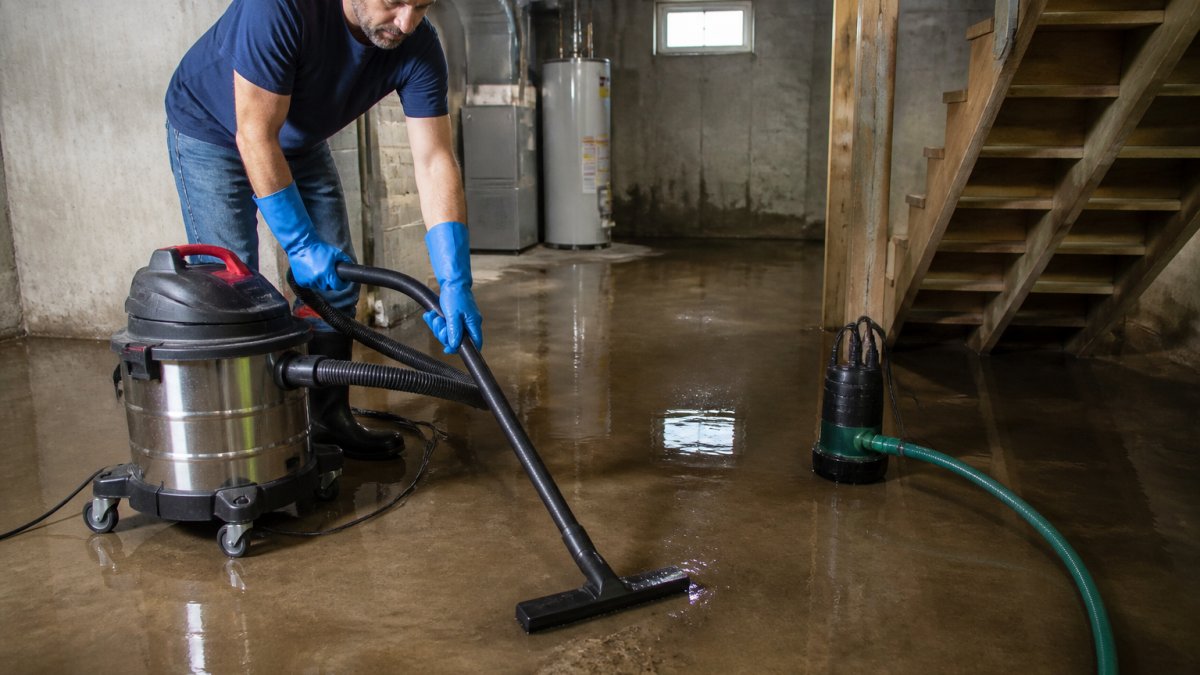
Check the water depth first. Under an inch is a mop-and-vac job. Over a foot calls for serious pumping.
Step 2: Extract Standing Water
For deep water, use a submersible pump or industrial pump; for shallow water, a wet/dry shop vacuum works. Water extraction moves water out fast, and speed limits how far water damage spreads.
Step 3: Pull Wet Carpet and Pad
Wet carpet and carpet pad almost never survive a flood. The pad traps water against the slab and feeds mold. Pull both, and bag them outside.
Step 4: Remove Water-Damaged Materials
Water-damaged materials like soaked drywall, baseboards, and insulation hold moisture. Cut them out to the waterline so air reaches the framing.
Step 5: Sort Salvageable Belongings
Move salvageable belongings and water-damaged contents to a dry area. Photograph everything before you toss it for your insurance claim.
Step 6: Dry the Space
Set up air movers and a dehumidifier. We cover drying in the next section.
Step 7: Sanitize and Verify
Sanitizing and disinfection come after drying, not before. Then verify moisture with a meter.
Basement Flood Cleanup Steps: Drying, Sanitizing, and Verifying
Basement flood cleanup steps do not end when the water is gone. The structure stays wet long after the floor looks dry, and that hidden moisture grows mold. Here is how to confirm the structure is dry.
Structural drying means removing moisture from framing, drywall, and the slab, not just the air.
Here is the equipment that does it:
- High-capacity air movers positioned to push air across wet surfaces at a shallow angle, not straight down
- A low-grain refrigerant dehumidifier sized to the cubic footage of the space, not the square footage of the floor
- Ventilation to exchange humid air for drier air when outdoor conditions allow
Run the dehumidifier continuously and empty it often.
Drying targets and moisture monitoring
This is the part most homeowners skip. A surface that feels dry can still hold enough moisture to feed mold inside the wall cavity.
Use a pin-type moisture meter on wood framing and a non-penetrating meter on drywall and concrete.
Track relative humidity with a hygrometer. Drying is progressing when indoor relative humidity stays below outdoor levels and keeps falling.
A few practical checks:
- Wood framing: readings should trend toward the dry reference, not plateau
- Drywall: if the paper is still cool to the touch or the meter reads high, the cavity is still wet
- Concrete slab: slabs dry slowly and can read high for weeks; surface dryness is not the same as slab dryness
Buy or borrow a moisture meter before you start drying. It tells you when the framing is actually dry, not just when the floor feels dry. Most homeowners stop drying too early because the surface reads dry while the studs behind it are still wet.
Sanitizing after drying
Once surfaces are dry, apply a disinfectant to any area touched by gray or black water. Sanitizing a wet surface dilutes the product and spreads contamination, so dry first, then disinfect.
Mold prevention depends on getting moisture below safe levels within the first day or two.
For a full set of drying standards, the IICRC restoration standards are the industry benchmark that trained technicians follow.
How Long Does It Take for a Basement to Dry?
How long does it take for a basement to dry?
Drying time depends on:
- Water depth and how long it sat
- How quickly you started extraction
- Humidity levels and airflow
- What materials got wet
Moisture hides in drywall, wood, and concrete. Check with a meter daily; if readings are not dropping, add airflow or call a pro.
For a full set of drying standards, the IICRC restoration standards are the industry benchmark that trained technicians follow.
Basement Water Removal Cost: What Drives the Price
Basement water removal cost depends on water category, square footage, and how much material must be replaced.
What drives the price:
- Water category: clean water costs less to handle than sewage
- Affected area: more square footage means more equipment and labor
- Materials removed: carpet, drywall, and insulation add to the job
- Drying time: longer drying means more equipment rental days
We do not publish flat prices because every job is different. For a real number, request a quote after an on-site assessment.
Most homeowner insurance policies cover sudden water damage. Document everything and keep receipts.
DIY or Call a Pro? A Decision Tree for Flooded Basements
Most guides give a vague rule of thumb. The useful version is a decision tree keyed to four variables: water category, water depth, how long it has been sitting, and what equipment you have on hand. Work through it in order.
Step 1: Classify the water
- Category 1 (clean): burst supply line, rainwater that has not touched contaminated surfaces
- Category 2 (gray): washing machine discharge, dishwasher water, toilet overflow without solids
- Category 3 (black): sewage backup, ground flood, river or storm surge water
If it is Category 3, stop here. Do not wade in it, do not run a shop vac through it, and do not try to dry it yourself. Call a pro.
Step 2: Measure depth and affected area
- Under 1 inch, one room: a wet/dry shop vac and fans can handle it if the water is Category 1
- 1 to 6 inches, one or two rooms: a submersible pump plus a dehumidifier is the minimum
- Over 6 inches, or more than one floor affected: call a pro; you need commercial extraction and drying capacity
Step 3: Check how long it has been sitting
- Under 12 hours: DIY is reasonable for clean, shallow water
- 12 to 24 hours: mold risk climbs sharply; weigh a pro call even for clean water
- Over 24 hours: call a pro; contamination and mold growth are likely
Step 4: Inventory your equipment
DIY is only realistic if you have all of these:
- A wet/dry shop vac or submersible pump
- A refrigerant dehumidifier sized for the space
- At least two air movers or high-velocity fans
- A moisture meter
If you are missing more than one item, renting or buying it often approaches the cost of professional extraction, and you still will not have the drying capacity to finish the job.
Step 5: Decide
- Clean water, under an inch, caught within hours, full equipment on hand? DIY is reasonable.
- Clean water, over an inch, or sitting overnight? Call a pro.
- Gray or black water, or any sewage? Call a pro immediately.
- Mold already visible, or a musty smell that will not clear? Call a pro.
Emergency water removal and water mitigation pros bring pumps, drying equipment, and moisture meters most homes do not have. They also document the damage for your claim, which matters when the adjuster asks for evidence.
The decision tree is not about whether you are capable. It is about whether you have the equipment, the time, and the documentation to finish the job before mold starts. If any of those is missing, the pro call is the cheaper path.
This is where Aquaflame Restores it comes in. Our IICRC-trained technicians offer 24/7 emergency service and a 30-minute arrival guarantee across metro Atlanta. We handle direct insurance billing and full reconstruction, so you deal with one team from extraction to the finished repair.
Homeowners facing Category 3 water, deep flooding, or any sign of mold. These jobs need professional extraction and drying equipment, plus documentation your insurer will accept.
Conclusion: Dry It Fast, Document Everything
A flooded basement gets worse by the hour. Standing water, water damage, and mold growth all move faster than most homeowners expect, and the difference between a quick cleanup and a rebuild often comes down to how fast you act.
If the water is deep, contaminated, or already showing mold, do not wait. Aquaflame Restores it offers 24/7 emergency response, a 30-minute arrival guarantee, IICRC-trained technicians, and direct insurance billing.
Frequently Asked Questions
Will homeowners insurance cover a flooded basement?
It depends on the cause. Sudden, accidental events like a burst pipe or a failed water heater are usually covered. Flooding from heavy rain, surface water, or a sewage backup typically requires a separate flood or sewer backup endorsement. Document the source with photos and video before you start cleanup, keep receipts, and call your insurer early. Aquaflame Restores It handles direct insurance billing for covered losses, which can reduce the back-and-forth with your adjuster.
How do you safely remove water from a flooded basement?
Shut off power at the breaker before entering, and wear rubber boots and gloves. Stop the water source first, then remove standing water with a wet/dry shop vacuum or submersible pump. Pull wet carpet and pad, and dispose of any materials that were soaked by contaminated water. Set up air movers and a dehumidifier, and check framing with a moisture meter. If the water came from a sewage backup or covers electrical outlets, leave it to a professional.
Can water in the basement cause mold?
Yes. Mold can begin growing on wet drywall, wood, and carpet within 24 to 48 hours. That is why drying needs to start the same day, not the next weekend. Remove standing water, pull saturated carpet and pad, and run air movers and a dehumidifier until a moisture meter shows materials are back to normal. If mold is already visible or you smell a musty odor, professional remediation with clearance documentation is the safer route.
When should you call a professional for basement water removal?
Call a pro when the water is deeper than a couple of inches, when it came from a sewage backup or outdoor flooding, when electrical panels or outlets were submerged, or when the space is larger than about 300 square feet. Also call if the water has been sitting more than 24 hours, or if you need documentation for an insurance claim or a real estate sale. Aquaflame Restores It offers 24/7 emergency service with a 30-minute arrival guarantee across metro Atlanta.