Last Updated: November 9, 2026
Quick Summary
Nothing kills mold spores outright, so what kills mold after a flood is removing the spores and cutting off the moisture they need. Dead spores still trigger allergies and asthma, so scrub hard surfaces, bag wet porous materials, and dry the space with a dehumidifier and fans.
- Mold can start growing in as little as 24 to 48 hours after water damage, and Georgia humidity speeds that up.
- Plain dish soap and water is enough for light cleaning on hard, non-porous materials.
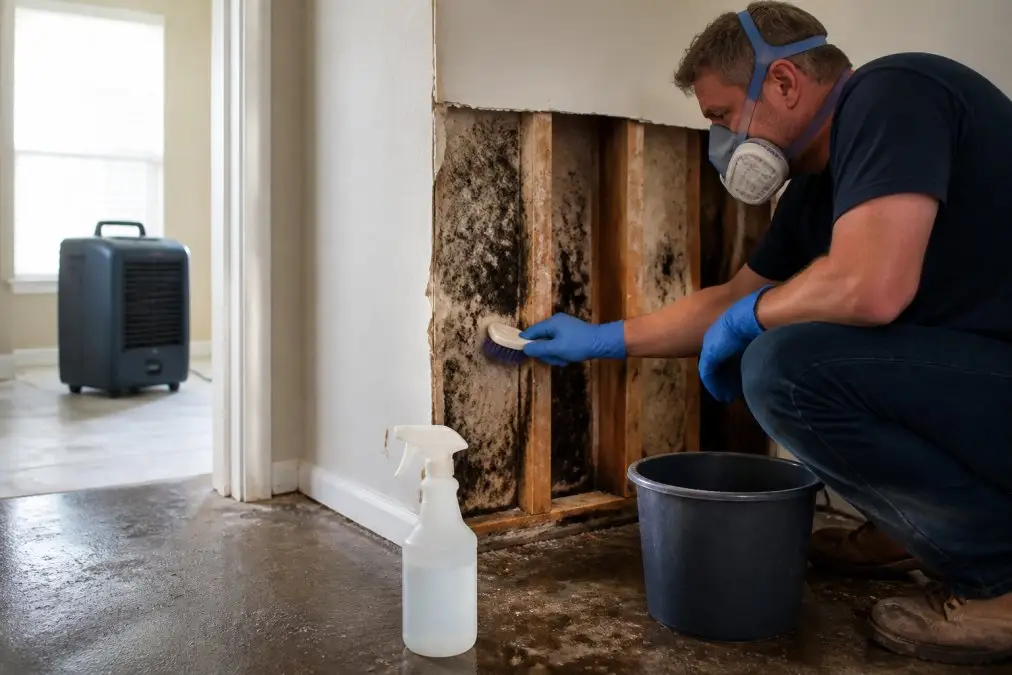
- Never dry-scrub mold, because it sends spores into the air and spreads them to clean rooms.
- A musty odor that returns within a week of cleaning usually means hidden growth in a cavity, under carpet, or in insulation.
- Anything larger than about 10 square feet, hidden mold, or Category 3 water needs a professional assessment.
Table of Contents
- What Actually Kills Mold After a Flood
- How Long Does It Take for Mold to Grow After Water Damage?
- What to Spray to Prevent Mold After Water Damage
- How to Clean Mold Without Spreading Spores
- Is It Safe to Clean Black Mold Yourself?
- Why Flood Mold Comes Back in Metro Atlanta Homes
- Call Aquaflame Restores It for a Free Mold Assessment
- Frequently Asked Questions
What Actually Kills Mold After a Flood
Nothing kills mold spores outright. The honest answer to what kills mold after a flood is that you don’t kill spores, you remove them and take away the water they need to survive. Dead spores still trigger allergies and asthma, so the goal is physical removal plus moisture control.
A spray bottle is not a fix. It is one step in a process.
Mold needs three things to grow: moisture, food, and time. Take away the moisture and the colony stops spreading. That is why drying matters more than any product on the shelf.
Why Dead Spores Still Cause Problems
A disinfectant can make a spore unable to reproduce. It cannot make the spore disappear. Those dead particles stay on drywall, in insulation, and in carpet fibers, and they still get into the air you breathe.
That is why the EPA’s mold guidance focuses on removing mold, not just treating it. Scrubbing, bagging, and discarding porous material does the real work.
Watch out: spraying a moldy surface and leaving it wet can make the problem worse. Trapped moisture feeds new growth.
How Long Does It Take for Mold to Grow After Water Damage?
Mold can start growing in as little as 24 to 48 hours after water damage, and Georgia humidity can speed that up. Spores are already in the air of most homes, waiting for a wet surface.
The clock starts when the water lands, not when you notice the stain. Here is what the timeline looks like in practice:
- 0 to 24 hours: Water soaks into drywall, subfloor, and carpet pad.
- 24 to 48 hours: Spores settle and begin to colonize damp surfaces.
- 48 to 72 hours: Visible mold and a musty smell appear.
- One week plus: Growth spreads into wall cavities and insulation.
Fast drying changes everything. If you want to know how long it takes to dry out a flooded house, the equipment and airflow matter more than the calendar.
What to Spray to Prevent Mold After Water Damage
The honest answer is that no spray prevents mold on its own. What prevents mold is removing the water fast and treating each surface according to what it is made of.
Here is how the surfaces in a typical metro Atlanta home actually respond, and what to do with each:
| Material | Can it be saved? | What works | What to skip |
|---|---|---|---|
| Painted drywall (paper facing wet) | Usually no if soaked through | Cut out and bag the wet section; dry the framing behind it | Spraying the face, the mold is inside the paper |
| Solid wood studs and joists | Yes, if dried quickly | Sand the surface, then dry with airflow and a dehumidifier | Leaving it wet under plastic |
| Hardwood flooring | Sometimes, if caught within a day or two | Extract standing water, run drying equipment, monitor moisture | Sealing over damp boards |
| Carpet and carpet pad | Pad almost never; carpet rarely | Remove and bag the pad; evaluate carpet case by case | Spraying and re-laying wet pad |
| Fiberglass insulation | No once wet and compressed | Remove, bag, and replace after the cavity is dry | Drying it in place |
| Tile and grout | Yes | Scrub with soapy water, dry fully, then treat with an antimicrobial | Fogging the whole room |
| Metal, glass, sealed concrete | Yes | Clean, dry, and apply an antimicrobial after cleaning | Relying on the spray alone |
| Brick and unfinished concrete | Yes, with patience | Scrub, then dry slowly, masonry holds water for weeks | Assuming it is dry because the surface feels dry |
A few rules apply across the table. Plain dish soap and water is enough for light surface cleaning on hard, non-porous materials.
What actually helps is mechanical:
- Run a dehumidifier to pull moisture from the air.
- Add fans and open windows for air circulation.
- Use a hygrometer to track relative humidity and keep it low.
- Treat hard surfaces with an antimicrobial after cleaning, not instead of it.
Georgia humidity changes the math. In summer, outdoor air in metro Atlanta often carries more moisture than the room you are trying to dry, so open windows can work against you.
Watch out: spraying a moldy surface and leaving it wet can make the problem worse. Trapped moisture feeds new growth, and a wet wall cavity behind a freshly sprayed surface is the most common reason a cleanup fails.
If the wet area is larger than about 10 square feet, if the water came from flooding or sewage, or if you cannot see behind the wall, stop treating and call for an assessment. Surface treatment is the last step, not the first.
How to Clean Mold Without Spreading Spores
The biggest mistake is scrubbing dry mold. That sends mold spores into the air and spreads them to rooms that were clean. The right method contains the spores first, then removes them, and then proves the job worked before anyone moves back in.
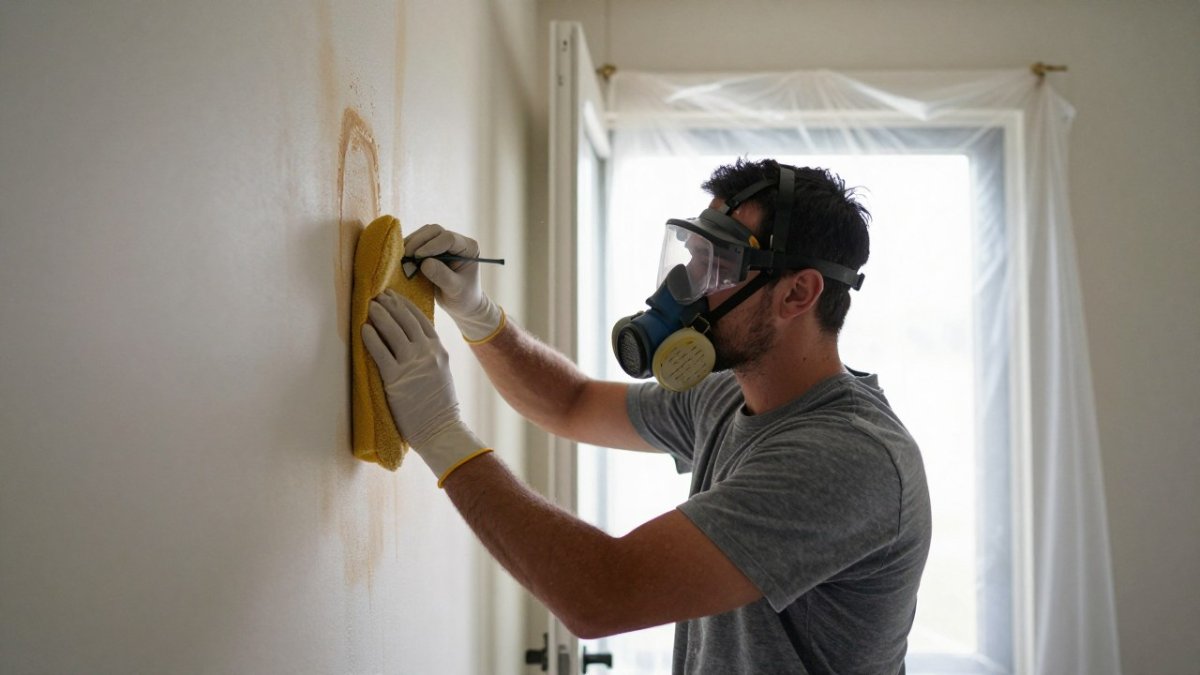
Here is the containment-first method we use:
- Seal the doorway with plastic sheeting to stop cross-contamination.
- Put on personal protective equipment: an N95 mask or respirator, goggles, and gloves.
- Mist the surface lightly so spores stay put.
- Scrub non-porous surfaces with soapy water, then dry them fully.
- Bag and remove porous materials like drywall, insulation, and carpet pad.
- Keep the dehumidifier and fans running until the area is dry.
How to Tell Whether the Mold Is Actually Gone
Most guides stop at step six. That is where the real question starts, because a surface that looks clean can still be wet inside, and a surface that looks dry can still be feeding a colony behind it.
A practical verification sequence looks like this:
- Moisture readings, not eyeballs. A pin-type or pinless moisture meter pressed into drywall, studs, and subfloor tells you whether the material is actually dry. A wall that reads dry on the surface and wet at the base is a common failure pattern in older homes.
- Relative humidity in the room. Keep it in the range your drying plan targets and hold it there for a day or two after the equipment comes out. If humidity climbs back up once the dehumidifier is off, the moisture source is still active.
- The smell test, taken seriously. A musty odor that returns within a week of cleaning almost always means hidden growth in a cavity, under carpet, or in insulation. Trust it and investigate rather than re-spraying.
- Visual re-check after a few days. Look for new discoloration at the base of walls, around trim, and along the ceiling line below a bathroom or A/C line. Fresh staining is a sign the source was never fixed.
- Professional verification for anything you cannot see. If mold was hidden, if the area was larger than about 10 square feet, or if the water was Category 3 (flood or sewage), an assessment with moisture mapping and, where appropriate, air or surface sampling is how you confirm the space is safe to reoccupy.
A common pattern is a homeowner who cleans a visible patch, paints over it, and calls it done. The paint can trap moisture, the growth can continue behind it, and the stain may return larger. Verification is usually cheaper than a second cleanup.
For a full walkthrough, see our step-by-step mold remediation guide. The short version: contain, remove, dry, and verify.
Watch out: never dry-scrub mold or skip the respirator. Mycotoxins and spores you disturb can affect air quality and your health, and a clean-looking room is not proof the job is finished.
Is It Safe to Clean Black Mold Yourself?
A small patch on a hard surface, roughly 10 square feet or less, can often be cleaned yourself with proper gear. Anything larger, any hidden mold, or any water from flooding or sewage needs a professional. Black mold is not automatically more dangerous than other colors, but the health risk rises with the amount and the moisture behind it.
Do not clean and hope. If the mold keeps returning, the water source is still active. Our DIY versus professional comparison breaks down when to call in help.
Watch out: never dry-scrub mold or skip the respirator. Mycotoxins and spores you disturb can affect air quality and your health.
Why Flood Mold Comes Back in Metro Atlanta Homes
Recurring mold almost always means the moisture was never fixed. In metro Atlanta, recurring mold often shows up in older homes with crawl spaces that stay damp after summer storms. Clay soil can hold water against the foundation, and winter cold snaps can burst pipes that leak behind walls for days.
Treating the visible mold without drying the subfloor, insulation, and wall cavities just restarts the cycle. The fix is finding the source: a slow leak, a wet crawl space, or condensation from an A/C line.
That is the root-cause approach we take. Our guide on why mold keeps returning explains how to stop the cycle instead of cleaning the same wall twice.
Call Aquaflame Restores It for a Free Mold Assessment
The calm next step is a real assessment, not another bottle of spray. Aquaflame Restores It is locally owned in Decatur and serves metro Atlanta, including DeKalb, Clayton, Cobb, Henry, Fulton, Gwinnett, and Rockdale counties.
We offer free damage assessments and direct insurance billing, and we handle contents pack-out and plumbing repairs when a leak is the source. Rated 5.0 on Google.
Call 678-379-8000 for a free assessment. A technician can assess the moisture and the extent of the damage during the assessment. You can also book a free mold assessment in Decatur, GA online.
Mold after a flood is a moisture problem before it is a mold problem. If you are staring at a spreading stain or a musty crawl space, do not wait for it to get worse.
Frequently Asked Questions
How do you get rid of mold after a flood?
Start by removing the water and drying the structure, because mold cannot grow without moisture. Then treat affected surfaces: non-porous materials like tile and metal can be scrubbed and disinfected, while porous items such as drywall, insulation and soaked carpet usually have to be removed. Anything beyond a small patch, roughly 10 square feet, hidden growth, or water from a sewage backup should go to a professional. In metro Atlanta, call Aquaflame Restores It at 678-379-8000 for a free assessment.
What kills mold immediately?
Nothing kills mold instantly and completely, despite what labels suggest. Disinfectants and antimicrobial products reduce mold on hard surfaces within minutes of contact, but they do not penetrate porous materials where roots grow. The real fix is moisture control: extraction, dehumidifiers, air circulation and a verified dry time. Until relative humidity and material moisture drop, mold will regrow no matter what you spray.
How long does it take for mold to start after a flood?
Mold spores can begin colonizing wet materials in 24 to 48 hours under warm, humid conditions. Georgia summers make that window shorter, especially in crawl spaces and closed-up rooms where air circulation is poor. That is why drying should begin as soon as possible after water extraction. If a flooded area has been wet for more than two days, assume mold is present and have it assessed rather than waiting for visible growth.
Is it safe to clean black mold yourself?
Small areas, about 10 square feet or less, on hard surfaces can often be cleaned with personal protective equipment: an N95 mask, goggles and gloves. Stop and call a professional if the mold is hidden behind drywall, in the HVAC system, in a crawl space, or if anyone in the home has asthma or a weakened immune system. Disturbing black mold without containment spreads spores and cross-contamination to other rooms.