Table of Contents
- Understanding Commercial Property Insurance
- How Self-Funded Restoration Works
- Commercial Property Insurance Deductibles and Coverage Limits
- Risk Retention vs Risk Transfer: Core Differences
- Cost of Emergency Restoration Services and Financial Impact
- Pros and Cons Comparison
- Which Option is Right for Your Business
Last Updated: August 17, 2026
Understanding Commercial Property Insurance
Commercial property insurance protects buildings and their contents against damage from fire, water, theft, and natural disasters. This coverage transfers the financial risk of property damage to an insurance company in exchange for regular premium payments. When a loss occurs, the policyholder files a claim, and the insurer compensates for covered damages up to the policy limits.
For business owners and property managers, commercial property insurance represents a risk transfer strategy. Rather than bearing the full cost of restoration themselves, they shift that burden to an insurer who pools risk across many policyholders. This approach provides financial predictability and access to professional claims administration.
The policy structure typically includes a deductible, which is the amount the policyholder pays out-of-pocket before insurance coverage begins. Coverage limits cap the maximum the insurer will pay for a single loss or per-occurrence claim. Understanding both elements is essential when evaluating whether this approach fits your business needs.

At Aquaflame Restores it, we work directly with insurance companies on behalf of property owners, handling the claims process and coordinating restoration services. This direct billing arrangement means you’re not fronting restoration costs while waiting for reimbursement. The insurer pays us directly once the claim is approved, simplifying the financial recovery process.
Commercial property insurance also includes liability coverage in many policies, protecting against claims if someone is injured on the property. Business interruption coverage reimburses lost income if the property becomes unusable due to a covered loss. These additional protections make the policy more comprehensive than basic property coverage alone.
How Self-Funded Restoration Works
Self-funded restoration means a property owner sets aside capital in a dedicated loss fund to cover restoration costs when damage occurs. Rather than paying insurance premiums to a third party, the business retains the financial risk and builds its own reserve to handle claims. This approach requires disciplined capital allocation and accurate loss projections.
The mechanics are straightforward: money flows into a contingency fund over time, accumulating capital for potential emergencies. When damage occurs, the business draws from this fund to pay for restoration services directly. If no losses occur, the accumulated capital remains available for other business purposes or continues building the reserve.
Self-funded restoration demands rigorous actuarial analysis to determine adequate reserve levels. A business must project potential losses based on property type, location, historical loss patterns, and industry risk profiles. Underfunding the reserve creates financial vulnerability; overfunding ties up capital that could generate returns elsewhere.
This approach works best for organizations with multiple properties or predictable, manageable loss patterns. A small business with a single property faces greater uncertainty and may lack the financial cushion to absorb a major loss. Larger organizations with diversified risk across many locations can more reliably predict aggregate losses and maintain appropriate reserve levels.
The tax implications of self-funded restoration differ significantly from insurance. Businesses can deduct actual losses when they occur, rather than paying non-deductible insurance premiums. This creates potential tax efficiency, though the timing and deductibility rules require careful accounting.
Commercial Property Insurance Deductibles and Coverage Limits
Deductibles represent the policyholder’s financial participation in each loss. Common commercial property deductibles range from $500 to $5,000 or higher, depending on the policy and industry. A higher deductible reduces premium costs but increases out-of-pocket expenses when a loss occurs.
Coverage limits define the maximum amount the insurer will pay for a single occurrence or aggregate claims within a policy period. A building valued at $500,000 might have a coverage limit of $450,000, meaning the policyholder bears $50,000 in uninsured exposure. Underinsurance creates a critical gap that self-funded reserves might address.
The relationship between deductibles and limits shapes your actual financial protection. A $5,000 deductible on a $250,000 limit means you pay the first $5,000 of any loss, and the insurer covers up to $250,000 after that. If a loss exceeds the limit, you cover the difference yourself.
Many businesses structure deductibles strategically. A higher deductible reduces annual premiums significantly, freeing capital for other uses. However, this works only if the business can reliably cover that deductible from cash reserves. A company without adequate liquidity might face a cash crisis if a deductible triggers during a slow revenue period.
Coverage limits often fail to match actual property values. Buildings appreciate over time, but policies aren’t automatically adjusted upward. A property worth $750,000 today might carry a limit set five years ago at $600,000. Regular revaluation and policy updates prevent underinsurance gaps that leave you exposed.
Risk Retention vs Risk Transfer: Core Differences
Risk transfer moves financial responsibility from the business to an insurance company. Commercial property insurance exemplifies risk transfer: you pay premiums, and the insurer assumes the cost of covered losses. This approach provides certainty and limits your maximum exposure to the deductible amount.
Risk retention means the business keeps financial responsibility for losses. Self-funded restoration is pure risk retention: you absorb the full cost of any damage. This approach requires sufficient capital reserves and tolerance for financial uncertainty.
The trade-off between these strategies centers on cost predictability versus capital efficiency. Insurance provides cost certainty, you know your maximum annual exposure is the deductible plus premiums. Risk retention offers potential savings if losses are lower than expected, but exposes you to catastrophic losses if they exceed reserves.
Many organizations use a hybrid model combining both strategies. Excess insurance, also called stop-loss coverage, protects against catastrophic losses while allowing self-funding for routine claims. A business might self-fund losses up to $50,000 per occurrence, then purchase insurance covering losses above that threshold. This approach reduces premium costs while protecting against financial ruin.
Risk appetite determines which strategy suits your organization. Conservative businesses with low loss tolerance prefer insurance’s certainty. Aggressive organizations with strong financial positions and predictable loss patterns often favor self-funding. Mid-sized companies frequently adopt hybrid models balancing cost control with risk mitigation.
The decision also depends on your organization’s financial solvency and liquidity. A business with strong cash flow and multiple properties can sustain self-funded reserves. A startup or single-property owner typically lacks the financial cushion for pure self-funding and benefits from insurance’s risk transfer.
Cost of Emergency Restoration Services and Financial Impact
Emergency restoration costs vary dramatically based on damage severity, property size, and restoration scope. Water extraction and structural drying for a small commercial space might cost several thousand dollars. Major fire damage requiring complete reconstruction could exceed hundreds of thousands of dollars.
Response speed significantly impacts total restoration costs. Rapid intervention prevents secondary damage like mold growth, structural deterioration, and business interruption losses. Delays multiply costs exponentially: water damage left unaddressed for days becomes a mold remediation project costing multiples more than immediate extraction.
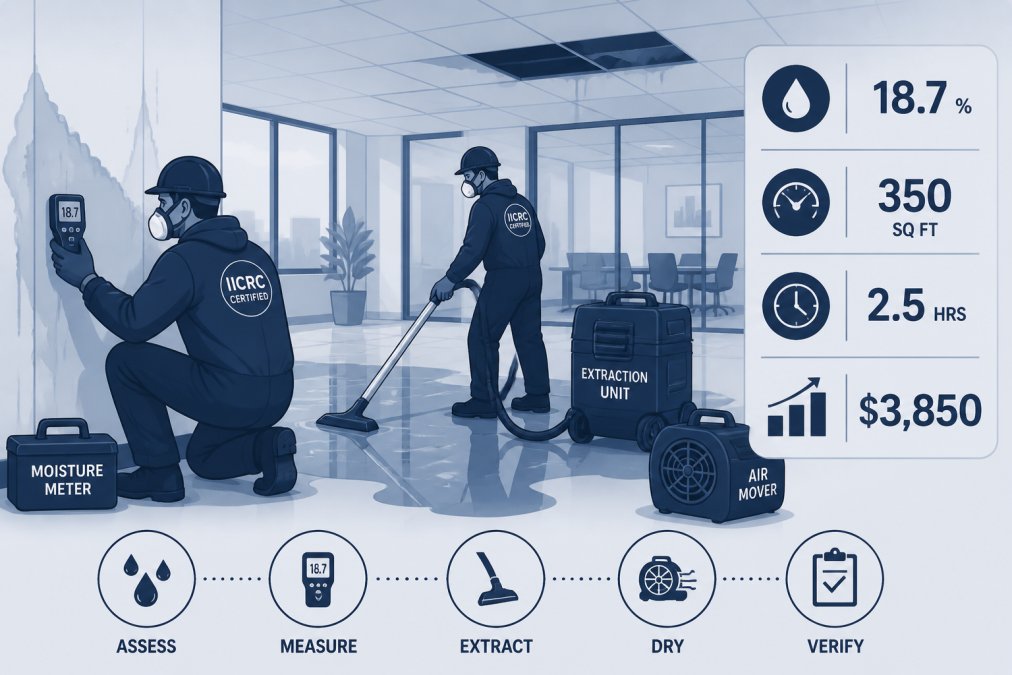
Business interruption represents a hidden cost often exceeding direct restoration expenses. A commercial property generating $10,000 daily revenue that’s unusable for two weeks loses $140,000 in revenue. Insurance with business interruption coverage reimburses this loss; self-funded businesses absorb it entirely.
Aquaflame Restores it’s 30-minute arrival guarantee minimizes these secondary costs. Rapid response prevents damage progression and accelerates the return to normal operations. Our IICRC-trained technicians assess damage immediately, determine restoration scope, and begin mitigation work within hours of arrival.
Third-party administrator fees apply in self-funded models. Claims management, documentation, and coordination require professional oversight. These administrative costs, typically 5-15% of claim value, reduce the apparent savings from avoiding insurance premiums.
The financial impact extends beyond direct costs. A business forced to relocate temporarily during restoration incurs temporary space rental, equipment moves, and operational disruption. Insurance policies with business interruption coverage address these costs; self-funded businesses must absorb them.
Pros and Cons Comparison
| Aspect | Commercial Property Insurance | Self-Funded Restoration |
|---|---|---|
| Cost Predictability | Fixed annual premiums | Variable based on actual losses |
| Capital Requirements | Monthly/quarterly payments | Large reserve fund needed upfront |
| Maximum Exposure | Deductible + premiums | Unlimited if reserves depleted |
| Claims Administration | Insurer handles process | Business manages claims directly |
| Tax Treatment | Premiums non-deductible | Losses deductible when incurred |
| Response Speed | Dependent on insurer network | Controlled by business directly |
| Regulatory Compliance | Insurer ensures compliance | Business responsible for standards |
| Best For | Small to mid-sized businesses | Large organizations with multiple properties |
Commercial property insurance offers immediate financial protection without requiring large capital reserves. You pay manageable premiums and transfer the financial burden of major losses to the insurer. Claims administration is handled by insurance professionals with established processes and networks.
The primary disadvantage of commercial property insurance is cost accumulation over time. Annual premiums represent pure expense with no residual value if losses don’t occur. Over 20 years, a business paying $5,000 annually spends $100,000 in premiums, with nothing to show if no claims materialize.
Self-funded restoration eliminates premium expenses entirely, allowing capital to accumulate in your loss fund. If losses remain below projections, you retain the accumulated capital. This creates potential for significant savings over time for organizations with favorable loss histories.
However, self-funded restoration demands substantial capital discipline and financial sophistication. You must accurately project losses, maintain adequate reserves, and manage claims professionally. A single catastrophic loss can deplete reserves, leaving the business vulnerable to subsequent losses.
Regulatory requirements often mandate insurance for certain property types. Mortgage lenders typically require commercial property insurance as a loan condition. Landlords usually require tenants to maintain insurance. These constraints eliminate self-funding as an option for many businesses.
Self-funded restoration also creates accounting complexity. Reserve accounting, loss accruals, and claims management require sophisticated financial systems. Insurance simplifies accounting by converting variable loss costs into fixed premium expenses.
Which Option is Right for Your Business
Selecting between commercial property insurance and self-funded restoration depends on multiple business-specific factors. Your organization’s size, financial position, risk tolerance, and property portfolio all influence the optimal choice.
Small to mid-sized businesses with single or few properties typically benefit from commercial property insurance. The predictable cost structure and transfer of administrative burden outweigh premium expenses. Insurance also satisfies lender and landlord requirements without exception.
Organizations with large property portfolios and strong financial positions often benefit from hybrid approaches. Excess insurance combined with self-funded reserves for smaller losses reduces premium costs while protecting against catastrophic exposure. This strategy leverages the organization’s financial strength while maintaining disaster protection.
Businesses with highly predictable loss patterns and diversified properties can sustain pure self-funding. Hospitals, large retailers with multiple locations, and industrial operations often maintain self-funded retention programs. These organizations have actuarial data supporting reserve projections and financial capacity to absorb losses.
Your industry and property type matter significantly. Hospitality properties in flood-prone areas face higher loss frequency, favoring insurance. Warehouses in stable locations with modern systems may justify self-funding based on lower historical losses.
Regulatory environment also constrains choices. Heavily regulated industries like healthcare and financial services often require insurance. Mortgage-financed properties require lender-mandated coverage. These constraints eliminate pure self-funding for many businesses.
Financial liquidity is the practical limiting factor. Maintaining adequate self-funded reserves requires capital that could otherwise fund operations or growth. Businesses with tight cash flow cannot sustain self-funding without risking operational failure.
At Aquaflame Restores it, we support both insured and self-funded property owners through direct insurance billing for insured losses and transparent cost documentation for self-funded claims. Our 24/7 emergency response, IICRC-trained technicians, and comprehensive restoration services work seamlessly with either approach. Whether your property is protected by commercial property insurance or self-funded reserves, rapid response and professional claims management minimize losses and restore operations quickly.
The decision ultimately reflects your organization’s financial position, risk tolerance, and operational priorities. Conservative organizations with limited financial flexibility should maintain commercial property insurance. Sophisticated organizations with strong balance sheets and multiple properties should evaluate hybrid models. Regardless of your choice, maintaining adequate financial protection, whether through insurance premiums or self-funded reserves, is essential for business continuity.
Unexpected property damage can devastate operations and finances. Whether you choose commercial property insurance or self-funded restoration, having a trusted restoration partner matters critically. Aquaflame Restores it provides 24/7 emergency response with IICRC-trained technicians, direct insurance billing coordination, and comprehensive water, fire, and mold restoration services. Our 30-minute arrival guarantee and complete reconstruction capabilities ensure your property returns to normal operations rapidly, minimizing business interruption and secondary damage. Contact Aquaflame Restores it immediately when damage occurs, our emergency team is ready to respond.
Frequently Asked Questions
What is the 80% coinsurance rule in commercial property insurance?
The 80% coinsurance clause requires you to insure your property for at least 80% of its replacement value. If you underinsure and suffer a loss, your insurer may reduce your claim payment proportionally. For example, if your property is worth $1 million but you only insure it for $600,000, you're underinsured and may recover only a percentage of your losses. This rule encourages accurate property valuation and full coverage to ensure adequate financial protection.
What are the primary financial risks of self-funding property restoration?
Self-funded restoration requires you to maintain sufficient capital reserves to cover unexpected losses, which ties up cash that could fund operations or growth. You bear 100% of the risk for catastrophic events, with no insurance company sharing the burden. Without actuarial analysis and proper contingency planning, you may underestimate costs or face liquidity challenges when major damage occurs. Additionally, you assume liability for claims administration and regulatory compliance without the expertise of an insurance carrier.
How do commercial property insurance deductibles affect my out-of-pocket costs?
A higher deductible lowers your insurance premiums but increases what you pay when a claim occurs. For instance, a $5,000 deductible means you cover the first $5,000 of any loss yourself. Choosing the right deductible depends on your risk appetite and financial capacity to absorb losses. Many businesses use a hybrid approach with excess insurance or stop-loss coverage to manage both premium costs and catastrophic risk exposure without carrying the full burden alone.
Is self-funded restoration a viable alternative for small businesses?
Self-funded restoration is risky for most small businesses because a single major loss can threaten financial solvency. Small businesses typically lack the capital reserves and actuarial resources to accurately predict and fund potential losses. A hybrid model combining a modest commercial property insurance policy with a self-funded loss fund for smaller claims may work better, providing asset protection while reducing premium costs. Consulting with a risk management professional helps determine if your business has the financial strength for any self-funding approach.
This article was written using GrandRanker