Table of Contents
- Professional Mold Removal vs DIY: Key Differences
- Comparison Table: Professional vs DIY Mold Removal
- The 10 Square Foot Rule and EPA Guidelines
- Health Effects of Mold Exposure: Why It Matters
- Risks of DIY Mold Removal
- Why Professional Mold Remediation Is More Effective
- Mold Remediation Cost: Professional vs DIY Pricing
- Step-by-Step DIY Mold Cleanup Guide (For Small Areas)
Last Updated: July 17, 2026
When facing mold problems in your home, you’ll need to decide whether to tackle cleanup yourself or hire professionals. This choice has significant implications for your health, wallet, and property integrity. Understanding what separates professional mold remediation from DIY cleanup, when each approach makes sense, and the specific risks involved will help you make the right decision.
Mold isn’t just an aesthetic problem, improper removal spreads spores throughout your home, damages structural components, and exposes your family to health risks. Yet not every mold situation requires a professional contractor. Understanding the 10 square foot EPA threshold, the true costs of each approach, and the specific risks involved is essential.
Professional Mold Removal vs DIY: Key Differences
Professional remediation involves containment protocols, specialized equipment like HEPA vacuums and air quality testing, and post-remediation verification to confirm mold is actually gone. DIY cleanup typically means using consumer-grade cleaners and basic protective equipment on visible mold patches.
Professional services follow IICRC standards and EPA guidelines. Technicians assess moisture sources, not just visible mold. They use air quality testing to measure spore counts before and after remediation, implement containment barriers to prevent cross-contamination, and verify their work with post-remediation air sampling, proof that the problem is solved.
DIY approaches focus on surface cleaning using bleach, vinegar, or commercial mold cleaners. The challenge: mold often extends beyond visible growth into drywall, under flooring, and within HVAC systems. Surface cleaning leaves these hidden colonies untouched.
What Professional Services Include
Professional mold remediation starts with a detailed inspection and moisture assessment. Technicians identify not just where mold is growing, but why, usually a moisture source like a leak, condensation, or water damage. Without fixing the moisture problem, mold returns within weeks.
The remediation process includes containment using plastic sheeting and negative air pressure to isolate the affected area. Technicians use HEPA vacuums, which capture 99.97% of particles 0.3 microns and larger. They apply EPA-approved biocides to kill mold colonies and prevent regrowth.
Post-remediation verification is where professional work proves its value. Air quality testing measures spore counts in the remediated area and compares them to baseline levels. A successful remediation returns indoor spore counts to outdoor levels or below, measurable proof the problem is solved.
What DIY Mold Removal Involves
DIY cleanup begins with identifying visible mold and gathering supplies: cleaning solution, brushes, rags, trash bags, and protective gear. You scrub affected surfaces, wipe down mold growth, and dispose of contaminated materials. For porous materials like drywall or carpet, you remove and replace them.
The challenge is knowing when you’ve actually solved the problem. DIY approaches lack the verification step. You clean what you see and assume it’s gone, but mold spores are invisible and persist in air, on surfaces, and within materials. Without air quality testing, you can’t confirm whether remediation succeeded.
Most DIY efforts miss the moisture source entirely. If a wall is moldy because of a roof leak, cleaning the mold without fixing the leak guarantees regrowth.
Comparison Table: Professional vs DIY Mold Removal
| Aspect | Professional Service | DIY Approach |
|---|---|---|
| Moisture Assessment | Identifies and addresses root cause | Usually skipped; focuses on visible mold |
| Containment Protocol | Full isolation with negative air pressure | Minimal or none; risk of spore spread |
| Equipment | HEPA vacuums, air testing, specialized tools | Consumer cleaners, standard vacuum |
| Verification | Post-remediation air quality testing | Visual inspection only |
| Certification | IICRC standards compliance | No industry standard |
| Insurance Coverage | Often covered; direct billing available | Usually not covered |
| Cost Range | Varies; contact for quote | $200-$800 in supplies |
| Guarantee | Problem solved with verified proof | No guarantee; risk of regrowth |
| Best For | Areas over 10 sq ft, hidden mold, structural damage | Small visible patches under 10 sq ft |
The biggest risk in DIY mold removal is treating the symptom instead of the disease. If the moisture source remains, mold returns within weeks, creating a cycle of repeated failures.
The 10 Square Foot Rule and EPA Guidelines
The EPA’s 10 square foot threshold is often misunderstood. It applies to visible mold on non-porous surfaces in healthy individuals without respiratory conditions. It’s not a hard cutoff between safe DIY and mandatory professional work, but a practical guideline.
Several factors push you toward professional remediation even for small areas: mold type (toxic species like Stachybotrys warrant professional handling regardless of size), location (HVAC systems, crawl spaces, or wall cavities require professional assessment), water damage history (flooding or sewage backup involves biohazard-level contamination), your health (asthma, allergies, or compromised immunity require professional containment), and moisture control (identifying and fixing the moisture source is non-negotiable).
Health Effects of Mold Exposure: Why It Matters
Mold exposure triggers health effects ranging from mild allergic reactions to serious respiratory complications. Common effects include allergic reactions (sneezing, runny nose, itchy eyes), asthma attacks, and respiratory infections. People with mold allergies experience symptoms during and after exposure. Those with asthma may experience increased frequency and severity of attacks.
The challenge is that mold exposure often happens without obvious symptoms. You breathe in spores continuously in a moldy home, and symptoms accumulate over weeks or months. Children, elderly people, and those with pre-existing respiratory conditions face elevated risk.
Toxic mold species like Stachybotrys produce mycotoxins that can cause neurological symptoms, chronic fatigue, and immune dysfunction. The health argument for professional remediation is straightforward: professionals use containment and personal protective equipment to minimize spore exposure during cleanup. DIY approaches expose you to high concentrations of spores while actively disturbing mold colonies.
Risks of DIY Mold Removal
DIY mold removal carries specific, measurable risks that professional services eliminate.
Cross-Contamination and Spore Spread
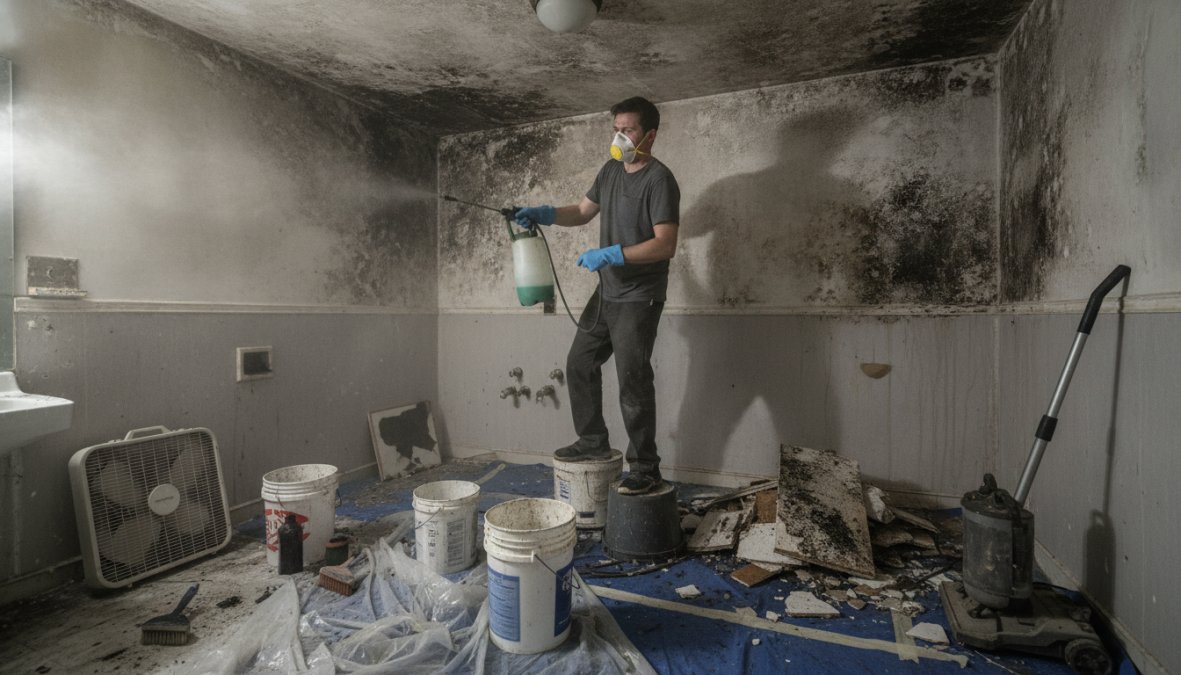
When you scrub or disturb mold, you release spores into the air. Without containment barriers, these spores travel through your home via air currents, settling on surfaces in other rooms. Professional remediation uses containment with plastic sheeting and negative air pressure to capture and filter spores. DIY approaches lack this containment, easily spreading mold from one room to multiple rooms.
Inadequate Personal Protective Equipment
Most DIY cleaners use basic N95 respirators and latex gloves, providing minimal protection. Professional technicians wear full-face respirators with cartridge filters, body suits, and booties.
If you handle DIY mold cleanup, upgrade your protective gear beyond standard N95 masks. Use a half-face or full-face respirator with organic vapor cartridges. Wear disposable coveralls. These upgrades cost $50-$150 but significantly reduce exposure risk.
Additional risks include improper disposal of contaminated materials, failure to address moisture sources, and structural damage from aggressive cleaning.
Why Professional Mold Remediation Is More Effective
Professional mold remediation succeeds where DIY approaches fail because it addresses root causes, not just symptoms.
IICRC Standards and Professional Certification
The Institute of Inspection, Cleaning and Restoration Certification (IICRC) establishes standards for mold remediation that define best practices. IICRC-certified technicians follow documented protocols for assessment, containment, remediation, and verification. This standardization ensures consistency and accountability.
Professional certification requires ongoing training. Technicians understand moisture dynamics, building science, and mold biology at a level DIY homeowners can’t match. They recognize hidden mold in wall cavities, attic spaces, and crawl spaces and understand how to address moisture sources, the critical step that prevents regrowth.
Post-Remediation Verification and Air Quality Testing
After remediation, professionals conduct air quality testing using equipment that measures mold spore counts. They compare indoor spore levels to outdoor baseline levels and pre-remediation levels. This testing provides proof of success. If indoor spore counts match or fall below outdoor levels, remediation succeeded.
DIY approaches lack this verification. You clean the mold and hope it’s gone. Months later, when mold reappears, you’re back to square one.
Mold Remediation Cost: Professional vs DIY Pricing
Cost comparison requires understanding what each approach includes. The upfront cost of DIY seems lower, but the total cost often exceeds professional remediation when you factor in failed attempts, regrowth, and material replacement.
Professional Service Costs and Insurance Coverage
Professional mold remediation pricing depends on affected area size, mold type, moisture source severity, and structural damage extent. The key advantage is insurance coverage. Many homeowners insurance policies cover mold remediation if it results from a covered peril like a burst pipe or roof leak. Professional contractors manage insurance claims directly, often resulting in little or no out-of-pocket cost.
DIY cleanup is rarely covered by insurance. Professional services also include moisture source repair in many cases, preventing regrowth and protecting long-term property value.
DIY Equipment Rental vs Purchase
DIY mold removal requires equipment most homeowners don’t own. HEPA vacuums ($30-$50 per day rental), air sampling kits ($90-$150 per sample), and containment materials ($100-$300) add up quickly. A week-long DIY project with equipment rental can cost $500-$1,200.
The hidden cost in DIY approaches is material replacement. If mold penetrates drywall, carpet, or insulation, you must remove and replace these materials. Drywall replacement costs $15-$25 per square foot installed. A 100-square-foot area with drywall replacement costs $1,500-$2,500 just in materials and labor.
The true cost of DIY mold removal isn’t just initial cleanup supplies, it’s the cost of regrowth, material replacement, and potential health impacts. Professional remediation, especially when covered by insurance, frequently costs less than the total expense of failed DIY attempts.
Step-by-Step DIY Mold Cleanup Guide (For Small Areas)
If you decide to handle small, visible mold patches yourself, follow this process to minimize risks. This guide applies to non-toxic mold on hard surfaces, affecting areas under 10 square feet, in homes without occupants with respiratory conditions.
Assessment and Moisture Control
Step 1: Assess the affected area. Identify all visible mold and measure the total area in square feet. Look for mold on hard surfaces like tile, concrete, or painted drywall. If mold has penetrated porous materials like carpet or insulation, professional remediation is recommended.
Step 2: Identify the moisture source. Look for leaks, condensation, or water damage. Fix the moisture source first, or mold will return within weeks.
Step 3: Improve ventilation. Open windows and doors to increase air circulation. Use fans to direct air toward windows, pushing mold spores outside rather than through your home.
Step 4: Gather safety equipment. Use a half-face or full-face respirator with organic vapor cartridges. Wear disposable coveralls or clothes you don’t mind discarding. Use nitrile gloves and eye protection.
Containment and Surface Cleaning
Step 5: Contain the work area. Close doors to isolate the affected room. Seal gaps under doors with duct tape. Tape plastic sheeting over HVAC vents if they’re in the room.
Step 6: Prepare cleaning solution. Use a commercial mold killer like RMR-86 Instant Mold & Mildew Stain Remover or Concrobium Mold Control. Follow product instructions for dilution and application.
Step 7: Clean affected surfaces. Apply the cleaning solution generously and let it sit for the recommended time (usually 10-15 minutes). Scrub with a brush to remove mold growth. Wipe clean with disposable rags. Repeat until all visible mold is removed.
Step 8: Discard contaminated materials. Place rags, cleaning materials, and any removed materials in sealed plastic bags. Double-bag if possible. Dispose of these bags in outdoor trash.
Step 9: Apply preventive treatment. After cleaning, apply a mold-preventive coating to inhibit future growth.
HVAC System Protection and Verification
Step 10: Protect your HVAC system. Change your furnace filter before and after remediation. If mold is near HVAC returns, cover them during cleanup to prevent spore circulation.
Step 11: Monitor moisture levels. Use a moisture meter to check humidity in the remediated area. Keep indoor humidity below 50% to prevent mold regrowth.
Step 12: Verify success. Wait two weeks after remediation. If no mold reappears, cleanup succeeded. If mold returns, the moisture source wasn’t adequately addressed, or the mold extends beyond visible areas. Professional remediation is then recommended.
When to Hire a Professional Mold Removal Service
Certain situations demand professional remediation. Attempting DIY cleanup in these scenarios increases health risks, spreads mold, and often costs more than professional services.
Hire professionals if mold affects an area larger than 10 square feet. Larger areas require containment protocols and equipment that justify professional expertise.
Hire professionals for mold in HVAC systems, crawl spaces, or wall cavities. These areas require specialized access and equipment. Disturbing mold in HVAC ducts spreads spores throughout your entire home.
Hire professionals if you have respiratory conditions, asthma, or a compromised immune system. DIY cleanup exposes you to high spore concentrations.
Hire professionals if mold resulted from sewage backup or flooding. These situations involve biohazard-level contamination requiring proper disinfection and material disposal.
Hire professionals if you suspect toxic mold species. Visual identification isn’t reliable; laboratory analysis is needed.
Hire professionals if mold has caused structural damage. Professional assessment determines repair scope and ensures structural integrity.
Mold problems rarely resolve themselves. Whether you choose professional remediation or DIY cleanup depends on the mold size, type, location, and your health status. For small visible patches on hard surfaces, careful DIY cleanup with proper equipment can work. For anything larger, hidden, or potentially toxic, professional remediation delivers the verification and moisture control that prevents regrowth. Professional IICRC-certified technicians provide complete mold remediation with post-remediation air quality testing, moisture source repair, and direct insurance billing, eliminating guesswork and ensuring your home is actually mold-free.
Frequently Asked Questions
When should you not remove mold yourself?
You should not attempt DIY mold removal if the affected area exceeds 10 square feet (per EPA guidelines), if mold is in your HVAC system, if you have health conditions sensitive to mold exposure, or if the mold resulted from sewage or contaminated water. Large-scale mold remediation requires professional containment, specialized equipment like HEPA vacuums, and proper disposal protocols to prevent cross-contamination and spore spread throughout your home.
What are the dangers of DIY mold removal?
DIY mold removal risks include inadequate personal protective equipment (like N95 respirators), improper containment leading to spore dispersal, potential exposure to toxic mold species like Stachybotrys, and failure to address the moisture source, allowing mold to regrow. Without professional-grade equipment and IICRC-trained techniques, you may also miss hidden mold colonies in walls, attics, or crawl spaces, spreading contamination and creating long-term health hazards.
Is professional mold removal worth the cost?
Professional mold removal is worth the investment when dealing with large areas, structural damage, or health concerns. Professional services provide IICRC-certified remediation, post-remediation verification through air quality testing, insurance billing support, and assurance that the moisture source is permanently addressed. They prevent costly re-infestation and potential property damage, plus they eliminate health risks from improper handling of mold colonies and mycotoxins.
What is the difference between mold removal and mold remediation?
Mold removal focuses on cleaning visible mold stains and colonies from surfaces using biocides or fungicides. Mold remediation is a comprehensive process that includes removal, moisture source identification and control, containment, HVAC system protection, and verification testing to ensure spore counts return to normal levels. Remediation addresses the root cause; removal alone often leads to regrowth without addressing underlying moisture problems.
How much does professional mold removal cost?
Professional mold removal costs depend on the affected area size, severity of contamination, whether structural repairs are needed, and your location. Many factors influence pricing, including containment requirements, equipment needs, and labor hours. Contact a local professional like Aquaflame Restores It for a detailed assessment and quote, they offer 24/7 emergency response and direct insurance billing to help manage costs effectively.
This article was written using GrandRanker