Table of Contents
- What Is Mold Remediation and Why It Matters in Decatur
- Signs You Need Professional Mold Removal Decatur GA
- Mold Inspection Decatur GA: The Assessment Process
- Black Mold Removal Decatur GA: Specialized Protocols
- Mold Removal Cost Decatur GA and Insurance Navigation
- Mold Prevention Tips Georgia: Stop Growth Before It Starts
- Emergency Mold Removal and 24/7 Response in Decatur
- Conclusion: Professional Remediation Protects Your Home
Last Updated: August 1, 2026
What Is Mold Remediation and Why It Matters in Decatur
When moisture infiltrates your home, mold removal Decatur GA becomes a health priority. At Aquaflame Restores it, we’ve responded to hundreds of mold situations across metro Atlanta and learned that early intervention prevents property-wide crises.
Mold remediation is the comprehensive process of identifying, containing, and removing microbial growth while addressing the moisture source that enabled it. This involves air quality testing, containment protocols, HEPA filtration, and verification that the environment is safe before work concludes, not simply wiping visible spores with bleach.
Decatur’s climate creates ideal conditions for mold. The region experiences high humidity, frequent temperature fluctuations, and substantial rainfall, especially spring and summer. Combined with roof leaks, A/C condensation, or crawlspace moisture, these factors accelerate fungal contamination. Many homeowners don’t notice mold until visible colonies appear or they experience respiratory irritation.
Understanding Microbial Growth and Health Risks
Mold spores exist everywhere outdoors. When they land on damp indoor surfaces, colonization begins within 24-48 hours. This timeline is critical because homeowners often don’t discover water damage immediately, a slow roof leak might go unnoticed for weeks.
Prolonged mold exposure triggers allergic reactions, asthma attacks, and respiratory complications, particularly in children, elderly individuals, and those with compromised immune systems. Black mold produces mycotoxins that cause more severe symptoms in sensitive populations.
Many homeowners attempt DIY mold cleanup using household cleaners. This approach fails because it doesn’t address the root moisture problem and can disperse spores throughout the home via air currents, making contamination worse.
Why Local Climate Factors Increase Mold Risk
Decatur’s subtropical climate keeps humidity above 50 percent during summer months. Combined with 50 inches of annual rainfall, basements, crawlspaces, and attics become vulnerable to moisture accumulation. Many Decatur homes built in the 1970s-1990s have outdated HVAC systems and insufficient moisture control, creating perfect conditions for fungal growth.
Structural drying becomes essential after any water intrusion. Wet ceilings from roof leaks, flooded basements, or burst pipes require professional dehumidification and air circulation to prevent mold colonization. Without proper drying, moisture remains trapped in walls and insulation for months, creating hidden growth.
Signs You Need Professional Mold Removal Decatur GA
Recognizing when mold removal Decatur GA is necessary separates homeowners who catch problems early from those facing costly remediation later. Many warning signs are subtle enough that untrained eyes miss them.
Visual Indicators and Air Quality Concerns
Visible mold, dark spots or fuzzy patches on walls, ceilings, or crawlspace surfaces, is the most obvious sign. However, many colonies grow inside walls, beneath flooring, or within HVAC ductwork where you cannot see them.
Other physical indicators include musty odors, water stains, peeling paint in bathrooms or basements, warped drywall, visible condensation on windows, and recent water damage events.
Air quality concerns often precede visible mold discovery. If household members develop unexplained respiratory symptoms or persistent coughing in specific rooms, professional air quality testing may reveal elevated spore counts.
If you notice a musty smell after your A/C runs for several hours, mold likely colonizes your HVAC system itself. Mold in ductwork and evaporator coils circulates spores throughout your home every time the system runs.
Mold Inspection Decatur GA: The Assessment Process
Professional mold inspection Decatur GA goes beyond visual walkthrough. A thorough assessment identifies not only where mold exists but why it’s growing there, the moisture source that initiated the problem.
Surface Sampling and Environmental Testing
Certified technicians visually inspect crawlspaces, attics, basements, bathrooms, and water-damaged areas. They use moisture meters and thermal imaging to detect hidden dampness behind walls.
Surface sampling involves collecting material from suspected mold using sterile swabs or tape lifts. These samples are analyzed to confirm mold presence, identify species, and establish a baseline for post-remediation verification. Environmental testing measures spore count in the air, determining whether indoor air quality has returned to normal levels after remediation.
Mold inspection is distinct from mold testing. Inspection is visual and physical assessment performed on-site. Testing requires laboratory analysis of collected samples. Both are essential for a complete picture.
Spore Count Analysis and Containment Planning
Once samples are analyzed, technicians establish a remediation protocol based on contamination extent, species identified, and moisture source. Spore count analysis reveals whether indoor spore levels exceed normal outdoor levels, a key threshold for determining whether remediation is necessary.
Containment planning addresses how to isolate affected areas during remediation. For small colonies (under 10 square feet), standard cleanup may suffice. For larger infestations, professional containment barriers, negative air pressure systems, and HEPA filtration prevent spore dispersal to unaffected areas.
Black Mold Removal Decatur GA: Specialized Protocols
Black mold, technically Stachybotrys chartarum, requires specialized handling due to its mycotoxin production and tendency to colonize in hard-to-reach areas like crawlspaces and HVAC systems. Black mold removal Decatur GA demands rigorous containment and verification protocols.
Containment and HEPA Filtration Standards
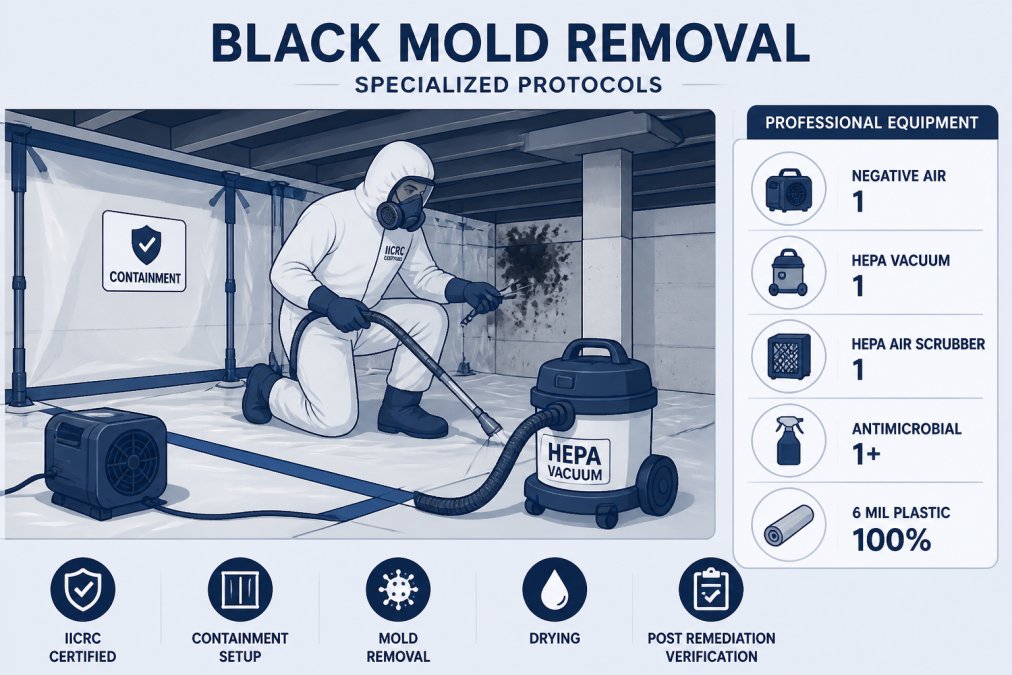
Professional black mold remediation begins with containment. Technicians establish negative air pressure within the affected area, preventing spores from migrating to clean areas during removal. HEPA filtration systems capture 99.97 percent of particles 0.3 microns or larger, small enough to catch mold spores.
The removal process involves isolating the contaminated area with plastic sheeting, removing affected materials if contamination is extensive, cleaning surfaces with antifungal solutions, applying mold-inhibiting treatments, and maintaining continuous air filtration throughout.
Aquaflame Restores it technicians follow IICRC remediation standards, which mandate specific protocols for containment size, air changes per hour, and clearance verification. This ensures thorough, safe remediation.
Post-Remediation Verification and Clearance
After removal, verification testing confirms the environment is safe for reoccupancy. This involves collecting air samples and comparing indoor spore counts to outdoor baseline levels. Most jurisdictions and insurance companies require post-remediation clearance documentation before the property is considered remediated.
Clearance testing typically occurs 24-48 hours after remediation concludes. If spore counts remain elevated, additional cleaning or drying may be necessary. Only after clearance testing confirms normal levels do technicians remove containment barriers.
Post-remediation clearance documentation is your proof that the mold problem is truly resolved. This documentation is essential for insurance claims, real estate transactions, and your peace of mind.
Mold Removal Cost Decatur GA and Insurance Navigation
Understanding mold removal cost Decatur GA requires recognizing that pricing depends on contamination extent, location, moisture source complexity, and whether structural repairs are needed. Focus on what drives actual costs and how insurance typically responds.
Understanding Coverage and Direct Billing
Most homeowners insurance policies cover mold remediation if mold resulted from a covered peril, sudden water damage from a burst pipe or storm damage. Coverage excludes mold caused by neglect, lack of maintenance, or chronic moisture issues.
Direct billing with insurance companies simplifies the process. When you hire a restoration company that handles insurance coordination, they communicate directly with your adjuster, manage documentation, and bill the insurance company for covered work. You avoid paying out-of-pocket and fighting for reimbursement.
Aquaflame Restores it manages direct insurance billing for all covered mold remediation work, allowing your focus to stay on property recovery while we handle claims processing.
DIY vs. Professional Remediation: When to Call Experts
Small, isolated mold colonies under 10 square feet might be addressed with careful DIY cleaning if you can contain spores and address the moisture source. However, even small DIY attempts carry risks: improper technique can disperse spores throughout your home.
Professional remediation becomes essential when mold covers more than 10 square feet, growth is visible in crawlspaces or HVAC systems, water damage is extensive, household members have respiratory symptoms, you’re selling the property and need clearance documentation, or insurance coverage is involved.
The cost difference between failed DIY attempts and professional remediation is often substantial. Many homeowners spend $500-$1,000 on failed cleanup, then hire professionals anyway at significantly higher cost because the problem has worsened.
| Situation | Best Approach | Why Professional Wins |
|---|---|---|
| Small visible spot, recent water damage | Professional inspection first | Identifies hidden growth and moisture source |
| Extensive visible growth | Professional remediation | Requires containment and verification testing |
| Musty odor, no visible mold | Professional assessment | Air quality testing detects hidden contamination |
| Crawlspace or attic mold | Professional only | Difficult access and high contamination risk |
| Insurance claim involved | Professional with direct billing | Ensures coverage and proper documentation |
Mold Prevention Tips Georgia: Stop Growth Before It Starts
Prevention is always more cost-effective than remediation. Decatur’s climate makes ongoing moisture management essential.
Moisture Control and Humidity Management
Maintaining indoor relative humidity below 50 percent is the single most effective mold prevention strategy. Use a hygrometer to monitor humidity levels in moisture-prone areas.
Practical moisture control measures include running bathroom exhaust fans during and 30 minutes after showers, ensuring dryer vents exhaust outside, grading soil away from foundation walls, installing and maintaining gutters to channel runoff at least 6 feet from the foundation, insulating cold water pipes, repairing roof leaks and A/C condensation lines immediately, and ensuring crawlspace vents are unobstructed or installing encapsulation.
Many Decatur homeowners underestimate crawlspace management. Crawlspaces are naturally damp, and without proper encapsulation or dehumidification, they become mold incubators that distribute spores upward into living spaces.
Structural Drying and Crawlspace Encapsulation
After any water intrusion, structural drying must occur within 24-48 hours to prevent mold colonization. Professional drying involves positioning dehumidifiers and air movers to extract moisture from walls, flooring, and insulation at the rate it’s being released from materials.
Crawlspace encapsulation involves installing a vapor barrier across the crawlspace floor and sealing vents to prevent outside moisture from entering. This creates a controlled environment where dehumidification maintains safe humidity levels. While encapsulation requires upfront investment, it prevents years of ongoing mold problems.
If you’ve had water damage in your crawlspace, don’t assume it’s dry just because visible water is gone. Moisture can remain trapped in insulation for weeks. Professional moisture testing confirms true dryness before you close up the space.
Emergency Mold Removal and 24/7 Response in Decatur
Water damage doesn’t wait for business hours. Burst pipes, severe storms, and flooding can occur anytime, and delaying response allows mold colonization to begin within hours.
Aquaflame Restores it provides 24/7 emergency mold removal response in Decatur and throughout metro Atlanta. Our 30-minute arrival guarantee means a trained technician reaches your property quickly to assess the situation and begin emergency mitigation.
Emergency response includes immediate moisture extraction, dehumidification setup, and temporary containment if mold is suspected. This rapid action prevents minor water problems from becoming major mold remediation projects. Many homeowners who call within hours of water damage avoid mold growth entirely.
Mold doesn’t resolve itself, and delaying professional remediation allows contamination to spread, creating health risks and costly structural damage. When you need mold removal Decatur GA, Aquaflame Restores it provides IICRC-trained technicians, 24/7 emergency response, and direct insurance billing to handle the entire process from assessment through post-remediation clearance. Contact our team today to schedule your mold inspection and take control of your indoor air quality.
Frequently Asked Questions
How do I know if I need professional mold removal in Decatur, GA?
Signs include visible mold growth (especially black mold), musty odors, water stains, or health symptoms like respiratory issues. If mold covers an area larger than 10 square feet or appears after water damage, professional mold removal in Decatur, GA is strongly recommended. Environmental testing and air quality assessment can confirm contamination levels and guide remediation decisions.
What does mold inspection in Decatur, GA involve?
Professional mold inspection includes visual assessment, surface sampling, air quality testing, and spore count analysis. Technicians use hygrometers to measure relative humidity, examine crawlspaces and HVAC systems, and conduct bioaerosol testing to identify fungal contamination. Results determine whether remediation is needed and the scope of work required for proper containment and treatment.
How much does mold removal cost in Decatur, GA?
Mold removal cost in Decatur, GA depends on contamination size, location (crawlspace, attic, walls), and remediation complexity. Many insurance policies cover water-damage-related mold under property coverage. Direct insurance billing through certified remediation companies can minimize out-of-pocket costs. Contact for a free assessment and quote, pricing varies based on your specific situation.
Can I prevent mold in my Georgia home?
Yes. Mold prevention tips for Georgia include maintaining relative humidity below 50% using dehumidification, ensuring proper drainage around foundations, fixing roof leaks and A/C condensation issues promptly, and improving crawlspace ventilation. After water damage, structural drying and moisture control are critical. Regular HVAC cleaning and crawlspace encapsulation also reduce mold spore proliferation and indoor air quality problems.
External Resources
For more information on mold health effects and remediation standards, consult these authoritative sources:
[EXTERNAL_LINK: EPA Mold Remediation Guidelines | epa.gov]
[EXTERNAL_LINK: CDC Indoor Environmental Quality and Mold Prevention | cdc.gov]
[EXTERNAL_LINK: IICRC Standards for Professional Mold Remediation | iicrc.org]
This article was written using GrandRanker