
Table of Contents
- Step 1: Secure the Property and Start the Claim File
- Step 2: Master Restoration Claim Documentation Requirements
- Step 3: Use Xactimate Estimating for Restoration Invoices
- Step 4: Submit the Invoice and Manage the Adjuster Relationship
- Step 5: How to Appeal a Denied Water Damage Insurance Claim
- Step 6: Protect Your Cash Flow and Lien Rights
- Common Mistakes That Delay Insurance Billing for Restoration
- Frequently Asked Questions
Last Updated: September 14, 2026
Step 1: Secure the Property and Start the Claim File
Handling insurance billing for restoration starts before a single invoice exists. The claim file you build in the first 24 hours determines how smoothly every dollar moves later, which is why the Insurance Information Institute’s guide to filing a homeowners claim stresses prompt, documented reporting to the carrier.
At Aquaflame Restores it, crews open that file on arrival: photos of standing water or char, moisture readings, a written scope, and a signed work authorization. Without those four items, carriers treat the loss as unverified.
Emergency services come first. Board-up, extraction, and damage mitigation get billed as separate line items, and they need their own timestamps. A common mistake is treating mitigation as a freebie to win the job. It isn’t free, and skipping the documentation makes it nearly impossible to recover later.
Never begin reconstruction before the carrier has seen the mitigation documentation. Once walls are closed, you lose the ability to prove what the damage looked like, and adjusters routinely reduce or deny those line items.
Step 2: Master Restoration Claim Documentation Requirements
Restoration claim documentation requirements are the paper trail that proves a loss happened, that it was mitigated, and that every charge ties to the scope of work. Weak documentation is the single biggest reason restoration invoices get cut.
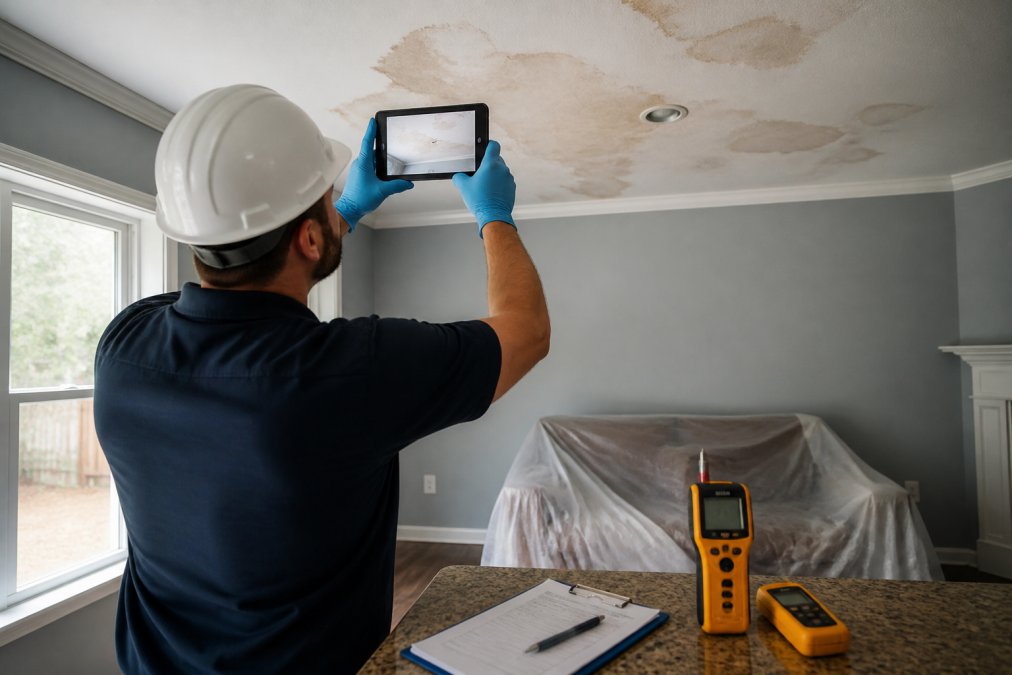
What a complete file includes:
- Moisture readings and thermal imaging from day one and every drying day after
- Time-stamped photos before, during, and after mitigation
- Daily equipment logs showing placement and run hours
- A signed scope of work with the homeowner or property manager
- Material receipts for anything replaced
- A written claim report summarizing cause, category, and class of water loss
The IICRC’s standards for professional water damage restoration define the categories and classes that drive drying decisions, and carriers expect your documentation to reference them. A file that names the standard reads as professional. A file that says “it was wet” does not.
Step 3: Use Xactimate Estimating for Restoration Invoices
Xactimate estimating for restoration is the industry’s pricing language. It converts your scope of work into line items the adjuster can compare against their own software, which shortens the review cycle considerably.
The platform prices labor, materials, and equipment by region, so the same drying job prices differently in one metro than another. That regional pricing is why line-item justification beats a lump-sum invoice every time.
| Document | Purpose | Who Uses It |
|---|---|---|
| Scope of work | Defines what will be done | Contractor and adjuster |
| Xactimate estimate | Prices each line item | Adjuster review |
| Proof of loss | Formal sworn claim statement | Insurance carrier |
| Supplemental billing | Adds costs found mid-job | Contractor and carrier |
Two rules keep estimates clean. First, match every line item to a photo or reading. Second, submit supplemental billing the moment hidden damage appears, not at the end. Adjusters approve what they can verify in real time.
Step 4: Submit the Invoice and Manage the Adjuster Relationship
The insurance adjuster is not your adversary, but they are not your advocate either. They are verifying a property damage claim against policy limits, deductibles, and depreciation, and they work a queue.
Practical steps that speed payment:
- Send the invoice with the claim report attached, not as a bare PDF.
- Reference the claim number in every email subject line.
- Answer adjuster questions within one business day.
- Log every call, email, and site visit in the claim file.
- Follow up on payment every seven days until it lands.
What most guides miss is that adjusters change mid-claim. When that happens, a clean file means the new adjuster can pick up without a site visit. A messy file means starting over.
Ask the adjuster for their preferred documentation format on day one. Some want photos in a shared folder, others want them embedded in the estimate. Matching their format can shave days off approval.
Step 5: How to Appeal a Denied Water Damage Insurance Claim
Learning how to appeal a denied water damage insurance claim is a skill worth building before you need it. Denials are usually about missing documentation, a disputed cause of loss, or a coverage interpretation, not about coverage disappearing. The appeal is a documentation contest, and the contractor who can produce the file wins more often than the contractor who argues the loudest.
Read the denial before you respond
Every denial letter should cite the specific policy language the carrier relied on. If it doesn’t, request it in writing. Common denial reasons in restoration work fall into a few buckets:
- Cause of loss disputed, the carrier says the damage is from a long-term leak, not a sudden event.
- Coverage exclusion, mold, ordinance or law, or gradual deterioration exclusions are cited.
- Documentation insufficient, no moisture readings, no daily logs, no signed authorization.
- Scope disagreement, the carrier accepts the loss but disputes the method or the line items.
Each bucket has a different rebuttal. A cause-of-loss denial needs thermal imaging, moisture maps, and a written narrative tying the readings to a single event. A documentation denial needs the missing items produced, not an argument. A scope denial needs a line-item comparison against the carrier’s own estimate.
The appeal path, in order
- Request the denial in writing with the specific policy language cited. A verbal denial is not appealable.
- Compare the denial reason against your claim documentation. Identify the exact gap the carrier is pointing at.
- Submit a written rebuttal with photos, readings, the IICRC category and class, and a point-by-point response to each denial reason. Reference the NAIC’s consumer guidance on claim disputes process for escalation language if the carrier stalls.
- Ask for a re-inspection if the cause of loss is disputed. A second set of eyes on the same evidence often flips a denial.
- Request an appraisal if the policy contains an appraisal clause. Appraisal is a policy-provided dispute mechanism for the amount of loss, and it is separate from the appeals process.
- Escalate to the state department of insurance if the carrier misses statutory response deadlines. Every state has a consumer complaint process, and carriers track those complaints.
Underpaid claims follow the same route
Partial approvals are more common than outright denials, and they are easier to fix. A trimmed line item usually means the adjuster could not verify it. Resubmit with the specific evidence the adjuster said was missing, a photo, a reading, a receipt, a manufacturer spec, and reference the original line item number so the reviewer can match it.
Two patterns show up repeatedly:
- Equipment charges trimmed, usually because daily logs were missing or did not show run hours. Rebuild the log from the drying record and resubmit.
- Mitigation denied as “not covered”, often a coverage interpretation, not a documentation problem. Respond with the policy language and the scope of work that ties the mitigation to the covered loss.
Do not resubmit the same invoice without new evidence. A second submission with no new documentation is treated as a duplicate and can slow the file further.
Track appeal deadlines
Most policies and state regulations impose deadlines on both sides. The carrier has a set number of days to acknowledge and respond to a claim, and the contractor has a set number of days to submit a proof of loss or appeal. These vary by state and by policy form. Put the deadlines in the claim file on day one, not the day the denial arrives.
A denial is a documentation problem more often than a coverage problem. The fastest path to reversal is a point-by-point rebuttal that answers each denial reason with a specific piece of evidence from the claim file.
Step 6: Protect Your Cash Flow and Lien Rights
Cash flow management separates restoration companies that survive a slow season from those that don’t. Carriers pay in 30 to 60 days on a clean file, but payroll, equipment rental, and material suppliers don’t wait. The billing process and the cash-flow process are the same process, every delay in documentation becomes a delay in payment. Eliminating these manual bottlenecks requires the implementation of automated restoration workflows to ensure that every document moves toward approval without human intervention.
Accounts receivable discipline
Set the rhythm before the first invoice goes out:
- Send statements weekly, not monthly.
- Call on anything past 45 days, email is easy to ignore.
- Never let a commercial job drift past 90 days without a written payment plan.
- Track days-sales-outstanding by carrier, not just by customer. Some carriers are consistently slow, and that is a pricing and scheduling decision, not a collections problem.
A common pattern is that the same three or four line items cause most delays: equipment charges without daily logs, mitigation billed as a lump sum, and supplements submitted after the job closes. Fixing those three reduces the collections workload more than any software upgrade.
Preliminary notices and lien rights
Preliminary notice rules protect your right to file a mechanic’s lien on commercial work. The notice puts the property owner and the lender on record that you are performing work and expect to be paid. Without it, your lien rights can be erased entirely.
Key mechanics:
- Who sends it, the contractor, and in many states subcontractors and suppliers as well.
- When to send it, before or shortly after work begins. Deadlines vary by state and by project type, and some states tie the deadline to the first day of work, others to the date of the contract.
- Who receives it, the property owner, the general contractor, and often the construction lender.
- How it is sent, certified mail or another verifiable method, with proof of delivery retained in the claim file.
Residential owner-occupied work is treated differently in most states, and some states require a written contract and a notice of cancellation before a lien can be filed. Verify the rules for the state and the project type before you start, not after payment stalls.
Lien deadlines after the notice
A preliminary notice preserves the right to lien; it does not file the lien. Lien filing deadlines are short, often measured in weeks or a few months from the last day of work, and missing one forfeits the right. Calendar the deadline the day the notice goes out.
If a carrier or property owner stalls past the lien deadline, the remaining options are a breach-of-contract claim or a payment bond claim on bonded projects. Both are slower and more expensive than a lien, which is why the notice and the deadline matter more than the collection call.
On commercial property damage claims, send the preliminary notice before the first day of work. It costs almost nothing and preserves your only real leverage if the carrier or the property owner stalls.
Tie lien rights to the billing file
Keep the preliminary notice, the proof of delivery, the signed contract, and the lien deadline in the same claim file as the scope of work and the daily logs. When a carrier delays payment, the billing file and the lien file are the same evidence, and the contractor who can produce both on the same day has the strongest position.
Common Mistakes That Delay Insurance Billing for Restoration
The mistakes that stall restoration billing are predictable, and most of them happen in the first week. Fixing them is mostly about discipline, not software.
| Mistake | Fix | Impact |
|---|---|---|
| No signed authorization | Get it before work starts | Prevents payment disputes |
| Missing daily drying logs | Log equipment every day | Protects equipment charges |
| Late supplemental billing | Submit as damage is found | Recovers hidden costs |
| No preliminary notice | File before work begins | Preserves lien rights |
| Verbal change orders | Confirm every change in writing | Blocks scope disputes |
Billing software and automation help, but they only organize what you already captured. A tool cannot photograph a wet ceiling for you.
Water and fire losses rarely arrive at a convenient time, and the billing that follows can feel like a second emergency. Aquaflame Restores it handles direct insurance billing, documents every claim with IICRC-trained technicians, and offers a 30-minute arrival guarantee across metro Atlanta, so homeowners and property managers deal with one team instead of three. From emergency services through full reconstruction, the claim file is built correctly the first time. Get started with Aquaflame Restores it and let a licensed, insured, 5.0-rated local team manage the paperwork while you focus on recovery.
Frequently Asked Questions
How does the insurance restoration billing process work?
The process starts when you file a claim and the carrier assigns an adjuster. The restoration contractor documents all damage with photos, moisture readings, and a scope of work, then submits an estimate through Xactimate. The adjuster reviews it against your policy limits and deductibles. Once approved, the carrier issues payment directly to you or the contractor. Any gaps between the approved amount and the final invoice become out-of-pocket costs or grounds for a supplemental claim.
What documentation is required to get a restoration invoice approved?
Carriers typically require photographs of all affected areas, moisture mapping, a written scope of work, material receipts, and an itemized estimate built in Xactimate. You also need the claim number, proof of loss, and any emergency mitigation records. Missing even one of these can stall the billing cycle. Incomplete restoration claim documentation requirements are the single biggest reason invoices get kicked back for revision instead of approved.
How do you handle denied insurance claims for restoration work?
Start by reading the denial letter carefully. Carriers must cite the specific policy language they relied on. Then gather your documentation, including photos, moisture logs, and the Xactimate estimate, and submit a formal appeal in writing. If the denial involves a disputed scope, request a re-inspection. For underpaid claims, file a supplemental billing request with new evidence. If the carrier still refuses, you can escalate to your state’s department of insurance.
What is the difference between direct billing and out-of-pocket payments?
With direct billing, the restoration company invoices the insurance carrier and receives payment directly, so you only pay your deductible. With out-of-pocket payments, you pay the contractor upfront and seek reimbursement from your insurer. Direct billing reduces your financial risk and paperwork, but not every carrier allows it. Out-of-pocket gives you more control over contractor choice but requires you to front the cost and wait for reimbursement.