Table of Contents
- Why Hospitality Claims Fail: The Three Gaps That Cost You Money
- The Commercial Property Damage Documentation Checklist
- Insurance Claim Timeline for Commercial Properties
- How to Appeal a Denied Water Damage Insurance Claim
- Insurance Claims Support for Hospitality Management: Building Your Pre-Loss Playbook
- Insurance Claim Audit Preparation: What Underwriters Will Ask For
- Frequently Asked Questions
Last Updated: September 18, 2026
Why Hospitality Claims Fail: The Three Gaps That Cost You Money
Insurance claims support for hospitality management is the coordinated process of documenting, reporting, and negotiating property and liability losses so a hotel, resort, or restaurant recovers faster and collects what its policy owes. We see the same three failures derail claims, and none start with the insurer, but with the first 48 hours.
Gap 1: Incident Reporting Happens Too Late
Delay is the most expensive mistake in hospitality claims. A burst supply line at 2 a.m. becomes a mold claim by week two, and mold coverage is far narrower than water damage coverage under most commercial property policies.
Photographing damage before extraction is fine, but waiting more than 24 hours to notify your carrier can give an adjuster grounds to question whether the loss was mitigated properly. Late notice is one of the most common reasons claims get reduced.
Gap 2: Documentation Is Incomplete or Disorganized
Adjusters pay for evidence, not adjectives. “The carpet was soaked” is a sentence; a timestamped photo, a moisture reading, and a line-item drying log is a claim.
Gap 3: Adjusters and Policyholders Speak Different Languages
An adjuster speaks in coverage limits, deductibles, and depreciation. A general manager speaks in room nights, guest complaints, and lost revenue. Neither is wrong, but the conversation goes nowhere until someone translates.
The Commercial Property Damage Documentation Checklist
A commercial property damage documentation checklist is the single highest-return document a hospitality property can prepare before a loss. Build it now, store it where any manager can reach it, and update it annually. What moves a settlement is the protocol behind the list, who captures what, where it lives, and how it stays admissible when the carrier questions it months later.
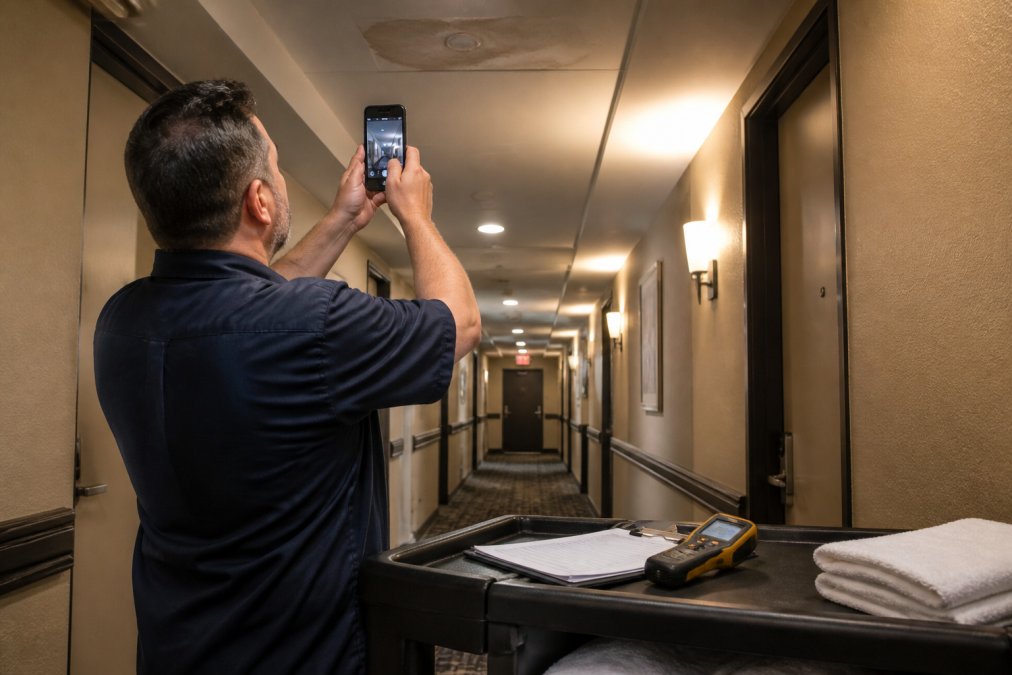
Within the first hour (before mitigation begins):
- Date, time, and exact location of the incident, written in a shared log, not a text thread
- Wide-angle photos of every affected room or area, including a reference object for scale
- Close-up photos of the damage source, such as the failed fitting, sprinkler head, or supply line
- A 30-second video walkthrough narrated aloud, stating the date, time, and what you are seeing
- Names and contact details of everyone who witnessed or reported it
During mitigation (the phase most properties skip):
- Moisture meter readings with timestamps, taken at the same points each visit so the drying curve is comparable
- A line-item drying log showing equipment placement, start time, and removal time
- Vendor invoices for any emergency work already performed, matched to the date of loss
- Photos of equipment in place, which prove you mitigated rather than waited
Throughout the claim:
- A written narrative of what happened, in plain language, updated as facts develop
- Copies of maintenance records for the affected system, pulled before the adjuster asks
- Guest or tenant complaints related to the incident, with room numbers and dates
- A running log of every call, email, and visit with the carrier, including the adjuster’s name and claim number
Digital Evidence Collection Protocols
Cloud storage beats a phone camera roll every time: photos on a personal device get lost, deleted, or belong to an employee who quits. Here is what holds up.
What to Photograph and When
Photograph before, during, and after mitigation. Before shows the loss. During shows you acted responsibly. After shows the property was restored to its prior condition.
Insurance Claim Timeline for Commercial Properties
The insurance claim timeline for commercial properties typically runs from 30 days for a simple, well-documented loss to several months when coverage is disputed or business interruption is involved. Speed on your side compresses the carrier’s side.
Here is how the phases generally break down:
| Phase | Typical Duration | What Happens |
|---|---|---|
| Notice and assignment | 1-3 days | Claim filed, adjuster assigned |
| Inspection | 3-14 days | Adjuster visits, scope is drafted |
| Documentation review | 1-4 weeks | Estimates, invoices, and logs reviewed |
| Settlement negotiation | 2-8 weeks | Offer made, gaps negotiated |
| Payment and repair | Varies | Funds released, restoration begins |
Real-Time Reporting and Claims Portal Access
Most major carriers now offer a claims portal where you can upload documents and track status without waiting on hold. Use it consistently.
Why Speed Determines Settlement Size
Faster reporting means less secondary damage, and less secondary damage means a smaller, simpler claim that is harder to dispute. It also preserves evidence that disappears with time, like the failed part or the exact water line on a wall.
The properties that collect the most are not the ones that argue hardest. They are the ones that documented fastest and handed the adjuster a complete file on day one.
How to Appeal a Denied Water Damage Insurance Claim
To appeal a denied water damage insurance claim, request the denial in writing with the specific policy language cited, then respond with documentation that directly addresses the stated reason. Denials are often about a missing proof point, not a genuine coverage exclusion.
Follow these steps:
- Get the denial in writing, including the policy section the carrier relied on
- Compare that section against your actual policy language
- Identify what evidence the carrier says is missing
- Assemble that evidence, plus anything that contradicts the denial
- Submit a written appeal within the deadline stated in your policy
- Escalate to the carrier’s claims manager if the first appeal stalls
The Appeal Letter: What to Include
Keep the appeal letter factual and short: state the claim number, date of loss, and reason given for denial, then walk through your evidence point by point.
When to Hire a Public Insurance Adjuster
A public insurance adjuster is a licensed professional who represents the policyholder, not the insurance company, during a claim. They typically charge a percentage of the settlement, so they make sense when a claim is large, complex, or already disputed.
Insurance Claims Support for Hospitality Management: Building Your Pre-Loss Playbook
Insurance claims support for hospitality management works best when it starts before the loss. A pre-loss playbook is a written plan telling every shift who calls whom, what gets photographed, and where the documents go. Establishing these protocols early ensures that operational resilience remains a core component of hospitality development consulting during the initial design and construction phases.
Risk Mitigation and Loss Control Basics
Risk mitigation in hospitality starts with the systems that fail most often: supply lines, sprinkler systems, roof drainage, and HVAC condensate lines. Inspect them on a schedule and log the inspections.
Post-Claim Operational Recovery Plans
Recovery does not end when the check arrives. A post-claim operational recovery plan covers how you reopen rooms, communicate with guests, and rebuild revenue while repairs are underway.
Insurance Claim Audit Preparation: What Underwriters Will Ask For
Insurance claim audit preparation is the practice of keeping your claim file complete and consistent so it holds up if the carrier reviews it after payment. Insurers do audit claims, and disorganized files invite clawbacks, the audit is where a well-handled claim can still go wrong.
Why Carriers Audit Claims After Paying Them
A post-payment audit is not an accusation but a routine control: carriers sample claims to check the loss was covered, the payment matched the documented damage, and nothing contradicts the original report. Audits are more likely on larger losses, claims with business interruption components, and properties that filed multiple claims in a short window.
What Underwriters and Auditors Actually Ask For
Underwriters and auditors typically want the original incident report, the full photo set, moisture or damage readings, vendor invoices matching the submitted estimate, and a clear record of communications. Completeness matters more than order. Expect requests for:
- The signed incident report and the date it was filed with the carrier
- The complete photo and video set, with timestamps intact
- Moisture, temperature, or damage readings taken at the time of loss
- Vendor invoices and contracts, matched line-by-line to the submitted estimate
- Proof of payment for any emergency work, showing you actually paid what you claimed
- The full communication log, including emails, portal messages, and call notes
- Any surveillance footage or digital logs referenced in the claim
Building a Claim Binder That Survives Review
Keep a single “claim binder,” digital or physical, that mirrors exactly what you submitted to the carrier. Structure it the same way the carrier’s estimate is structured, so an auditor can move from a line item to the supporting invoice in one step, and produce anything requested in minutes, not days.
Before you close out a claim, do your own audit. Walk the file as if you were the carrier: does every dollar on the estimate have a matching invoice? Does every photo have a date? Does the communication log have any unexplained gaps? Fix those before the carrier finds them.
Common Pitfalls That Trigger Clawbacks
The patterns that get claims flagged are consistent: an estimate that grew after the initial adjuster visit without a documented reason, invoices dated after the work was described as complete, photos showing less damage than the estimate claims, a communication log that stops for two weeks mid-negotiation.
Frequently Asked Questions
What are the most common insurance claims in the hospitality industry?
The most frequent claims involve property damage from burst pipes, sprinkler failures, and roof leaks, plus third-party liability from slip and fall incidents and foodborne illness. Natural disasters and severe storms also drive large claims, as do theft and vandalism. Many of these losses trigger business interruption coverage when rooms or event spaces must close during repairs. Documenting each incident as it happens, rather than after a loss, gives you a stronger position when you file.
How does a public insurance adjuster help with hotel property damage claims?
A public insurance adjuster works for you, not the insurer. They review your policy, prepare an independent estimate of covered damage, and handle settlement negotiation with the claims adjuster. For hospitality properties with complex losses like business interruption and lost room revenue, this can close gaps between what you claim and what the insurer initially offers. You typically pay them a percentage of the final settlement, so ask about fees before signing. They are not the same as the adjuster your insurer sends.
What documentation is required for a hospitality business insurance claim?
You will need a completed commercial property damage documentation checklist: dated photos and video of all damage, a written incident report with names and times, maintenance and inspection records, vendor invoices for emergency repairs, a room-by-room inventory of damaged contents, and financial records proving lost income. Keep original receipts and do not discard damaged items until the adjuster has inspected them. Missing documentation is one of the top reasons claims get reduced or denied, so build the file from day one.
How can hospitality managers minimize business interruption losses?
Speed and preparation matter most. Report the incident immediately through your claims portal or by phone, begin emergency mitigation like water extraction before mold sets in, and keep a pre-approved vendor list so repairs start without delay. Review your business interruption coverage limits annually to confirm they match current revenue. A post-claim operational recovery plan, written before a loss happens, lets you relocate guests, reroute operations, and reopen faster. Every day of downtime compounds lost revenue and reputation damage.