Last Updated: October 31, 2026
Quick Summary
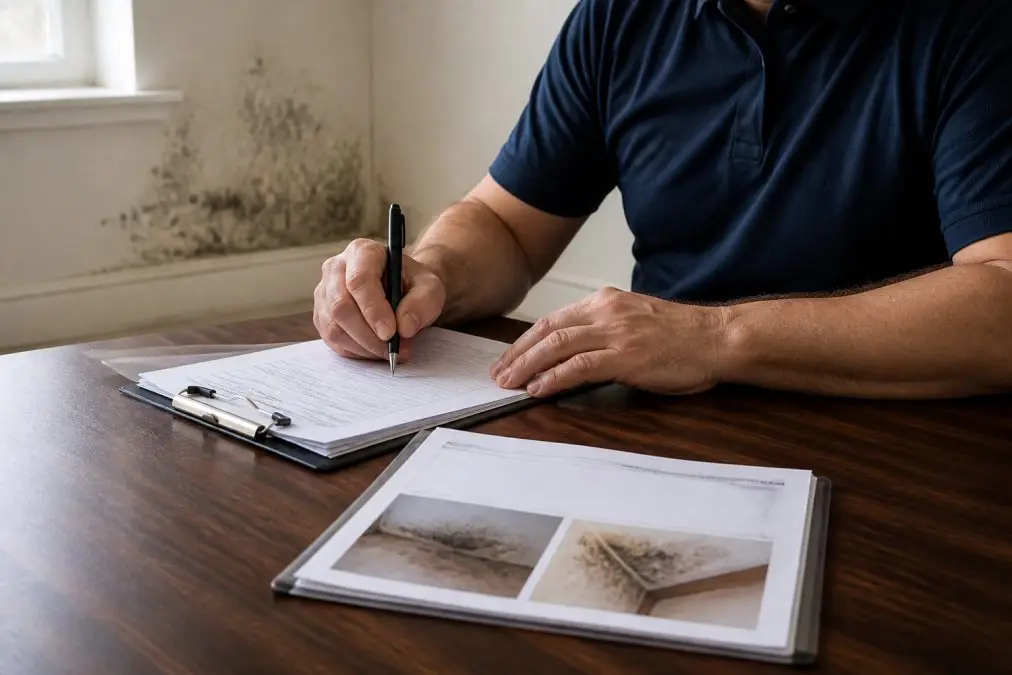
Mold clearance documentation for a home sale is the paper trail proving mold was found, its moisture source fixed, the area remediated, and the space tested clear afterward. Buyers and lenders use it to confirm the problem is truly resolved, which keeps the deal from stalling.
- Gather the original inspection report, moisture readings, and photos from the first assessment.
- Collect remediation scope, itemized invoices, and before, during, and after photos.
- Schedule independent clearance testing after the work is complete and the space is dry.
- A clearance report should list sampling locations, lab results, and a plain pass or fail conclusion.
- Ask for a remediation certificate confirming completed work, dates, clearance result, and the company involved.
Table of Contents
- Why Buyers and Lenders Ask for Mold Clearance Documentation
- Step 1: Gather the Original Inspection and Assessment Records
- Step 2: Collect Your Mold Remediation Documentation
- Step 3: Schedule Post-Remediation Mold Testing
- Step 4: Verify the Mold Clearance Report Contents
- Step 5: Obtain and File the Mold Remediation Certificate
- Building a Complete Sale Packet and Common Documentation Mistakes
- Start Your Mold Documentation With a Free Assessment at 678-379-8000
- Frequently Asked Questions
Why Buyers and Lenders Ask for Mold Clearance Documentation
When you sell a home in metro Atlanta with a mold history, buyers and lenders want proof that the problem was dealt with.
Buyers usually bring up mold after a home inspection. Lenders may ask for records before they approve a loan.
- Buyers want to know the problem is gone, not just covered up
- Lenders want documentation that matches the property’s condition
- A complete file reduces back-and-forth during escrow
Georgia humidity and summer storms make mold a common issue in older homes, especially those with crawl spaces.
Step 1: Gather the Original Inspection and Assessment Records
Start by pulling together every record from the first time mold or water damage was found.
Look for these items:
- The original home inspection report that noted the mold
- Any professional assessment or visual inspection report
- Photographs of the affected areas taken during the assessment
- Moisture readings recorded by the technician
An inspection report should list the areas evaluated, the findings, and any recommended next steps. Keep every page, even the ones that seem minor.
Watch out: If the original records are missing, ask the company that did the assessment for copies. Many keep files on hand for years.
Step 2: Collect Your Mold Remediation Documentation
Next, gather the paperwork from the remediation work itself. This shows what was done to remove the mold and fix the problem.
Your remediation file should include:
- The remediation scope, which describes the work planned
- Itemized remediation receipts and invoices
- Photos before, during, and after the work
- Notes on the moisture source that was corrected
If you have questions about what your records should cover, Aquaflame Restores It can review your file and point out gaps. You can also call 678-379-8000 for a free assessment.
Step 3: Schedule Post-Remediation Mold Testing
Once remediation is finished, the next step is independent clearance testing. This tells buyers and lenders whether the air and surfaces are now within normal levels.
Testing usually involves:
- Sampling at locations chosen to represent the affected areas
- Laboratory analysis of the samples
- A written test report with results for each sampling location
Clearance testing should happen after the work is complete and the space is dry. Testing too early can give misleading results.
Many sellers find it helpful to ask whether the tester is independent from the remediation company. Independent testing carries more weight with buyers.
Step 4: Verify the Mold Clearance Report Contents
A mold clearance report is the core document in your sale packet, and it is also the document most likely to be picked apart by a buyer’s inspector or a lender’s reviewer. Before you accept it, read it the way a skeptical buyer would.
What a defensible clearance report should contain
- The property address, the specific rooms or areas tested, and the date and time of sampling
- The name, company, and credentials of the person who performed the sampling, plus that person’s relationship to the remediation contractor
- The sampling method used at each location (for example, air sampling with a spore trap, surface sampling, or both) and the lab that analyzed the samples
- The number and placement of samples, including at least one outdoor or unaffected control sample when air sampling is used
A report that lists results but never states a pass/fail conclusion, or that omits the control sample, is hard to defend in a transaction. Ask the tester to clarify in writing rather than interpreting it yourself.
Why sampling method and placement matter
Air sampling tells you what was airborne at the moment of the test; surface sampling tells you what settled on a specific material. A report built only on air samples from one room may not persuade a buyer who is worried about a crawl space or an upstairs bathroom. The placement should map to where the mold was actually found and where moisture traveled.
Independence and timing
Many sellers find it helpful to ask whether the tester is independent from the remediation company. A clearance performed by a separate assessor carries more weight with buyers and their agents. Timing matters too: testing should happen after the work is complete and the space is dry. Testing too early, or while fans and dehumidifiers are still running in a way that masks conditions, can produce results that do not hold up on retest.
When results are inconclusive or fail
A failed or inconclusive clearance is not the end of the sale, but it must be resolved before the report goes into the packet. A failed test in the file gives a buyer a reason to walk or renegotiate. A common pattern is:
- Read the lab results to see which location failed and what was found.
- Check whether the moisture source was actually corrected, a failed clearance often traces back to residual moisture rather than missed mold.
- Have the affected area re-treated and dried, then retested at the same locations plus any newly identified ones.
- Keep both the failed report and the passing retest in the file, with a short written note explaining what changed. Hiding the first result is worse than explaining it.
If a result is inconclusive because of sampling error, ask for a retest rather than treating the ambiguity as a pass.
Before you accept a clearance report, confirm the sampling locations match the areas named in the original assessment. A mismatch is the single most common reason a buyer’s agent asks for a second opinion.


A clearance report should contain the following elements, which buyers and reviewers will check:
| Report element | What to confirm | Why it matters |
|---|---|---|
| Sampling locations | Match areas named in original assessment | Mismatch is the most common reason for second opinions |
| Control sample | Outdoor or unaffected sample included | Needed to defend air sampling results |
| Tester independence | Separate from remediation contractor | Independent testing carries more weight |
| Pass/fail conclusion | Stated in plain language with criteria | Results alone are hard to defend |
| Signature and date | Tester signature and report date present | Confirms the report is authentic and current |
| Timing of sampling | After work complete and space dry | Early testing can mislead |
Step 5: Obtain and File the Mold Remediation Certificate
After clearance, ask for a remediation certificate or letter confirming the work was completed. This document summarizes the job and its outcome in one place.
Confirm that the certificate lists:
- The completed work and the area treated
- The date of completion
- The clearance result and tester information
- The company that performed the remediation
Keep the original and make copies for your agent, the buyer’s agent, and your own records. Store digital copies in a folder you can access quickly during the sale.
Building a Complete Sale Packet and Common Documentation Mistakes
Most sellers hand over a shoebox of PDFs. A packet that a buyer, a buyer’s agent, and a lender can each navigate in a few minutes does more for your sale than any single document in it. Build it once, in a fixed order, and reuse it for every request.
A packet order that works
- Cover summary, one page: property address, the date mold was first identified, the moisture source, the remediation completion date, and the clearance result. Written in plain language, no jargon.
- Original inspection and assessment, the home inspection page that flagged mold, plus any professional assessment report and its photos and moisture readings.
- Remediation scope and records, the scope of work, itemized invoices, before/during/after photos, and notes on the moisture source that was corrected.
- Clearance report, the full report, including sampling locations, methods, lab results, and the pass/fail conclusion.
- Remediation certificate or letter, the one-page confirmation of completed work and outcome.
- Index, a simple table of contents with page numbers or file names so nothing gets lost in email threads.
File-naming and digital handoff
Name files so they sort in the order above, for example 01-cover-summary, 02-original-inspection, 03-remediation-scope, 04-clearance-report, 05-certificate. Keep one master folder and send a single link or zip rather than a dozen attachments. If your agent prefers a shared drive, mirror the same structure there so the buyer’s side sees the same order you do.
The buyer-facing summary is the document that gets read
Most buyers will not read a lab report line by line. A one-page summary that states what was found, what was done, when it was completed, and what the clearance showed does more to keep a deal moving than the underlying reports. Keep it factual and avoid adjectives; let the reports carry the detail.
Common documentation mistakes
- Handing over a clearance report with no remediation records behind it
- Missing dates, signatures, sampling locations, or the lab’s name
- Waiting until closing week to start gathering paperwork
- Assuming a verbal promise of “it’s fixed” counts as documentation
Georgia disclosure context
Disclosure forms and the questions about water damage, moisture, and mold history are the ones most likely to trigger a documentation request. The form and the transaction type both matter, so confirm the requirements with your real estate agent or attorney before you rely on any single form.
If the original records are missing, for example, a mold event years ago handled without a contractor, do not fabricate a paper trail. Gather what evidence exists (photos, receipts, insurance correspondence) and consider a new independent assessment so the file reflects current conditions rather than an undocumented past.
If you have questions about what your records should cover, Aquaflame Restores It can review your file and point out gaps. You can also call 678-379-8000 for a free assessment.
Start Your Mold Documentation With a Free Assessment at 678-379-8000
Getting your mold clearance paperwork in order is much easier when you start early. Aquaflame Restores It is a locally owned company in Decatur, Georgia, with IICRC-certified technicians available 24/7 and on site within one hour. We offer free damage assessments and can help you understand what records your sale will need.
Frequently Asked Questions
What documents should a seller provide after mold remediation?
Sellers should gather the original inspection or assessment report, the remediation scope and contractor records showing the work performed, photographs of the affected areas before and after, moisture readings that confirm the moisture source was corrected, and the post-remediation clearance report. Keeping these together in one organized packet makes it easier for a buyer, home inspector, or lender to review the property condition. Ask your remediation contractor which records they provide at the end of the job so nothing is missing when the home goes under contract.
What is a mold clearance report?
A mold clearance report is a document from post-remediation testing that describes the sampling locations, the testing method, the laboratory analysis results, and the conclusion about whether the affected areas were cleaned to the level the testing method measures. It is typically prepared by an independent professional after remediation is complete. The report should list the areas evaluated and the test results, and it should be dated and signed so a buyer or lender can trust it.
Does a mold clearance report prove a home is mold-free?
No. A mold clearance report documents conditions at the time of sampling in the specific locations tested. It does not guarantee that no mold exists anywhere in the home, and it cannot rule out future growth if the moisture source returns. Buyers should read the report’s stated scope and limitations, and a moisture source correction record strengthens the documentation.
Should mold testing be done before or after remediation?
Testing is usually done in both stages. Pre-remediation assessment documents the original extent of the problem and helps define the remediation scope. Post-remediation testing, sometimes called clearance testing, is done after the work and cleaning are complete to confirm the results. Keep both sets of records, since a buyer will want to see the sequence from problem to resolution.
Call Aquaflame Restores It at 678-379-8000 today for a free assessment.