Table of Contents
- Why a Professional Mold Inspection Matters More Than You Think
- Signs of Mold Growth in Walls and Other Hidden Spots
- Mold Testing vs Inspection: What’s the Difference?
- What a Certified Mold Inspector Actually Does
- Mold Inspection Cost: What You’re Paying For
- The Benefits of Professional Mold Inspection for Health, Property, and Insurance
- Frequently Asked Questions
Last Updated: October 3, 2026
Why a Professional Mold Inspection Matters More Than You Think
Mold can start growing within 24 to 48 hours of a water intrusion event, according to EPA guidance on mold and moisture, which means the window between “small leak” and “colony behind the drywall” is shorter than most homeowners expect.
Here is the uncomfortable truth most guides skip: visible mold is rarely the whole problem. A professional mold inspection is the only way to map where colonies actually exist, how far contamination has spread, and what is keeping the environment wet enough to sustain fungal growth.
Below, we break down the warning signs, the difference between testing and inspection, what a certified inspector actually does, and how to read a mold inspection cost estimate without getting taken advantage of.
Signs of Mold Growth in Walls and Other Hidden Spots
Persistent musty odors, warped drywall, and unexplained condensation are the three most reliable early indicators of hidden mold. Most homeowners notice the smell first, weeks before any visible discoloration appears.
Musty Odors and Discoloration
A musty smell is the odor of microbial growth off-gassing as it digests organic material in your walls, insulation, or carpet backing. If the smell intensifies when your HVAC system runs, that is a strong signal of HVAC contamination pushing spores through the home. Discoloration, ranging from white powdery patches to dark green-black staining, usually appears near baseboards, ceiling corners, and around window frames where condensation collects.
Warping, Peeling, and Persistent Condensation
When drywall or trim absorbs moisture, it swells, then dries unevenly and cracks. Paint peels because the surface underneath is holding water. Condensation that keeps returning to the same window or pipe is moisture intrusion announcing itself. These are not cosmetic problems. They are structural integrity warnings that often sit directly above or beside a mold colony growing out of sight.
Do not paint over discolored drywall or caulk around recurring condensation. Sealing the surface traps moisture behind it and accelerates mold growth inside the wall cavity, turning a small remediation into a full reconstruction.
Mold Testing vs Inspection: What’s the Difference?
A mold inspection is a visual and instrumental assessment of your property to locate moisture sources and mold growth, while mold testing involves collecting physical samples to identify species and quantify spore count.
Inspection answers “where and why.” Testing answers “what and how much.” A certified inspector walks the property with moisture meters, thermal imaging, and a hygrometer, tracing water paths and identifying conditions that support fungal growth.
| Approach | What It Identifies | Best For | Limitation |
|---|---|---|---|
| Visual inspection | Location, extent, moisture source | Every property with suspected mold | Cannot confirm species or spore count |
| Air sampling | Airborne spores, indoor vs outdoor comparison | Post-remediation, health concerns | Does not pinpoint the source |
| Surface sampling | Species on a specific surface | Confirming toxic mold or mycotoxins | Only tests the spot swabbed |
| Thermal imaging | Hidden moisture behind surfaces | Finding leaks without demolition | Requires interpretation by a trained inspector |
For most homes, inspection comes first. Testing is added when species identification matters, such as a real estate transaction, an insurance claim, or a health concern.
What a Certified Mold Inspector Actually Does
A certified inspector traces moisture to its source, documents the extent of contamination, and produces a written report that supports remediation, insurance, and real estate decisions. The work is investigative, not just visual.
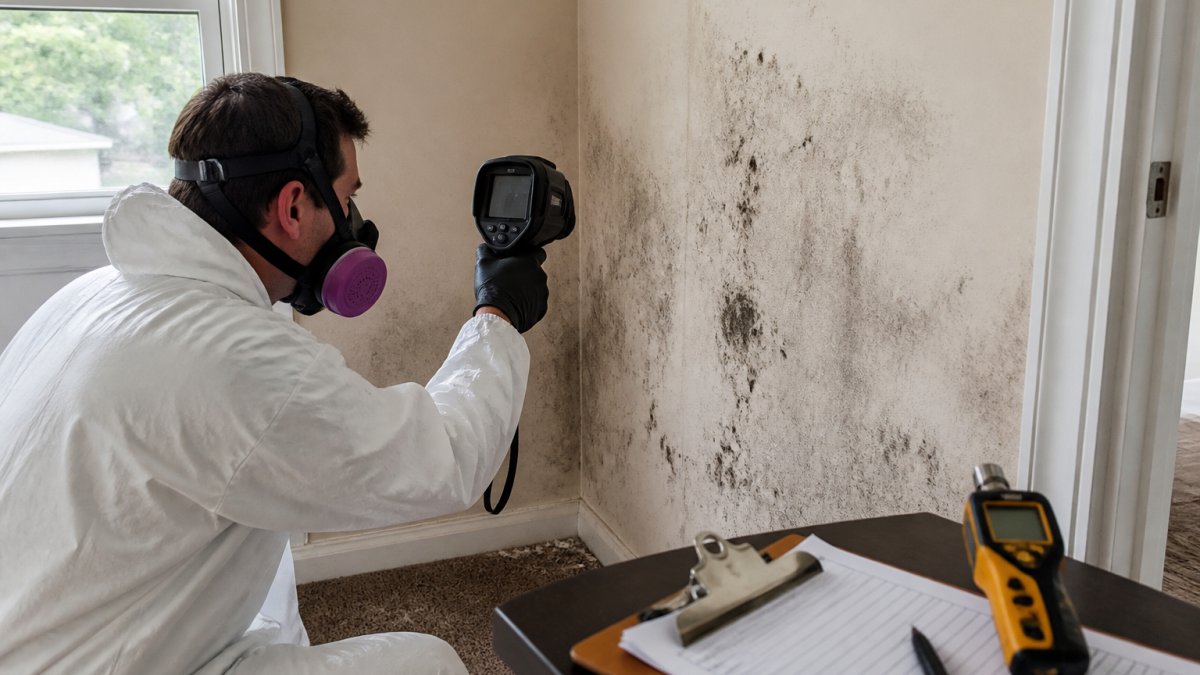
The process typically follows this sequence:
- Interview the occupant about leaks, odors, and health symptoms
- Walk the exterior to identify roof, grading, and drainage issues
- Inspect interior rooms, crawlspaces, and attics for visible growth
- Scan walls and ceilings with thermal imaging for hidden moisture
- Measure relative humidity with a hygrometer in each zone
- Collect air and surface samples where growth is suspected
- Document findings with photos and a written scope
Equipment Breakdown: Thermal Imaging, Hygrometers, and Air Sampling
Thermal imaging cameras detect temperature differences caused by evaporating moisture, revealing wet areas behind drywall without cutting into it. Hygrometers measure relative humidity; sustained readings above roughly 60% create conditions where mold colonies thrive. Air sampling uses a calibrated pump to capture airborne spores onto a slide or cassette, which a lab then analyzes to produce a spore count and species breakdown.
Ask your inspector for the moisture readings, not just the conclusion. A report that says “mold present” without relative humidity percentages, thermal images, and sample lab results gives you nothing to act on or submit to an insurer.
Mold Inspection Cost: What You’re Paying For
Mold inspection cost is driven by four variables: property size and complexity, the number of samples collected, whether laboratory analysis is included, and whether the inspector is producing documentation for an insurer, lender, or real estate transaction. Any quote that does not reference those four items is a guess, not an estimate.
Here is how the pricing actually breaks down, line by line:
- Base inspection fee. Covers the on-site walkthrough, moisture mapping, thermal scan, and a written summary. For a single-family home, expect this to scale with square footage and the number of conditioned zones, crawlspaces, and attic runs.
- Per-sample laboratory fees. Air sampling (spore trap cassettes) and surface sampling (swabs or tape lifts) are billed per sample because a third-party lab processes each one individually. A typical inspection collects two to four outdoor control samples plus one to several indoor samples, so sample count, not the base fee, is usually what swings the final invoice.
- Equipment and travel. Thermal imaging cameras, calibrated air pumps, and hygrometers carry real operating and calibration costs. Inspectors who travel outside a primary service radius add a trip charge.
How to Read a Mold Inspection Estimate
A trustworthy estimate separates the base inspection from the sample count and states the lab fee per sample. A quote that bundles everything into one number without a sample allowance is either padding the base or planning to cut lab work. Ask three questions before you sign:
- How many air samples and how many surface samples are included, and what is the per-sample charge beyond that?
- Is the lab a third-party accredited laboratory, and will I receive the raw lab report, not just a summary?
- Does the report include moisture readings in percentages, thermal images, and a written scope of work I can hand to an adjuster or a remediator?
If the answer to any of those is vague, the low quote is not a discount, it is a smaller deliverable. The two items most often cut to hit a low number are laboratory analysis and documentation, which are precisely the two things you need for an insurance claim, a real estate disclosure, or a remediation scope.
Ask for the estimate in writing with the sample allowance stated separately. A per-sample line item protects you from a surprise invoice and tells you exactly what the inspector intends to collect.
When Inspection Cost Is Money Well Spent
A professional inspection is a diagnostic, not a treatment. If it identifies the moisture source and maps the contamination, it prevents you from paying a remediator to remove mold that will return the moment the next rain hits.
If a quote is dramatically lower than others, ask which of the four cost buckets is being cut. Usually it is the lab work or the documentation, the two things you most need.
The Benefits of Professional Mold Inspection for Health, Property, and Insurance
The core benefit of a professional mold inspection is documented, source-based evidence: you learn what is growing, where the moisture is coming from, and what it will take to fix it permanently. That evidence protects your health, your property value, and your ability to file a successful insurance claim. But the real value shows up in three specific workflows that most guides never explain.
Health: Turning a Vague Symptom Into a Concrete Finding
Mold exposure is linked to allergic reactions and respiratory irritation, particularly in people with asthma or compromised immune systems, per CDC information on mold and health.
A useful pattern to watch for is symptom clustering by location. If headaches, coughing, or sinus irritation consistently worsen in one room or after the HVAC runs, that points toward an airborne source rather than a surface one.
Property: The Disclosure and Negotiation Asset
Unresolved mold is a disclosure issue in nearly every real estate transaction. Sellers who can produce a professional inspection report, and, when remediation was performed, post-remediation clearance testing, close faster and avoid last-minute price reductions.
The key detail most sellers miss is that a remediation receipt is not the same as a clearance report. A receipt proves work was done.
Insurance: How the Report Actually Drives the Claim
On insurance, the inspection report is the backbone of your claim. Adjusters are not evaluating whether you have mold, they are evaluating whether the loss is covered, what caused it, and what the scope of repair is. A professional report answers all three: it documents the moisture source (a burst supply line, a roof intrusion, a failed A/C condensate drain), maps the extent of contamination, and provides a written scope of work with photos, moisture readings, and lab results.
Claims supported by that documentation move through the process faster than claims built on homeowner photos and a description. Two practical points make the difference:
- Source documentation matters most. Most policies respond to the water event that caused the mold, not to the mold itself. The inspection report is what ties the growth to a covered peril.
- Clearance testing closes the loop. After remediation, post-remediation verification, air sampling compared against the outdoor control, is what proves the property was returned to a normal condition. Adjusters and lenders often require it before releasing final payment or clearing a file.
A professional mold inspection is not a sales pitch for remediation. It is evidence. The report is the asset that protects you whether you remediate, negotiate a price reduction, or file a claim, and the clearance report is what proves the fix held.
If you are dealing with a wet ceiling, a leaking A/C unit, a roof leak, or mold that keeps returning after a previous “fix,” the fastest path to a real answer is a professional inspection. Aquaflame Restores it provides 24/7 emergency response, a 30-minute arrival guarantee across metro Atlanta, and IICRC-trained technicians. We handle direct insurance billing and full reconstruction, so you are not juggling contractors while your property sits wet. Call our team for a professional mold inspection and get a documented answer instead of another guess.
Frequently Asked Questions
Is a professional mold inspection worth the cost?
Yes, for most homeowners. A professional mold inspection typically costs between $300 and $600, but it can save thousands by catching hidden mold early, preventing structural damage, and providing documentation for insurance claims. If you’ve had water damage, notice a musty odor, or are buying or selling a home, the inspection is a worthwhile investment. It also gives you a clear remediation plan instead of guesswork.
What does a professional mold inspector actually do?
A certified inspector examines your home for moisture intrusion, visible mold, and hidden mold using tools like thermal imaging cameras, hygrometers, and moisture meters. They collect air and surface samples to identify mold species and spore counts. They also document findings with photos and a detailed report, which can be used for insurance claims, real estate transactions, or planning remediation. The process usually takes 1-3 hours depending on property size.
Can I test for mold myself instead of hiring a pro?
DIY mold test kits are available, but they have limitations. They can confirm the presence of mold but often can’t pinpoint the source, measure spore counts accurately, or identify specific species like toxic black mold. Professional testing uses calibrated equipment and lab analysis, providing reliable data for health decisions, remediation, and legal documentation. If you suspect a serious issue or need clearance for a real estate deal, a professional inspection is the safer choice.
Does a mold inspection include air quality testing?
Most professional mold inspections include air quality testing as part of the service. Inspectors collect air samples inside and outside your home to compare spore counts and identify airborne spores. This helps determine if mold is actively growing and spreading. Some companies also offer surface sampling and bulk testing. Always confirm what’s included before booking, as air quality testing may be an add-on for some providers.