
Last Updated: November 4, 2026
Quick Summary
To identify mold in your house, watch for visible discoloration with a fuzzy or powdery texture, a musty smell that returns after cleaning, and moisture clues like condensation or water intrusion. These seven warning signs also include warped drywall, health symptoms that ease when you leave, and growth in crawl spaces, attics, and HVAC systems.
- Mold colonies appear as patchy black, green, gray, white, or orange discoloration that may smear when wiped.
- Indoor relative humidity above roughly 60% is generally considered a mold-friendly range.
- Signs behind walls include baseboards pulling away, bubbling paint, soft drywall, and dark rings around outlets.
- Keep DIY cleanup to patches smaller than about 10 square feet and call a professional for anything larger.
- Professional inspection traces the moisture source, maps the extent of growth, and documents findings for insurance.
Table of Contents
- Why Mold Identification Matters in Metro Atlanta Homes
- 1. Visible Discoloration and Fuzzy Texture
- 2. The Musty Smell in House That Won’t Go Away
- 3. Signs of Mold Behind Walls You Should Not Ignore
- 4. Moisture Clues: Condensation, Dampness, and Water Intrusion
- 5. Health Symptoms and Allergic Reactions That Point to Mold
- 6. High-Risk Spots: Crawl Spaces, Attics, and HVAC Systems
- 7. DIY Testing vs. a Professional Mold Inspection
- Frequently Asked Questions
Why Mold Identification Matters in Metro Atlanta Homes
Georgia’s humidity does most of the work for mold. Summer storms push damp air into crawl spaces, clay soil holds water against foundations, and older Decatur and DeKalb County homes trap moisture behind plaster and under subfloors. Learning to identify mold early is the difference between a small cleanup and a gutted wall.
This guide covers seven warning signs homeowners across metro Atlanta should watch for, from Decatur and DeKalb County to Fulton, Cobb, Gwinnett, Henry, Clayton, and Rockdale counties. Below, we’ll show you exactly what to look for, what each sign usually means, and when to stop guessing and call a professional.
Mold identification is the process of recognizing visible growth, odors, moisture clues, and health symptoms that point to fungal growth inside a building. Most homeowners miss the first signs because mold rarely announces itself. It hides behind baseboards, above ceiling tiles, and inside HVAC systems.
Watch out: treating a musty smell as “just an old house” is a common mistake, since that odor can come from active growth.
1. Visible Discoloration and Fuzzy Texture
Start with what you can see. Mold colonies usually show up as patchy discoloration, not a neat single spot.
Colors range from black and green to gray, white, or orange. Texture matters just as much as color. Mold often looks fuzzy or powdery, and it may smear when you touch it with a damp cloth.
- Black or dark green patches near windows and in bathrooms
- White or gray powdery film on joists and framing
- Orange or pink streaks on damp wood and around tubs
- Peeling paint or bubbling drywall with dark edges
Unsure whether a patch is mold or mildew? The two look similar but behave differently. Our guide on mold vs mildew in Atlanta homes walks through the side-by-side differences. For a closer look at drywall specifically, see early signs of mold on drywall.
2. The Musty Smell in House That Won’t Go Away
A musty smell in house is one of the most reliable early warnings you’ll get. It means spores and microbial growth are active somewhere nearby, even if you can’t see them.
The EPA’s mold guidance notes that mold needs moisture to grow, so a persistent musty odor often points to a hidden moisture source.
Try this test: leave the room, come back after ten minutes, and sniff near outlets, baseboards, and closets. Your nose adjusts fast, which is why a fresh entry is more telling.
If the smell returns after cleaning, the moisture source is likely still there.
3. Signs of Mold Behind Walls You Should Not Ignore
Signs of mold behind walls include warped drywall, bubbling paint, soft spots, and dark staining along baseboards.
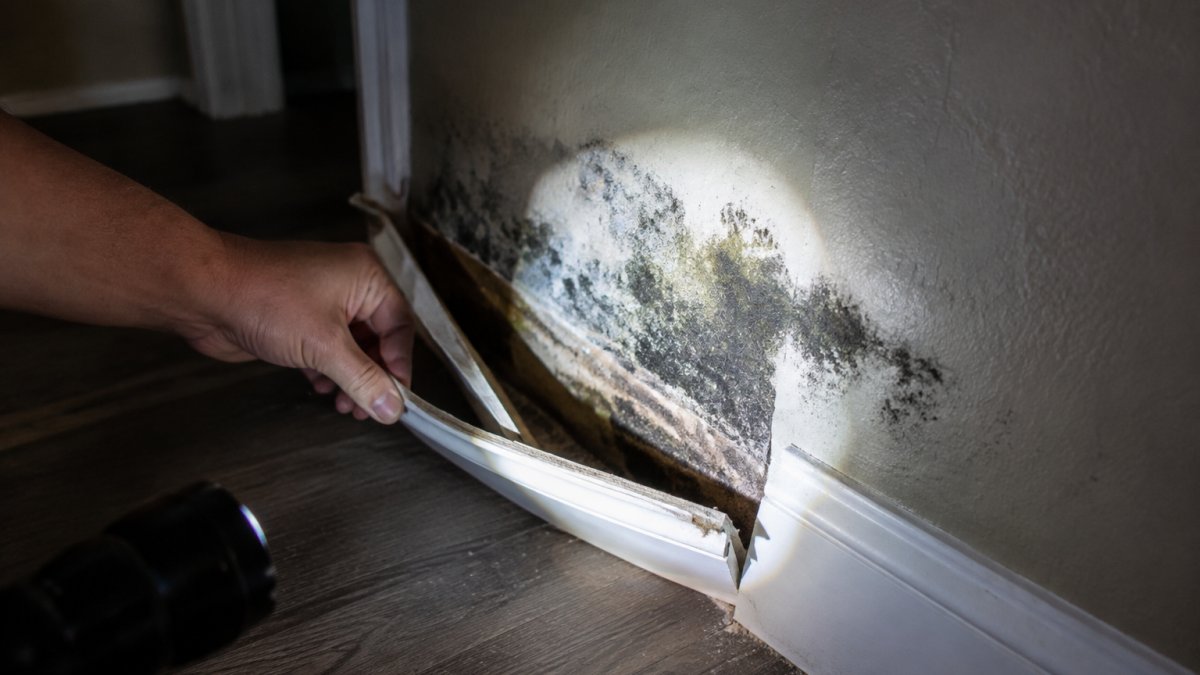
Work through this checklist:
- Baseboards that pull away from the wall
- Paint or wallpaper bubbling in one area
- Drywall that feels soft or crumbles when pressed
- Dark rings around outlets and light switches
- A musty smell strongest near one wall
Any two of these together justify a closer look. Our detection guide for mold behind drywall explains how moisture hides in wall cavities and what to check next.
4. Moisture Clues: Condensation, Dampness, and Water Intrusion
Mold needs moisture, so moisture problems come first. Find the dampness and you’ll usually find the growth. The trick is knowing which moisture clues actually matter and which are background noise.
Start with condensation. Water beading on window glass, toilet tanks, cold water pipes, and the inside of exterior walls is a sign that indoor humidity is high enough to condense on cool surfaces. That same condensation is landing on framing, sheathing, and the back of drywall, surfaces you can’t see. A hygrometer, an inexpensive meter that reads relative humidity, helps you track indoor dampness room by room. Indoor relative humidity above roughly 60% is generally considered a mold-friendly range.
Then look for water intrusion. After a summer storm, check around chimneys, window frames, door thresholds, and the base of exterior walls. In older Decatur and DeKalb County homes, water often enters at the sill plate and wicks upward into framing. In Fulton, Cobb, and Gwinnett basements, hydrostatic pressure from clay soil pushes moisture through block walls and floor joints. Frozen pipes during a winter cold snap create slow leaks that soak framing for weeks before anyone notices.
Watch out: drying a visible puddle and calling it done is the most common mistake. Water wicks into porous materials like wood, drywall paper, and insulation and stays there long after the surface feels dry. A moisture meter, pin-type for drywall and wood, pinless for tile and behind finishes, tells you whether a material is actually dry or just dry to the touch.
A simple seasonal walkthrough catches most of this:
- Read humidity in the crawl space, basement, and main floor with a hygrometer
- Check for condensation on windows, pipes, and toilet tanks
- Look for staining, efflorescence, or soft wood at the base of exterior walls
- Confirm bathroom and dryer exhaust vent outdoors, not into the attic
- After heavy rain, inspect the crawl space and basement for standing water or damp soil
If you find active moisture you can’t trace, or dampness that returns after drying, that’s the point to bring in a professional. Aquaflame Restores It can help identify the water source behind the growth, not just the visible mold.
5. Health Symptoms and Allergic Reactions That Point to Mold
Health symptoms can be a useful clue, but they are never proof on their own. Treat them as a reason to investigate, not a diagnosis.
Common reports include sneezing, coughing, itchy eyes, and skin irritation that ease when you leave the house. The CDC’s mold information explains that some people are more sensitive than others, and reactions vary widely.
If symptoms track with one room, that pattern is worth noting. We don’t diagnose anyone, and neither should a restoration company. A doctor handles health questions; we handle the building.
6. High-Risk Spots: Crawl Spaces, Attics, and HVAC Systems
Certain areas in metro Atlanta homes grow mold almost by default. Crawl spaces top the list because clay soil and poor ventilation keep them damp year-round.
Next come attics with roof leaks or blocked vents, then HVAC systems. An HVAC system pulls humid air through ducts and coils, and a damp air handler becomes a growth site that spreads spores through the house.
Check these spots seasonally:
- Crawl space joists and insulation edges
- Attic decking and rafters, especially under roof penetrations
- HVAC drip pans, coils, and the inside of ductwork
- Bathroom exhaust fans that vent into the attic instead of outside
7. DIY Testing vs. a Professional Mold Inspection
DIY test kits measure spore count in the air or on a surface, and they can suggest that mold is present. They generally can’t tell you where it’s coming from or how far it has spread.
Professional mold inspection typically traces the moisture source, maps the extent of growth, and documents findings for insurance and real estate transactions. That documentation can matter when a lender, buyer, or adjuster asks for proof.
| Approach | What It Tells You | Best For |
|---|---|---|
| DIY surface or air kit | Spores are present | A quick yes-or-no answer |
| Professional inspection | Source, extent, and documentation | Hidden growth or a pending sale |
| Post-remediation check | Whether cleanup worked | Confirming a job is finished |
Post-remediation verification is an important step. Cleaning visible mold doesn’t by itself show the problem is solved, which is why a follow-up check of moisture readings can be valuable.
For a full breakdown, read our comparison of professional mold removal vs DIY. When you’re ready to stop guessing, you can book a professional mold inspection and testing with our team.
Keep DIY cleanup to patches smaller than about 10 square feet. Anything larger, any hidden growth, or any water from sewage backup needs professional help. If you’re preparing an insurance claim, documentation such as moisture readings, photos of affected materials, and a record of the work performed can be helpful.
Frequently Asked Questions
What are the first signs of mold sickness?
The earliest signs are often respiratory: sneezing, a runny or stuffy nose, coughing, and itchy, watery eyes that worsen when you are inside a particular room or building. Some people also report headaches, fatigue, and skin irritation. These symptoms overlap with allergies and colds, so pay attention to the pattern. If they ease when you leave the house and return when you come back, mold exposure is worth investigating, especially in damp metro Atlanta homes with crawl spaces or older HVAC systems.
How can I tell if mold is hiding behind my walls?
Look for signs of mold behind walls: warped or bubbling paint, soft or crumbling drywall, dark staining near baseboards, and a musty odor that lingers in one room. Peeling wallpaper and baseboards that pull away easily are also clues. A moisture meter can confirm dampness inside the wall without cutting it open. If you suspect hidden growth, avoid disturbing the area, since that can release spores and airborne particles into the room, and bring in a professional to assess it.
When should I call a professional for mold assessment in the Atlanta area?
Call a professional when growth covers more than about 10 square feet, when you smell a musty odor but cannot find the source, or when mold keeps returning after you clean it. Hidden mold behind walls, under floors, or in crawl spaces also calls for an expert. In metro Atlanta’s humid climate, crawl spaces and attics are common trouble spots. Aquaflame Restores It offers free damage assessments and IICRC-certified technicians who can find the moisture source driving the growth.
Is it safe to stay in a house while waiting for mold remediation?
For small, contained patches on non-porous surfaces, staying is usually fine if you keep the area dry and ventilated. For larger areas, hidden growth, or anyone with asthma, allergies, or a weakened immune system, it is safer to limit time in the affected rooms until the issue is addressed. If the mold stems from sewage or flooding, treat it as a health risk and stay out of the space. A professional assessment can tell you how far the growth has spread before you decide.
