Table of Contents
- Assess Your Immediate Water Needs and Situation
- How Much Water to Store for Emergencies
- Identify Safe Sources of Emergency Water
- Emergency Water Purification Methods
- How to Disinfect Water with Bleach
- Store Water for Long-Term Emergency Use
- Common Mistakes to Avoid
- When to Call a Professional for Water Damage
Last Updated: August 11, 2026
Assess Your Immediate Water Needs and Situation
Before obtaining water in an emergency, understand what you’re facing: how many people depend on water in your household, how long you might be without normal supply, and what contamination risks exist.
Count occupants and pets. A single person needs far less stored water than a family of four. Consider medical needs too, anyone on dialysis, using medical equipment, or managing chronic conditions may need additional water beyond basic drinking and sanitation. Evaluate your situation: Is this a temporary boil-water advisory lasting hours? A multi-day flooding event? A long-term infrastructure failure? The answer changes your strategy entirely.
At Aquaflame Restores it, we’ve responded to countless emergencies where homeowners faced contaminated water supplies after flooding or pipe damage. The families who recovered fastest understood their actual needs and acted decisively.
Document your situation. Note when the emergency began, what triggered it, and any official warnings from local authorities. Check whether your local water utility has issued a boil-water advisory or if contamination has been reported. These details determine which purification methods you’ll need.
How Much Water to Store for Emergencies
The standard recommendation is one gallon per person per day for drinking and basic sanitation. For a family of four, that’s four gallons daily. If you live in a hot climate or your household includes children, elderly people, or pregnant women, increase this to 1.5 gallons per person per day. Add another gallon per person per day if anyone has medical conditions requiring extra hydration. For pets, add 0.5 to 1 gallon per animal daily depending on size.
Duration matters as much as amount. A three-day emergency requires 12 gallons for a family of four at minimum. A week-long scenario demands 28 gallons. Many preparedness experts recommend storing a two-week supply if space allows, which gives you 56 gallons for that same family.
Store water in multiple locations, some in your home, some in your vehicle, some at work if possible. This prevents total loss if one location becomes inaccessible. Keep emergency water separate from your everyday supply so you’re not tempted to use it for routine purposes.
Identify Safe Sources of Emergency Water
When municipal supply fails, you have several options for sourcing water. Not all are equally safe, and safety depends on contamination risk in your specific situation.
Tap water and stored reserves
Your first source should always be water you’ve already stored. Properly stored tap water remains safe to drink for six months to a year if kept in food-grade containers in a cool, dark place. If you haven’t stored water yet, fill bathtubs, large pots, and any clean containers immediately when you learn an emergency is imminent.
Tap water still flowing from your pipes during an emergency may or may not be safe. If your utility issues a boil-water advisory, assume all tap water is contaminated until cleared. If pipes have burst due to flooding, groundwater contamination is likely. Never drink tap water during an emergency unless your local authority explicitly confirms it’s safe.
Rainwater collection and usage
Rainwater is often overlooked as an emergency source, yet it’s surprisingly accessible. During rainfall, position clean buckets under downspouts or use tarps to direct water into containers. Water collected directly from the sky (not runoff from contaminated surfaces) is generally cleaner than expected, though it still requires treatment before drinking.
The key is collection method. Water from a clean roof gutter is safer than water pooled on the ground. Avoid rainwater that’s flowed across roofing materials treated with chemicals or through gutters clogged with debris and bird droppings. Let the first few minutes of rain run off to clear debris, then collect the subsequent flow.
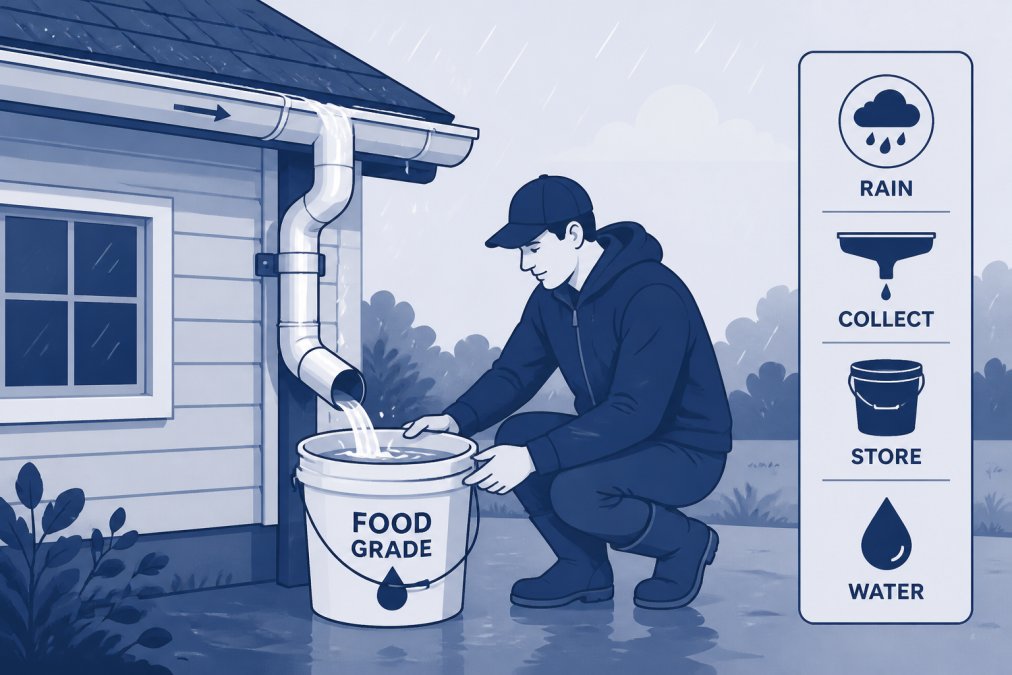
Rainwater needs purification before drinking but works well for washing, sanitation, and watering plants.
Water from home systems
Your water heater tank contains 30-50 gallons of water that’s already been treated. To access it, turn off the inlet valve at the top of the tank, attach a hose to the drain valve at the bottom, and let water flow into clean containers. This water is safe to drink without additional treatment.
Your toilet tank (not the bowl) contains clean water suitable for sanitation and, if necessary, for boiling or chemical treatment. The water in your pipes, if you haven’t experienced a break, is also drinkable if your utility confirms the supply is safe.
Some homes have wells. If yours is powered by an electric pump, it won’t function during a power outage unless you have a backup generator. If you suspect contamination, treat all well water before drinking.
Emergency Water Purification Methods
Contaminated water poses serious health risks. Waterborne pathogens cause illness ranging from mild gastrointestinal upset to severe dysentery. You have several purification methods available, each with different strengths.
Boiling water for safety
Boiling is the most reliable purification method available without special equipment. Heat water to a rolling boil and maintain it for at least one minute. At higher elevations (above 6,500 feet), boil for three minutes. Boiling kills bacteria, viruses, and most parasites but does not remove chemical contaminants or heavy metals.
The challenge is fuel. A gas stove works during power outages, but electric stoves don’t. Camping stoves, outdoor grills, and even candles under a pot can boil water if necessary. Plan your fuel source before an emergency occurs.
Filtration systems and sediment removal
Filtration removes particles and some pathogens but doesn’t kill all microorganisms. A simple approach is gravity filtration: layer sand, gravel, and cloth in a container, then pour contaminated water through. This removes sediment and large particles but requires subsequent boiling or chemical treatment for safety.
Commercial water filters (pitcher filters, faucet-mounted filters, or portable camping filters) work during emergencies if you have them on hand. Most remove chlorine, improve taste, and reduce some pathogens. However, standard pitcher filters don’t remove all bacteria or viruses, so boil filtered water or treat it chemically afterward.
Sedimentation works as a first step. Fill a clear container with contaminated water and let it sit undisturbed for several hours. Carefully pour the clearer water from the top into another container, leaving sediment at the bottom.
How to Disinfect Water with Bleach
Bleach disinfection is fast, inexpensive, and highly effective for killing bacteria and viruses. This method works best on clear water; if water is cloudy, filter or settle it first. Bleach does not remove sediment, chemicals, or heavy metals.
Use unscented household bleach containing 5-6% sodium hypochlorite. Add bleach using this ratio: 8 drops per gallon of clear water, or 16 drops per gallon of cloudy water. Stir well and let it sit for 30 minutes before drinking. The water should smell faintly of chlorine; if it doesn’t, add a few more drops and wait another 15 minutes.
For smaller quantities, use one drop of bleach per liter of clear water. If you lack precise measuring tools, err slightly toward more bleach rather than less.
The 30-minute wait time is critical. Chlorine needs time to kill pathogens. If water is very cold, extend the wait to 45 minutes, as chlorine works more slowly in cold conditions.
Store your emergency bleach bottle carefully. Keep it away from children and pets, out of direct sunlight, and in a cool location. Replace your emergency supply every 6-12 months.
Store Water for Long-Term Emergency Use
Proper storage is essential. Water stored correctly lasts years; water stored poorly becomes unsafe within weeks.
Choosing food-grade containers
Food-grade plastic containers are the standard for water storage. Look for containers labeled "food-grade" or marked with the recycling symbol #2 (HDPE) or #5 (polypropylene). Avoid containers that previously held chemicals, pesticides, or non-food products.
Glass containers work well but are heavy and breakable. Metal containers (except stainless steel) can rust and contaminate water. Stainless steel containers are excellent but expensive.
Five-gallon containers are manageable for most people. One-gallon containers are easier to handle and rotate. Many families use a mix of sizes.
Before filling, sanitize containers by rinsing with a weak bleach solution (one teaspoon per gallon), then rinsing thoroughly with clean water.
Water storage life and rotation
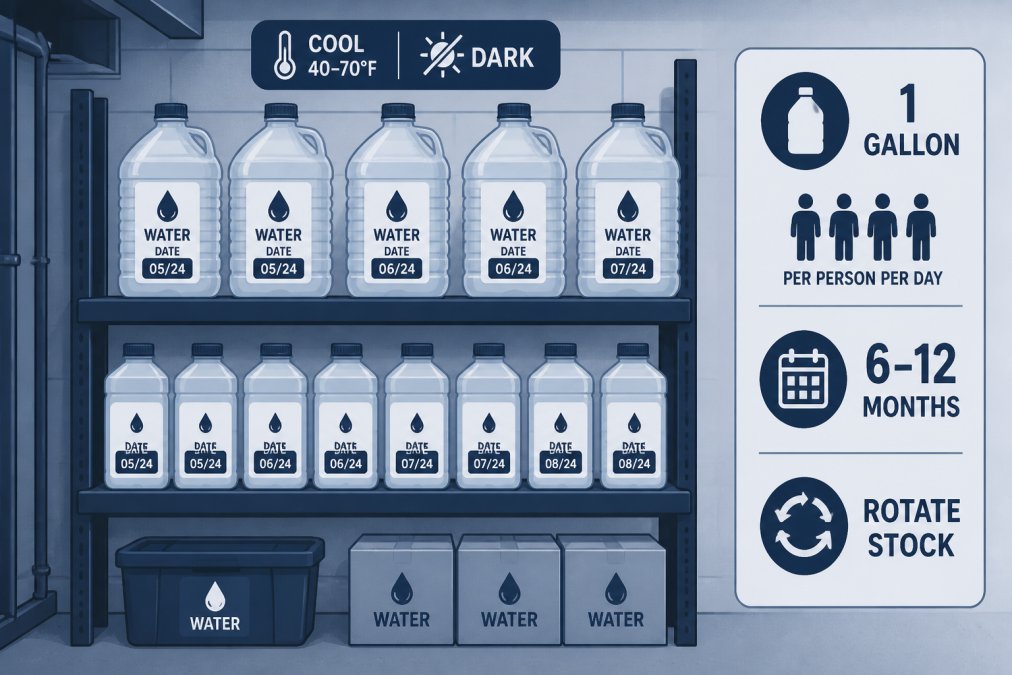
Tap water stored in food-grade containers in a cool, dark location remains safe for six months to one year. Cooler temperatures extend storage life; warmer environments shorten it. Darkness prevents algae growth and chemical degradation.
Label your containers with the storage date. Implement a rotation system: use the oldest water first for sanitation or washing, replacing it with freshly stored water. Some people rotate their stored water every six months; others extend it to a year if storage conditions are ideal.
For truly long-term storage (multiple years), consider using water storage additives designed for this purpose. These products inhibit bacterial growth and extend water life significantly.
Avoid storing water in direct sunlight or in warm locations. Basements, closets, and shaded pantries are ideal. Never store water near chemicals, pesticides, or gasoline.
Common Mistakes to Avoid
The biggest mistake is storing water without a rotation plan. Stale water develops off-flavors, harbors microorganisms, and requires treatment before drinking.
Another frequent error is storing water in inappropriate containers. Reusing soda bottles or juice jugs introduces contamination. Invest in proper food-grade containers.
Underestimating quantity is common. People calculate one gallon per person per day and stop there, forgetting that water serves multiple purposes: drinking, cooking, washing, sanitation, and pet care.
Many people store water but neglect to store the means to purify it. They have bleach for household cleaning but not the specific amount needed for water treatment. Prepare your purification toolkit before an emergency strikes.
Storing water without considering accessibility is another mistake. Keep some water in an easy-to-reach location, even if you store larger quantities elsewhere.
Finally, people often fail to test their purification methods before needing them. Practice your chosen methods now so you’ll execute them correctly when it matters.
When to Call a Professional for Water Damage
Sometimes obtaining and purifying water is only the beginning. If your emergency involves flooding, sewage backup, or contamination from external sources, you may need professional intervention.
If floodwater has entered your home, the water is almost certainly contaminated with sewage, chemicals, or other hazards. This water requires professional remediation, not home treatment. Contaminated floodwater poses serious health risks that exceed what bleach or boiling can safely address.
If your water supply has been contaminated by sewage (indicated by foul odor, visible discoloration, or official notification), avoid using tap water for anything except sanitation until authorities confirm safety.
Aquaflame Restores it handles water damage emergencies across metro Atlanta with 24/7 response and a 30-minute arrival guarantee. Their IICRC-trained technicians assess water contamination, manage extraction and drying, and coordinate directly with insurance companies. If your emergency involves structural water damage, mold risk, or contamination beyond simple treatment, professional intervention prevents costly mistakes.
If pipes have burst or frozen and thawed, water quality is compromised. Professional plumbers can flush systems and verify safety. If you suspect lead contamination (common in older homes with lead pipes), professional water testing identifies the problem.
Trust your instincts. If water looks, smells, or tastes wrong even after treatment, don’t drink it. Call for professional testing.
Emergencies test your preparation and your ability to stay calm under pressure. How to obtain water in an emergency boils down to three essentials: know your needs, store water properly, and understand your purification options. When flooding, contamination, or supply disruption occurs, you’ll act decisively rather than panic. For emergencies involving structural water damage or contamination beyond home treatment, professional restoration services like Aquaflame Restores it provide rapid response, direct insurance coordination, and the expertise to restore your home safely and completely. Their IICRC-trained team handles everything from water extraction to full reconstruction, ensuring you can focus on recovery while they manage the restoration process.
Frequently Asked Questions
How much water should I store for a one-person emergency?
Store at least 1 gallon per person per day for drinking and sanitation. For a two-week emergency supply, one person needs 14 gallons minimum. If you have children, elderly family members, or pets, increase this amount. Keep water in food-grade plastic containers in a cool, dark location. Rotate your supply every six months to maintain freshness and ensure potable water quality.
What is the correct water-to-bleach ratio for disinfection?
Use unscented household bleach (5-6% sodium hypochlorite) at a ratio of 2 drops per quart of clear water, or 8 drops per gallon. For cloudy water, use 4 drops per quart or 16 drops per gallon. Stir thoroughly and wait 30 minutes before drinking. Never use bleach with additives or scents. This disinfection method kills most waterborne pathogens and is recommended by emergency preparedness agencies.
Can I use rainwater as drinking water in an emergency?
Rainwater can be a safe water source if properly collected and treated. Use clean collection surfaces and food-grade containers. First rainfall often carries debris and contaminants, so discard the initial water. Treat rainwater through filtration to remove sedimentation, then boil or apply bleach disinfection before drinking. Avoid collecting rainwater near roofing materials containing asbestos or lead.
What should I do if my home's water supply is contaminated?
Stop using tap water immediately. If you experience a boil-water advisory, boil water for at least one minute (3 minutes above 6,500 feet elevation) before drinking or cooking. For suspected contamination from flooding or sewage, use bottled water or apply emergency water purification methods. Contact your local health department to confirm water safety. If contamination is severe or widespread, contact a professional water restoration service to assess your home's water system.
This article was written using GrandRanker