Table of Contents
- Understanding Flood Removal and Water Damage Restoration
- Emergency Water Removal: Why Speed Matters
- Water Extraction Equipment and Structural Drying Techniques
- Mold Remediation After Flood: Prevention and Root Cause Identification
- DIY vs. Professional Flood Removal: When to Call the Experts
- Cost of Flood Removal and Insurance Claim Documentation
- Post-Flood Health Hazards and Long-Term Structural Integrity
- Conclusion: Restoring Your Home After Flood Damage
Flood Removal: A Complete Guide to Water Extraction & Restoration
Last Updated: July 26, 2026
When water enters your home, every hour matters. Flood removal prevents secondary damage that compounds exponentially if left untreated. Water damage accelerates in stages: in the first 24 hours, structural materials begin absorbing moisture; by day three, mold colonies start forming in hidden cavities; by day seven, wood framing can begin rotting from the inside out. This is why flood removal demands immediate action.
Understanding Flood Removal and Water Damage Restoration
Flood removal is the systematic process of extracting water, drying affected materials, and preventing secondary damage like mold and structural decay. Professional flood removal involves specialized equipment, moisture mapping, and decontamination protocols that address threats invisible to the naked eye.
Water damage restoration encompasses three overlapping phases: emergency response and water extraction using industrial-grade pumps and wet vacuums; structural drying using dehumidifiers and air movers over 3-7 days depending on saturation levels; and remediation and reconstruction where contaminated materials are replaced and your home is restored to pre-loss condition.
The cost of flood removal depends on water category, square footage affected, materials involved, and how quickly extraction begins. Professional-grade equipment and IICRC-certified technicians catch problems DIY approaches miss entirely, as moisture can hide in wall cavities, subfloor spaces, and HVAC ducts for weeks before manifesting as mold or structural failure.
The first 72 hours are critical. Call a professional immediately, not tomorrow. Every hour of delay increases mold risk exponentially and reduces the likelihood of salvaging materials like hardwood floors and drywall.
Emergency Water Removal: Why Speed Matters
The speed of your response directly determines the scope of damage and final restoration costs. Professional emergency water removal halts water’s progressive damage by extracting water, establishing airflow, and beginning dehumidification within hours of your call.
24/7 Emergency Response and Rapid Extraction
Aquaflame Restores it operates 24/7 with a 30-minute arrival guarantee across metro Atlanta. When your basement floods at 2 a.m., waiting until business hours costs thousands in additional damage. IICRC-trained technicians arrive with extraction equipment already loaded, ready to begin water removal immediately.
First responders perform rapid damage assessment: identifying water source, categorizing water type (clean, gray, or category 3 sewage), and prioritizing extraction zones. They deploy industrial-grade pumps capable of moving 5,000+ gallons per hour. Professional water extraction equipment removes 95%+ of standing water, whereas DIY methods leave saturation that perpetuates mold and structural damage.
Response speed matters because every hour of standing water increases restoration costs by an average of 8-12%. A basement flooded at midnight and extracted by 1 a.m. typically requires 3-4 days of structural drying, while the same basement left standing until morning often requires 7-10 days with higher mold risk and material replacement costs.
First Steps: Water Extraction Process and Equipment
Professional water extraction uses three primary tools working in coordination: truck-mounted extraction systems that pull water from carpet and flooring materials; submersible pumps that move large volumes of standing water from basements and crawlspaces; and portable extractors that target specific zones where water collects.
After initial extraction, technicians deploy moisture-detecting equipment to identify residual saturation in subfloors, wall cavities, and structural materials. Aquaflame Restores it uses thermal imaging to visualize moisture patterns invisible to the human eye, allowing technicians to identify exactly where water has migrated and prevent the common mistake of assuming water removal is complete when surface water is gone.
Water extraction is phase one, but it’s incomplete without moisture mapping. Removing visible water is 40% of the job; the remaining 60% is finding and eliminating saturation that’s migrated into structural materials.
Water Extraction Equipment and Structural Drying Techniques
After standing water is removed, structural drying uses industrial-grade equipment operating continuously for days, creating airflow and dehumidification that forces moisture out of wood, drywall, and concrete.
Industrial-Grade Dehumidifiers and Air Movers
Professional flood removal requires equipment far more powerful than consumer-grade devices. Industrial-grade dehumidifiers remove 100-200 pints of moisture per day, compared to 50-80 pints for home models. Air movers, high-velocity fans capable of moving 3,000+ cubic feet per minute, create directional airflow that forces moisture out of cavities and onto dehumidifier coils.
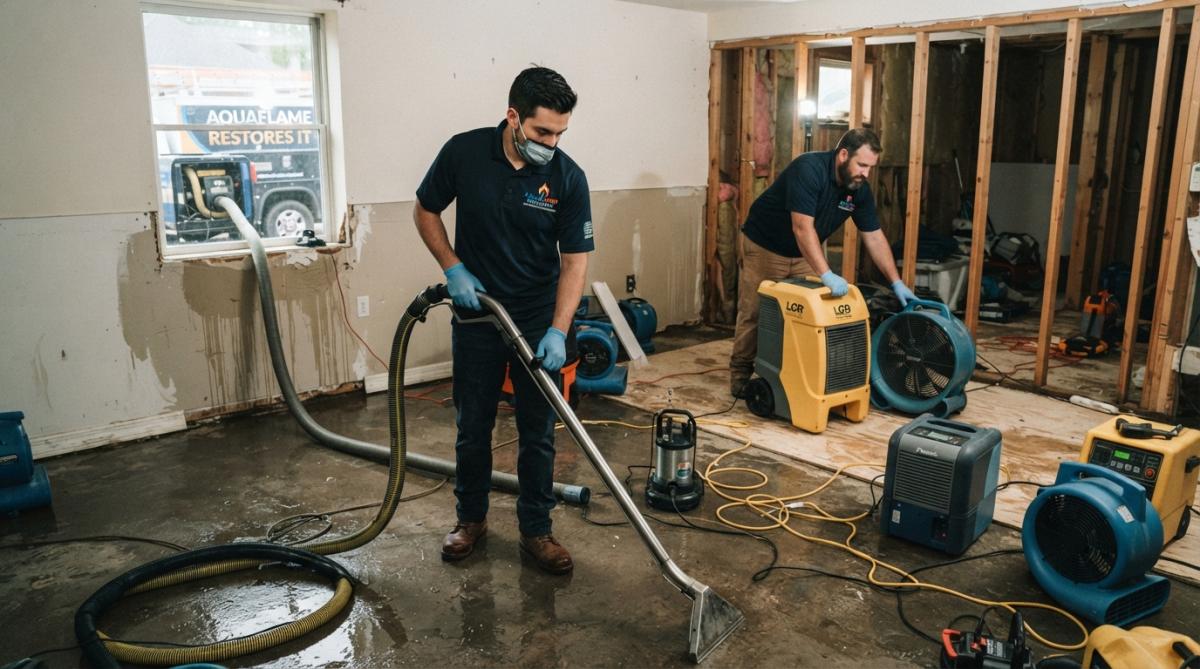
Together, dehumidifiers and air movers establish a drying cycle: air movers push moisture out of materials, dehumidifiers capture it from the air, and the cycle repeats continuously. Aquaflame Restores it deploys multiple units based on affected square footage. A 500-square-foot flooded basement typically requires 4-6 dehumidifiers and 8-12 air movers operating in coordinated zones. Structural drying duration depends on initial saturation level, material types, ambient temperature and humidity, and HVAC system functionality. Carpet and padding dry fastest (3-5 days), drywall and wood framing require 7-14 days, and concrete subfloors can take 14-21 days.
Moisture Mapping and Thermal Imaging for Complete Drying
Moisture mapping uses specialized equipment to quantify exactly how much water remains in materials after extraction. Moisture meters measure saturation levels in wood, drywall, and concrete, while thermal imaging shows temperature differentials that indicate moisture presence, wet materials appear cooler than dry ones because evaporating water absorbs thermal energy.
Professional restoration technicians use both tools daily during the drying phase. Moisture readings guide decisions about equipment placement, intensity, and duration. Hygrometers monitor ambient humidity levels in affected spaces, ensuring dehumidifiers are functioning effectively. Target humidity is typically 40-50% relative humidity; above this level, mold begins forming on materials.
Stopping dehumidification too early is a common costly mistake. Materials may feel dry to the touch while still holding dangerous moisture levels internally. Premature equipment removal leads to mold growth weeks later, requiring expensive remediation and material replacement.
| Drying Phase | Target Duration | Moisture Target | Equipment |
|---|---|---|---|
| Initial extraction | 24 hours | Remove standing water | Pumps, extractors |
| Structural drying | 5-14 days | Below 15-20% | Dehumidifiers, air movers |
| Final verification | 1-3 days | Below 12% in all materials | Moisture meters, thermal imaging |
Mold Remediation After Flood: Prevention and Root Cause Identification
Mold is the invisible secondary threat that makes flood removal complex. When flooding creates moisture conditions above 50% humidity, mold colonies establish within 24-72 hours. By day seven, mold can penetrate deep into wood framing and drywall, becoming nearly impossible to fully eliminate without material replacement.
Why Mold Returns: Common Mistakes in Flood Cleanup
The single most common mistake is treating mold as a surface problem. Homeowners spray disinfectant on visible mold and assume it’s gone. Weeks later, mold returns, often worse than before, because the root cause was never addressed.
Mold returns when moisture remains. If structural drying is incomplete, humidity stays elevated and mold colonies re-establish. If water-damaged materials like drywall or carpet aren’t removed, mold grows inside them where spray disinfectants can’t reach. Professional mold remediation addresses all three root causes: aggressive structural drying verified with moisture mapping, removal of contaminated materials that can’t be dried below mold-growth thresholds, and professional HVAC cleaning and sealing to prevent spore circulation.
Decontamination and Sanitization Standards
Professional decontamination uses EPA-approved disinfectants and follows IICRC guidelines for mold remediation. The process begins after structural drying is verified, as applying disinfectant before drying is incomplete is counterproductive.
Decontamination involves three steps: applying EPA-approved antimicrobial treatments to all affected surfaces including hidden areas; using HEPA-filtered air scrubbers to capture airborne mold spores; and performing post-remediation verification using air quality testing to confirm mold levels have returned to normal background levels.
Category 3 water contamination (sewage and biohazard water) requires additional decontamination protocols. All materials contacted by sewage must be removed and disposed of according to EPA regulations. Surfaces are disinfected with hospital-grade antimicrobials, and HVAC systems are completely purged and replaced if contaminated.
Mold remediation without addressing moisture is like treating a symptom while ignoring the disease. Professional restoration eliminates both the mold and the conditions that allowed it to grow, preventing recurrence.
DIY vs. Professional Flood Removal: When to Call the Experts
Not every water event requires professional intervention. A small pipe burst in a bathroom with water contained to one room might be manageable with DIY extraction and drying. But most residential flooding requires professional response.
What You Can Handle Yourself
Small, isolated water events with clean water sources are candidates for DIY response. Examples include a burst bathroom supply line where water is contained to tile and vinyl flooring, or a minor roof leak affecting a single drywall section before it spreads.
For these situations, stop the water source immediately, extract standing water using available equipment, and dry the area aggressively using fans and open windows. Monitor moisture levels daily using a basic moisture meter. If materials stay below 15% moisture content and dry within 3-5 days, you’ve likely prevented secondary damage.
However, this DIY threshold is narrow. The moment water involves carpet, drywall, insulation, or structural materials like wood subfloors, professional involvement becomes cost-effective. Incomplete drying of these materials leads to mold, structural decay, and replacement costs that dwarf professional restoration fees.
When Professional Water Damage Restoration Is Essential
Professional flood removal becomes essential when water affects more than one room, involves carpet or drywall, the water source is unclear or ongoing, involves sewage or contamination, or structural materials are saturated.
Basement flooding always requires professional response due to poor ventilation and moisture retention. Crawlspace flooding requires professional extraction and drying because these spaces are inaccessible for proper equipment placement and monitoring. Attic flooding requires professional response because water often saturates insulation and roof framing, creating hidden mold risk and structural compromise.
The cost of professional flood removal typically ranges from a few hundred dollars for small incidents to several thousand for whole-home flooding. This investment prevents far costlier alternatives: DIY drying that fails, leading to mold remediation ($2,000-$10,000), structural repairs ($5,000-$50,000), and potential health issues.
Call a professional immediately if you’re unsure. A 30-minute assessment costs far less than replacing water-damaged flooring, drywall, or structural framing weeks later.
Cost of Flood Removal and Insurance Claim Documentation
The cost of flood removal depends on affected square footage, water category, materials involved, and timeline. For current pricing and specific estimates, contact Aquaflame Restores it directly for a consultation.
What Affects Flood Removal Pricing
Affected area size is the primary driver. Water category matters enormously: clean water (burst pipes) costs less than gray water (appliance overflow), which costs less than category 3 water (sewage). Materials affected determine replacement costs. Immediate professional response often prevents material replacement, reducing overall expenses.
Insurance Claims Support and Direct Billing
Aquaflame Restores it manages direct insurance billing, coordinating with your insurance adjuster, submitting documentation, and billing the insurance company directly. This eliminates the common nightmare scenario where homeowners pay out-of-pocket and then fight with insurance for reimbursement.
Our process begins with comprehensive damage documentation: photos, moisture readings, affected material lists, and remediation protocols submitted to your insurance company immediately. We coordinate with adjusters and provide the professional assessment they require to approve claims. Documentation includes decontamination certificates, moisture mapping reports, and verification that remediation met IICRC standards, protecting you by proving restoration was professional and complete.
Post-Flood Health Hazards and Long-Term Structural Integrity
Flood removal isn’t complete when water is extracted and materials are dry. Health hazards persist if contamination wasn’t properly addressed, and structural integrity requires ongoing monitoring.
Category 3 Water Contamination and Safety Risks
Category 3 water, sewage, floodwater from rivers or storm drains, and other contaminated sources, poses serious health risks. This water contains pathogenic bacteria (E. coli, Salmonella), viruses (hepatitis A, norovirus), and parasites that cause infections and gastrointestinal illness.
All materials contacted by sewage must be removed and disposed of according to EPA regulations. Surfaces must be disinfected with hospital-grade antimicrobials. Residents should not return to contaminated areas until professional decontamination is verified complete. Aquaflame Restores it’s IICRC-trained team follows strict protocols for sewage handling, including proper PPE, containment, disinfection, and disposal.
Structural Inspections and Ongoing Monitoring
After flood removal is complete, structural inspection verifies that materials are dry, mold-free, and structurally sound. This inspection typically occurs 7-14 days after drying is complete. Inspectors check wood framing for rot, drywall for mold growth, and concrete for structural cracks or displacement.
Long-term monitoring continues for weeks after professional restoration. Moisture levels are checked periodically to confirm they remain stable. If readings begin climbing again, it indicates secondary moisture sources are reactivating saturation. Aquaflame Restores it provides post-restoration follow-up at 7 days, 14 days, and 30 days after drying is complete, catching problems early and providing documentation proving restoration was thorough and effective.
Flooding creates urgency, but it also creates opportunity for mistakes that compound into far larger problems. Professional flood removal isn’t optional for most residential flooding, it’s the cost-effective way to prevent structural decay, mold, and health hazards that DIY approaches inevitably miss.
Aquaflame Restores it provides 24/7 emergency water removal across metro Atlanta with a 30-minute arrival guarantee. Our IICRC-trained technicians handle everything from initial extraction through final structural inspection, managing your insurance claim directly. When flooding strikes, call Aquaflame Restores it immediately, the first hours determine whether restoration is straightforward or catastrophic.
Frequently Asked Questions
How quickly should flood water be removed from my home?
Flood removal should begin within the first 24-48 hours to prevent mold growth, structural damage, and category 3 water contamination. The longer water sits, the more damage occurs to subfloors, drywall, and insulation. Professional water damage restoration teams offer 24/7 emergency response to minimize these risks. Immediate water extraction and structural drying prevent costly long-term repairs and health hazards.
What equipment is needed for proper water extraction and flood removal?
Professional flood removal requires industrial-grade dehumidifiers, air movers, submersible pumps, and moisture-detection tools like hygrometers and thermal imaging cameras. These enable precise water extraction, structural drying, and moisture mapping to reach hidden water in subfloors and wall cavities. IICRC-certified restoration technicians use this professional restoration equipment to ensure complete drying and prevent mold remediation issues down the road.
Can I clean up flood damage myself, or should I hire professionals?
Small water damage from clean sources (burst pipes) may be DIY-manageable with proper equipment. However, category 3 water (sewage, contaminated floodwater) requires professional decontamination and sanitization. Professionals also identify hidden moisture in subfloors and wall cavities that DIY efforts miss, preventing mold from returning. If your flood removal involves structural drying, mold risk, or insurance claims, professional water damage restoration is essential for safety and coverage.
Does homeowner's insurance cover flood removal and water damage restoration?
Standard homeowner's insurance typically covers water damage from burst pipes or roof leaks, but NOT flooding from external water sources. However, many restoration companies provide direct insurance billing and handle flood damage assessment documentation to maximize your coverage. They'll work with your adjuster, manage claims paperwork, and ensure proper documentation for mold remediation and structural repairs. Always review your policy and ask about insurance claims support before hiring.
How do I prevent mold after flood removal?
Mold prevention starts with rapid water extraction and complete structural drying within 24-48 hours. Professionals use dehumidification, air movers, and moisture mapping to eliminate hidden moisture in subfloors and wall cavities, the root cause of mold return. Proper sanitization and decontamination of affected areas, combined with ongoing moisture monitoring, prevent mold remediation failures. Many homeowners face recurring mold because initial drying was incomplete; professional techniques ensure this doesn't happen.
This article was written using GrandRanker