Table of Contents
- What Is Mold Remediation and Why It Matters in Decatur GA
- Signs of Mold Infestation in Your Decatur Home
- Mold Inspection and Testing in Decatur GA
- Black Mold Removal in Decatur GA: Process and Safety
- Water Damage Restoration in Decatur GA and Mold Prevention
- Mold Prevention Tips for Decatur GA Properties
- DIY vs. Professional Mold Remediation: When to Call an Expert
- Post-Remediation Verification and Insurance Claims in Decatur
Mold Remediation in Decatur GA: Complete Guide
Last Updated: July 20, 2026
When homeowners in Decatur discover mold, the instinct is often panic. But mold remediation doesn’t have to be overwhelming when you understand what you’re dealing with. At Aquaflame Restores it, we’ve helped hundreds of families address mold problems before they escalate into costly structural damage or health concerns. This guide walks you through identifying mold, understanding professional remediation, and protecting your property going forward.
Mold thrives in Georgia’s humid climate. Many Decatur homeowners face moisture-related issues they don’t immediately recognize, and by the time symptoms appear, the problem has often spread beyond what’s visible. Below, we’ll show you how to identify mold infestation, when to call professionals, and what to expect from complete remediation.
What Is Mold Remediation and Why It Matters in Decatur GA
Mold remediation is the comprehensive process of identifying, containing, removing, and preventing fungal growth in your home. It’s not simply cleaning visible mold, it’s addressing the underlying moisture problem that allowed mold to develop in the first place. In Decatur’s humid subtropical climate, this distinction matters enormously.
Many people confuse mold remediation with basic mold removal. A contractor might spray bleach on visible mold and call it done. True mold remediation addresses root causes: water intrusion, inadequate ventilation, condensation buildup, or structural moisture trapped in walls and crawl spaces. Without fixing these underlying issues, mold returns within weeks or months.
The stakes are significant. Untreated mold damages property value, compromises indoor air quality, and creates health risks for residents. Insurance companies increasingly require professional remediation documentation before covering related claims.
True mold remediation isn’t about appearance, it’s about eliminating moisture sources and preventing recurrence.
Professional mold remediation follows protocols established by the Institute of Inspection, Cleaning and Restoration Certification (IICRC). These standards ensure thorough, documented remediation meeting industry best practices. Certified professionals understand containment, air quality testing, and verification procedures.
Signs of Mold Infestation in Your Decatur Home
Visual indicators and musty odors
The first sign most homeowners notice is a musty odor, that distinctive earthy smell signaling microbial growth. This smell often appears before visible mold becomes apparent, making it a valuable early warning system. If you detect this odor in your basement, crawl space, or HVAC system, investigation is warranted immediately.
Visual signs vary depending on mold type and location. Black mold appears as dark, slimy patches. Other fungal growth appears white, green, or orange. Mold commonly grows on bathroom tile grout, basement walls, crawl space joists, HVAC ducts, drywall around windows and doors, and under kitchen sinks.
The challenge with mold detection is that significant colonies often hide in walls, behind baseboards, or deep within crawl spaces where they’re invisible. Air quality testing reveals mold spore concentrations even when visible growth isn’t apparent.
Health symptoms linked to mold exposure
Mold exposure affects people differently depending on sensitivity and exposure duration. Common symptoms include persistent coughing, wheezing, nasal congestion, and sinus infections that don’t respond to typical treatment. People with asthma often experience increased attacks in moldy environments. Immunocompromised individuals face more serious risks.
Children and elderly residents are particularly vulnerable. Prolonged mold exposure can trigger respiratory infections, allergic reactions, and in severe cases, systemic fungal infections. The insidious aspect is that mold-related health issues resemble common illnesses, a persistent cough might be attributed to allergies when the actual cause is mold in the HVAC system or crawl space.
If family members develop respiratory symptoms that improve when away from home and worsen upon return, mold exposure should be investigated immediately. Delayed remediation can cause permanent respiratory damage.
Mold Inspection and Testing in Decatur GA
Air quality testing and mold spore assessment
Professional mold inspection goes far beyond visual assessment. Certified inspectors use air quality testing equipment to measure mold spore concentrations and identify species present. This testing reveals hidden mold in walls, HVAC systems, and crawl spaces that visual inspection alone cannot detect.
Air quality testing involves collecting samples from multiple locations: the suspected problem area, unaffected areas of the home, and outdoor baseline samples. A lab analyzes these samples to identify mold species, spore counts, and concentration levels. Results are compared against baseline outdoor levels; if indoor concentrations exceed outdoor levels, remediation is warranted.
Mold spore assessment determines which species are present. Some molds are relatively benign; others like Stachybotrys (toxic mold) and Aspergillus require more aggressive remediation protocols. Species identification guides remediation strategy and helps predict which health effects residents might experience.
Professional mold inspection provides critical documentation essential if you’re selling the property, filing insurance claims, or pursuing legal action against previous owners who failed to disclose mold problems.
Black Mold Removal in Decatur GA: Process and Safety
Professional remediation protocol and containment
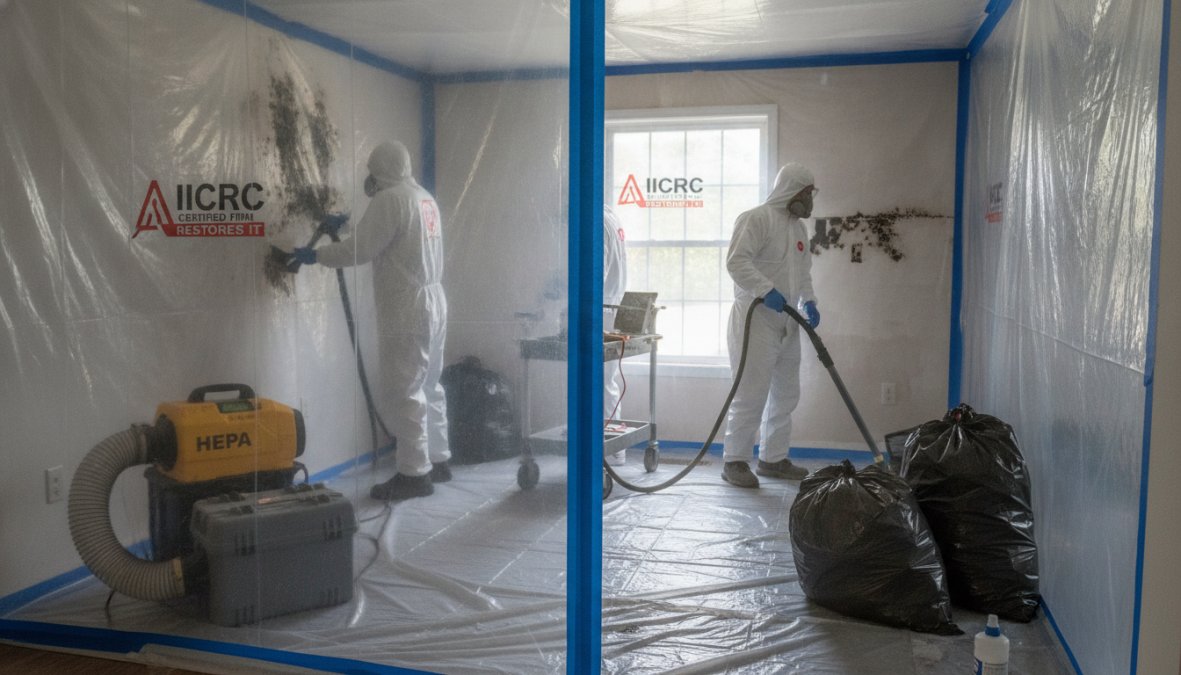
Black mold removal requires strict containment procedures to prevent spore dispersal throughout the home. Professional remediation uses negative pressure containment, creating isolated work areas where air pressure is lower than surrounding spaces, preventing mold spores from migrating to unaffected areas.
The containment process involves sealing the affected area with plastic sheeting and duct tape, installing negative air pressure units that exhaust filtered air outside, creating airlocks at entry points to prevent cross-contamination, and using HEPA-filtered vacuums exclusively within the containment zone.
This containment is non-negotiable when removing black mold. Without it, remediation efforts actually spread contamination throughout the home. Once containment is established, remediation specialists remove affected materials. Porous materials like drywall, insulation, and subflooring contaminated with black mold are typically removed and replaced. Non-porous materials are cleaned with specialized antifungal solutions.
HEPA filtration and microbial control
HEPA (High-Efficiency Particulate Air) filtration is central to safe mold remediation. HEPA filters capture 99.97% of particles 0.3 microns and larger, small enough to catch individual mold spores. Professional remediation equipment uses HEPA filtration in negative air pressure units, portable air scrubbers, vacuums, and respiratory protection equipment.
The HVAC system requires special attention during mold remediation. If mold has colonized ductwork or the air handler, the entire system must be professionally cleaned and treated. Many mold recurrence problems stem from inadequate HVAC cleaning; spores remain in ducts and recontaminate the home after remediation.
Microbial control extends beyond mold removal to include dehumidification and moisture management. After contaminated materials are removed and surfaces cleaned, the affected area must be dried thoroughly and kept dry going forward.
Professional remediation includes post-remediation verification (PRV) testing to confirm mold levels have returned to normal. This documentation protects you when selling the property or filing insurance claims.
Water Damage Restoration in Decatur GA and Mold Prevention
Structural drying and moisture control
Water damage and mold are inextricably linked in Decatur’s climate. Any water intrusion, whether from burst pipes, roof leaks, foundation cracks, or flooding, creates an ideal environment for mold growth within 24-48 hours. Rapid water extraction and structural drying are critical mold prevention strategies.
Professional water damage restoration involves multiple stages. First, standing water is extracted using submersible pumps and wet vacuums. Next, affected materials are removed if saturation is severe; wet drywall, insulation, and subflooring cannot be adequately dried and often harbor hidden mold even after apparent drying.
Structural drying uses commercial-grade dehumidifiers and air movers to remove moisture from remaining materials and the air itself. This process typically takes 3-7 days depending on saturation level and material types. Moisture meters verify that wood, concrete, and other materials have returned to normal moisture levels before restoration work begins.
Dehumidification and crawl space remediation
Crawl spaces are particularly vulnerable to mold in Decatur. These below-grade areas accumulate moisture from groundwater seepage, condensation, and inadequate ventilation. Mold in crawl spaces spreads upward through rim joists into the home’s main structure, contaminating insulation and creating widespread indoor air quality problems.
Effective crawl space remediation involves encapsulation, sealing the crawl space with vapor barriers and installing a dehumidification system. This prevents ground moisture from entering the space, keeping humidity levels below the 50-60% threshold where mold thrives. Whole-house dehumidifiers work alongside HVAC systems to extract excess moisture from the air.
The investment in dehumidification and crawl space encapsulation prevents mold recurrence and protects property value.
Mold Prevention Tips for Decatur GA Properties
Prevention is dramatically more cost-effective than remediation. Implement these moisture control strategies:
Monitor humidity levels. Keep indoor humidity between 30-50% year-round using humidity meters and dehumidifiers during humid months.
Ensure proper ventilation. Bathrooms should have exhaust fans vented outside. Kitchen exhaust hoods must vent externally. Attics need adequate soffit and ridge ventilation.
Address water intrusion immediately. Repair roof leaks, seal foundation cracks, and maintain gutters and downspouts. Direct water away from the foundation.
Insulate cold surfaces. Proper insulation on pipes, air conditioning ducts, and windows prevents surface condensation that fuels mold growth.
Maintain HVAC systems. Change filters regularly, have ducts professionally cleaned annually, and ensure condensation lines drain properly.
Improve drainage around the foundation. Ensure grading slopes away from the house and downspouts extend at least 4-6 feet from the foundation.
Use mold-resistant materials. When renovating bathrooms or basements, choose mold-resistant drywall, paint, and insulation.
DIY vs. Professional Mold Remediation: When to Call an Expert
Small surface mold, less than 10 square feet on non-porous surfaces, can sometimes be cleaned with proper precautions: use a HEPA-filtered vacuum, wear an N95 respirator, and clean with diluted bleach solution or commercial mold cleaner.
However, several situations demand professional intervention:
Mold extent exceeds 10 square feet. EPA guidelines recommend professional remediation for larger areas.
Mold has contaminated porous materials. Drywall, insulation, and subflooring cannot be adequately cleaned; they must be removed and replaced.
Black mold is present. Stachybotrys and other highly toxic molds require professional containment and removal.
Mold is in HVAC systems, crawl spaces, or walls. Hidden mold requires professional inspection and specialized equipment.
You have respiratory conditions or compromised immunity. Professional remediation protects your health.
The property is being sold or refinanced. Lenders require professional remediation documentation.
A failed DIY remediation that spreads mold throughout the home becomes exponentially more expensive to fix professionally. Professional mold remediation, while an upfront investment, prevents costly mistakes and ensures thorough, documented remediation.
Improper mold removal can spread spores throughout your home’s HVAC system, making the problem dramatically worse. When in doubt, hire professionals with IICRC certification and proper containment equipment.
Post-Remediation Verification and Insurance Claims in Decatur
Clearance documentation and lender requirements
After mold remediation is complete, professional verification testing confirms that mold levels have returned to normal. Post-remediation verification (PRV) involves air quality testing similar to initial inspection, comparing treated areas against baseline outdoor levels. Results must show indoor mold concentrations at or below outdoor baseline levels.
This clearance documentation is essential for selling the property, refinancing, and processing insurance claims. If you’re selling, buyers’ lenders typically require PRV documentation before approving financing. Without PRV documentation, you have no proof that remediation was successful.
Direct insurance billing and coverage guidance
Insurance coverage for mold remediation varies depending on the cause and your specific policy. Mold resulting from sudden, accidental water damage (burst pipes, roof leaks) is typically covered. Mold from chronic moisture problems (poor drainage, condensation) is usually excluded.
Professional remediation companies familiar with insurance claims can navigate this complexity. They handle direct insurance billing, managing the claims process on your behalf. When filing a claim, documentation is critical: professional inspection reports, photos of affected areas, and remediation invoices support your claim.
Most policies require that you report water damage immediately; delaying notification can result in coverage denial. Professional mold remediation companies typically have established relationships with major insurance carriers and understand coverage limits, deductibles, and documentation requirements.
Mold problems in Decatur don’t resolve themselves, they worsen with time and humidity. Whether you’re dealing with visible black mold, mysterious musty odors, or water damage that might lead to mold growth, professional assessment and remediation protect your health and property value. Aquaflame Restores it provides IICRC-certified mold remediation with 24/7 emergency response, direct insurance billing, and post-remediation verification documentation. Their locally-owned team arrives within 30 minutes and handles everything from initial inspection through structural restoration. Contact them today for a free assessment of your mold concerns.
Frequently Asked Questions
What is the mold remediation process, and how long does it take?
Professional mold remediation begins with a thorough mold inspection and air quality testing to identify contamination. Once assessed, technicians establish containment, remove affected materials, apply HEPA filtration, and treat surfaces with sanitization. Structural drying and dehumidification follow to eliminate moisture. The timeline depends on the extent of damage, minor cases may take days, while extensive water damage restoration can take weeks. Post-remediation verification ensures clearance before your home is safe for occupancy.
How much does mold remediation cost in Decatur, GA?
Mold remediation pricing depends on the scope of inspection findings, affected area size, contamination severity, and whether water damage restoration is needed. Crawl space remediation, basement mold removal, and black mold treatment all carry different costs. Rather than estimate, we recommend requesting a free assessment from a licensed professional. Many insurance policies cover remediation if water damage triggered the fungal growth, direct insurance billing can offset your out-of-pocket costs significantly.
Does homeowner's insurance cover mold remediation in Georgia?
Coverage depends on the cause. If mold results from sudden water damage (burst pipes, storm flooding), most policies cover remediation. If mold developed from gradual moisture or neglect, coverage is typically denied. Georgia homeowners should review their policy and contact their adjuster before hiring. Professional remediation companies handle direct insurance billing and provide the clearance documentation and post-remediation verification reports that lenders require, simplifying the claims process.
What makes professional mold remediation different from DIY cleanup?
DIY cleanup works only for small, non-toxic surface mold (under 10 square feet). Larger infestations, black mold, or mold linked to water damage require IICRC-certified professionals with containment protocols, HEPA filtration, and structural drying equipment. Professionals identify root causes, moisture control failures, crawl space ventilation, HVAC contamination, preventing recurrence. They also provide post-remediation verification and clearance documentation needed for insurance claims and property sales in Decatur and metro Atlanta.
This article was written using GrandRanker