Last Updated: November 5, 2026
Quick Summary
To remove mold from inside walls, first find and fix the moisture source, then open the wall inside a sealed work zone with a HEPA scrubber running. Clean only sound, nonporous materials with vinegar, hydrogen peroxide, or mild detergent, discard porous materials, and dry the cavity until moisture readings confirm it stays dry.
- A musty odor that strengthens when the A/C runs is a clue, not proof, so confirm with a moisture meter.
- Seal the doorway with plastic sheeting and wear an N95 respirator, goggles, and gloves before cutting.
- Bleach kills surface mold but does not reach roots in drywall paper and leaves water behind.
- Stop and call a professional if growth covers more than about 10 square feet or sits hidden behind the wall.
- Verify drying with meter readings on days 1, 3, 7, and 14, using the same meter in the same spots.
Table of Contents
- How to Detect Mold Inside Walls Before You Cut Anything
- Can Mold Inside Walls Make You Sick?
- Mold Cleanup After Water Damage: Find and Fix the Source First
- How to Open a Wall Safely and Contain the Mess
- How to Remove Mold From Walls Without Bleach
- Dry the Wall Cavity and Verify It Stays Dry
- DIY or Call a Pro? A Decision Tree for Metro Atlanta Owners
- Get a Free Mold Assessment From Aquaflame Restores It
- Frequently Asked Questions
How to Detect Mold Inside Walls Before You Cut Anything
Learning how to remove mold from inside walls starts long before you pick up a knife.
Here is what to look for:
- A musty, earthy odor that gets stronger when the A/C runs
- Bubbling, peeling, or soft paint on a wall
- Brown or gray rings near baseboards and window trim
Georgia humidity and summer storms can push moisture into wall cavities, and older homes with crawl spaces can hold it there.
A cheap moisture meter confirms your hunch.
For a deeper walkthrough of the visual clues, see this guide to signs of mold behind drywall.
Can Mold Inside Walls Make You Sick?
Mold inside walls can cause health effects in sensitive people. Common complaints include coughing, sneezing, itchy eyes, and skin irritation.
The EPA guide to mold and indoor air quality notes that mold grows wherever moisture lingers.
Not everyone reacts the same way. Some people live with hidden mold for months and feel fine.
That said, don’t ignore a musty smell in a bedroom or a child’s room.
Mold Cleanup After Water Damage: Find and Fix the Source First
Mold cleanup after water damage fails when the water source is still active. Mold spores need moisture to grow.
Common sources in metro Atlanta homes:
- A slow supply line leak under a sink
- Condensation on cold pipes during humid months
- A failed washing machine hose
Find the leak before you touch the mold. Otherwise it returns within weeks. Small leaks can sit behind a wall for months before anyone notices.
If mold keeps coming back after cleanup, the moisture source was never fixed. This explanation of why mold keeps returning covers how to track down the hidden leak behind it.
How to Open a Wall Safely and Contain the Mess
Opening a wall spreads spores if you skip containment. Do it wrong and you contaminate the whole room. Do it right and the mess stays inside a small work zone.
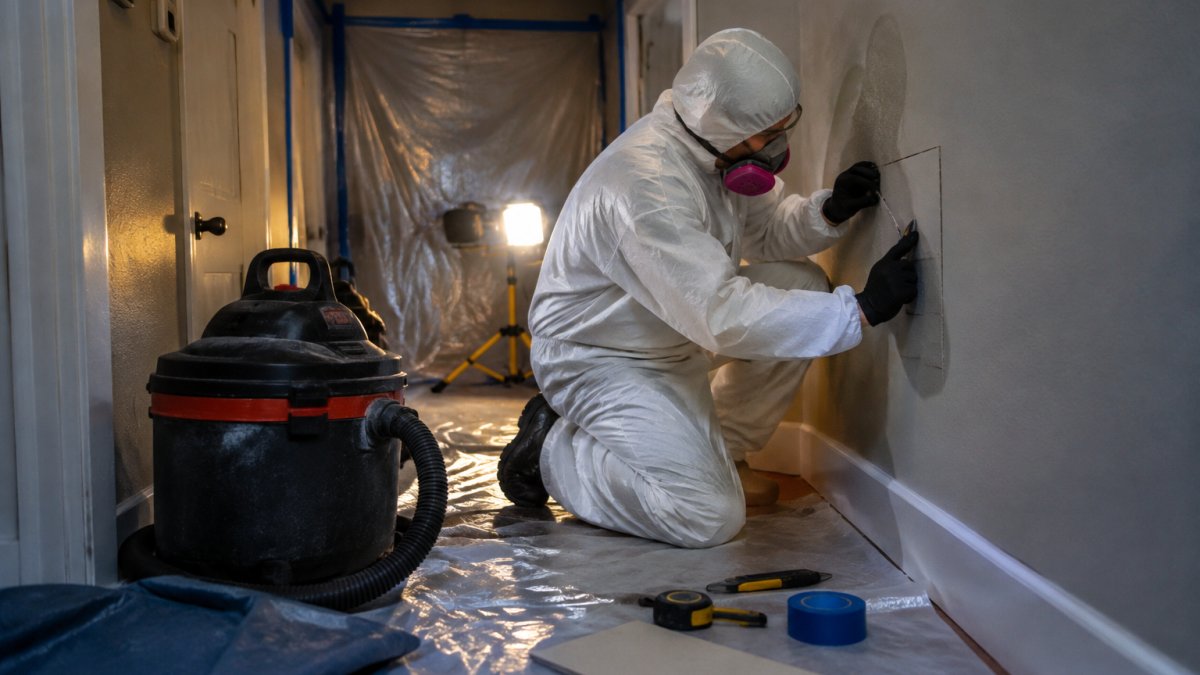
Follow these steps:
- Seal the doorway with plastic sheeting and tape.
- Set up a HEPA vacuum or air scrubber inside the work area.
- Put on an N95 respirator, goggles, and gloves.
- Score a small square with a utility knife, roughly the size of a dinner plate.
- Peel the drywall back slowly and bag it immediately.
Start small. You can always widen the opening. Watch out: cutting a large hole before you know the extent of the growth spreads spores through the house and turns a small job into a full remediation.
If the growth covers more than about 10 square feet, stop and call a professional.
How to Remove Mold From Walls Without Bleach
You can remove mold from walls without bleach, and in most cases you should. Bleach kills surface mold on nonporous materials, but it does not reach roots inside drywall paper. It also leaves water behind, which feeds new growth. The bigger question is not which solution to use, it is whether the material in front of you can be cleaned at all.
Decide by material before you spray anything
Mold removal on walls comes down to porosity. Porous materials absorb moisture and spores into their structure, so surface cleaning only reaches what you can see. Hard, nonporous materials can be scrubbed and dried.
- Painted drywall with surface spotting only: cleanable if the paper facing is intact and the gypsum behind it is dry. Wipe with mild detergent and water, then dry quickly.
- Drywall with soft, crumbly, or stained paper: remove and discard. Once the paper facing is compromised, mold has grown into the material and cleaning will not reach it.
- Fiberglass batt insulation that is damp or discolored: remove and discard. Batts that stayed dry and show no growth can usually stay.
Cleaning solutions that work on hard surfaces
For the materials that can be cleaned, these are the common options:
- White vinegar: spray full strength, let it sit about 10 minutes, wipe.
- Hydrogen peroxide: apply to hard surfaces, wait, then scrub.
- Baking soda paste: good for light staining on painted walls.
Scrub hard, nonporous surfaces with a stiff brush. Work from the outer edge of the growth toward the center so you are not dragging spores across clean material.
Watch out: over-wetting a wall during cleaning is one of the most common ways a small cleanup turns into a larger problem. The moisture you add can feed growth inside the cavity you were trying to protect.
Bagging and disposing of removed materials
When material has to come out, handle it as contaminated waste:
- Mist the surface lightly before cutting to keep dust down.
- Cut in manageable sections and place each piece directly into a heavy-duty bag.
- Seal the bag before carrying it through the house.
- Double-bag materials that are wet or heavily contaminated.
- Carry bags out through the work zone, not through clean rooms.
- Check with your county’s waste guidelines for disposal of mold-contaminated building materials, DeKalb, Fulton, Cobb, and Gwinnett each publish their own rules for construction debris.
Wear protective equipment the whole time: gloves, goggles, and a respirator. Keep the work area sealed and keep the HVAC system off or isolated so spores are not pulled into the ductwork.
For a fuller safe-cleanup routine, follow this guide on how to clean up mold safely after water damage.
If the growth covers more than about 10 square feet, if it is hidden behind the wall surface, or if the material type is unclear, stop and call a professional. Material decisions made wrong at this stage are expensive to undo.
Dry the Wall Cavity and Verify It Stays Dry
Drying the wall cavity is the step most homeowners rush. If the framing stays damp, mold returns, often within a month. But drying is only half the job. The other half is proving the cavity is dry and that the moisture source is actually gone, not just dormant.
Diagnose the moisture before you dry
Two very different problems look the same on a wall, and they need different fixes:
- An active leak shows up as a moisture reading that climbs over hours or days, often after a fixture is used. Supply line leaks, drain leaks, and failed washing machine hoses behave this way.
- Condensation shows up as moisture on cold surfaces, pipes, exterior wall sheathing, and the back of drywall on north-facing walls, and tends to track with weather. Georgia humidity and summer storms make this pattern common in older DeKalb County homes with crawl spaces.
A moisture meter tells you where the reading is high. It does not tell you which problem you have. Compare readings over time: a leak trends upward, condensation tracks with temperature and humidity. If you cannot tell the difference, that is a signal to bring in a professional before you close the wall.
Dry the cavity properly
Open the cavity to air. Run fans and a dehumidifier for several days. Georgia humidity means you cannot rely on open windows alone, on a humid week, outside air can add moisture faster than fans remove it. Keep the work zone sealed from the rest of the house and keep the HVAC system isolated so you are not pulling damp air through the ductwork.
Verify with readings, not with touch
A wall that feels dry to the touch can still hold moisture in the framing. Verify with a moisture meter, and compare the affected area against a known-dry wall nearby. Record the readings so you can see the trend rather than guessing.
Here is a simple verification schedule:
| When | What to Check | What It Tells You |
|---|---|---|
| Day 1 | Framing moisture reading | Baseline after cleanup |
| Day 3 | Framing and drywall edges | Drying progress |
| Day 7 | Same spots, same meter | Whether moisture is returning |
| Day 14 | Wall surface and baseboards | Confirmed dry or still leaking |
Use the same meter in the same spots each time. Different meters and different spots give you numbers you cannot compare.
Confirm the source is fixed before you close the wall
A dry reading is not proof the problem is solved.
Watch out: closing a wall on a cavity that is dry but still has an active moisture source is the most common reason mold returns within weeks.
If you are documenting the job for a landlord, a sale, or an insurance claim, keep your readings and photos. Lenders and buyers often want proof the cavity was dried and verified, not just cleaned.
DIY or Call a Pro? A Decision Tree for Metro Atlanta Owners
Use this checklist before you start:
- Small patch, visible, under 10 square feet, dry source: DIY is reasonable.
- Hidden mold behind a wall or under flooring: call a professional.
- Sewage or floodwater involved: call a professional. This is Category 3 water and carries real health risk.
Landlords should treat any tenant mold complaint as urgent. Renters should report it in writing and keep a copy.
If you are selling a home and an inspector found mold, ask whoever performs the work what documentation they provide.
When the job is bigger than a small patch, our professional mold removal and remediation team handles assessment, containment, and clearance.
Get a Free Mold Assessment From Aquaflame Restores It
Hidden mold is a moisture problem first and a cleaning problem second. That is the whole argument of this guide.
Aquaflame Restores It is locally owned in Decatur and serves metro Atlanta, including DeKalb, Clayton, Cobb, and Henry counties. Our IICRC-certified technicians respond 24/7 and are on site within one hour.
Before you book, check whether mold removal is covered by insurance so you know what to expect from your claim.
Call 678-379-8000 for a free assessment.
Frequently Asked Questions
What kills mold instantly inside walls?
No product kills mold instantly in the sense of making it disappear. Spores die when a surface is cleaned and fully dried, but dead spores still trigger reactions until they are physically removed. The practical order is to stop the moisture, contain the area, scrub hard surfaces with detergent and water, and dry the cavity completely. Bleach is not recommended on porous materials like drywall because it does not reach the roots of growth. For anything larger than about 10 square feet or hidden behind finished walls, call a professional for assessment.
Can I kill mold without removing drywall?
Sometimes, if the growth is on the surface of the drywall paper and the board is still structurally sound and dry. Scrub with detergent and water, then dry the cavity thoroughly. If the mold has soaked into the paper, the back of the board, or the insulation, removal is the only reliable fix. Porous materials that stay damp keep feeding new growth. A moisture meter reading and a visual check after drying tell you whether the board can stay. When in doubt, remove and replace the affected section.
Can mold inside walls make you sick?
Mold exposure can cause allergy-like symptoms such as sneezing, coughing, itchy eyes, and skin irritation, and people with asthma may notice more frequent attacks. Reactions vary widely between people, and a musty odor or visible growth is a reason to act regardless of symptoms. If you suspect mold is affecting your health, talk to a doctor. Removing the moisture source and the growth is the practical step that reduces exposure. Hidden mold behind walls in Decatur and older metro Atlanta homes is common after slow leaks.
How do I know when to stop cleaning and call a professional?
Call a professional when the affected area is larger than about 10 square feet, when mold is hidden behind finished walls or under flooring, when the water came from a sewage backup, or when the same wall keeps growing mold after cleanup. A pro uses moisture meters and thermal imaging to find the source, contains the work area, removes contaminated materials, and documents the job for insurance. Aquaflame Restores It offers free assessments across metro Atlanta at 678-379-8000.
Mold behind a wall rarely stays put. The longer it sits, the more material it ruins and the higher the odds your claim gets complicated. Aquaflame Restores It offers 24/7 emergency response, IICRC-certified technicians, direct insurance billing, and free damage assessments across metro Atlanta. Get started with Aquaflame Restores It and get your wall dried, cleaned, and verified before the next storm season.
