Table of Contents
- 5 Best Tools for Water Damage Cleanup: Overview & Selection Criteria
- 1. Water Extraction Equipment: Industrial Extractors & Carpet Wands
- 2. Moisture Detection & Mapping: Professional Moisture Meters
- 3. Dehumidification Systems: LGR Dehumidifiers for Structural Drying
- 4. Air Moving & Drying Equipment: High-Velocity Air Movers
- Water Damage Restoration Process Steps: Using Tools in Sequence
- Water Damage Cleanup Safety Tips: PPE & Hazard Mitigation
- Professional vs DIY Restoration Tools: Rental vs Purchase Cost-Benefit Analysis
Last Updated: July 12, 2026
Water damage strikes fast, and the first 24 hours determine whether you’ll minimize loss or face structural failure, mold growth, and insurance complications. At Aquaflame Restores it, we’ve managed hundreds of water damage emergencies across metro Atlanta, and we’ve learned that having the right tools makes the difference between a $5,000 restoration and a $50,000 nightmare. This guide covers the 5 best tools for water damage cleanup that professionals use, why each one matters in sequence, and when to rent versus call in the experts.
5 Best Tools for Water Damage Cleanup: Overview & Selection Criteria
Effective water damage restoration requires matching the right equipment to each phase of the job. The 5 best tools address five critical functions: extraction, moisture detection, dehumidification, air movement, and safety. Research from the Institute of Inspection, Cleaning and Restoration Certification (IICRC) shows that water damage mitigation within the first 48 hours reduces secondary damage by up to 60%.
How We Evaluated These Tools
We selected these tools based on real-world restoration workflows, professional recommendations from IICRC-certified technicians, and proven effectiveness across residential and commercial water damage jobs.
1. Water Extraction Equipment: Industrial Extractors & Carpet Wands
Water extraction is your first line of defense. Industrial extractors remove large volumes of standing water, preventing it from soaking deeper into structural materials and creating conditions for mold growth.
The Dri-Eaz HVE3000 Vacuum Water Extractor is the professional standard for rapid water removal. Unlike a standard shop vac, this unit combines powerful suction with an automatic pump-out system, meaning it can run continuously without stopping to empty a tank. HEPA filtration improves air quality during extraction, important when water contains bacteria or mold spores.
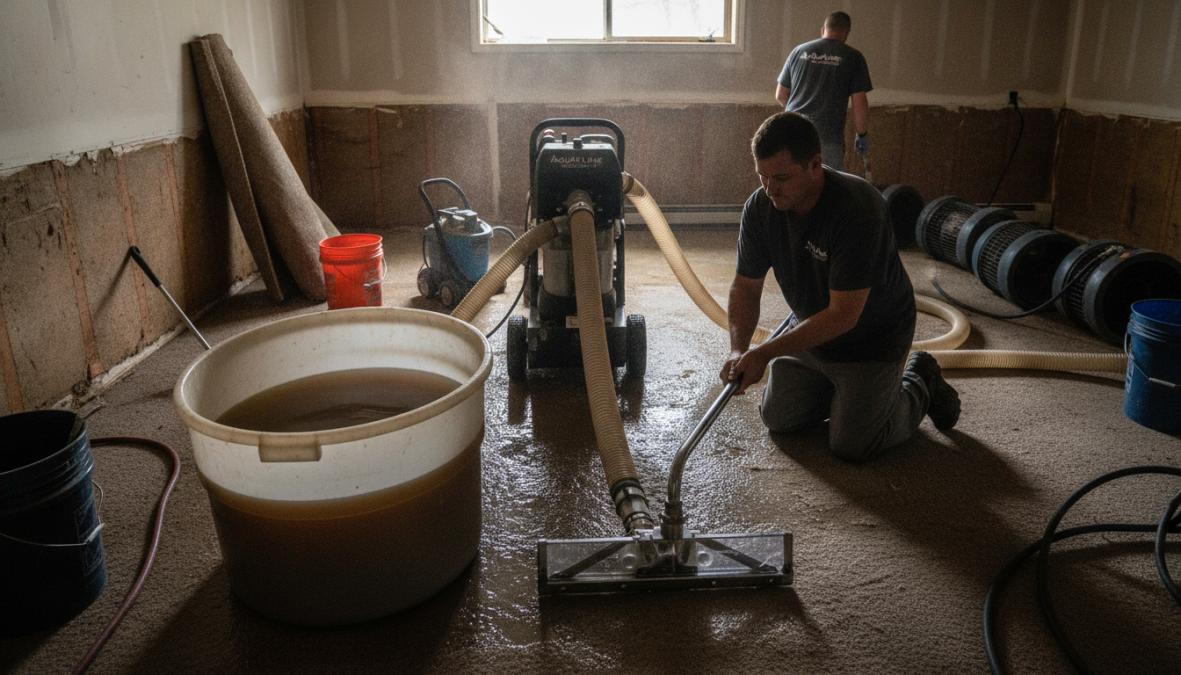
For carpet-specific extraction, carpet wands deliver precision. They spray a recovery solution while simultaneously pulling moisture back up, preventing re-wetting and speeding drying.
Start extraction from the highest point in the room and work downward. Water flows by gravity, so extracting upper areas first prevents re-contamination of already-dried zones. Most professionals make multiple passes over the same area, with each pass removing progressively less water as saturation decreases.
Water Extraction Vacuum vs Shop Vac: What’s the Difference?
A standard shop vac is designed to handle dry debris and occasional liquid spills. A professional water extraction vacuum is built for continuous wet operation.
| Feature | Shop Vac | Water Extraction Vacuum |
|---|---|---|
| Continuous wet operation | 15-30 minutes max | 8+ hours without stopping |
| Pump-out system | Manual (you empty it) | Automatic (runs indefinitely) |
| Solid/liquid separation | None (clogs easily) | Advanced (prevents blockages) |
| Air filtration | Basic | HEPA (removes mold spores) |
| Cost | $200-500 | $2,000-5,000 (rental: $75-150/day) |
For water damage affecting more than 100 square feet, a shop vac becomes a bottleneck. Professionals rent industrial extractors because the time savings justify the cost.
2. Moisture Detection & Mapping: Professional Moisture Meters
After extraction, water remains trapped inside walls, under flooring, and deep in structural materials. Moisture meters identify where to focus dehumidification efforts.
The Tramex Moisture Encounter ME5 is the professional choice because it offers non-destructive scanning without drilling holes or damaging finished surfaces. Its dual-depth penetration reads both surface moisture and moisture deep within materials. The ME5 uses Bluetooth to log readings and generate moisture maps, critical for insurance claims proving you addressed the entire affected area.
Pin-type moisture meters leave small holes in drywall and flooring that become entry points for mold if not sealed. For large-scale moisture mapping, use non-destructive meters. Reserve pin-type meters for spot-checking specific areas where you’re already planning repairs.
3. Dehumidification Systems: LGR Dehumidifiers for Structural Drying
Once you’ve extracted standing water and mapped moisture, you need to remove moisture from the air and pull it out of materials.
The Phoenix 250 MAX LGR (Low Grain Refrigerant) Dehumidifier is built for serious restoration jobs. LGR dehumidifiers extract moisture even in low-humidity environments, crucial because as materials dry, relative humidity drops, and standard dehumidifiers become ineffective. The integrated condensate pump allows continuous operation without manual tank emptying. Digital controls let you set target humidity levels (professionals aim for 30-40% relative humidity during drying).
A single LGR dehumidifier can handle a 2,000-3,000 square foot space. Larger areas require multiple units running in tandem.
Dehumidification is the longest phase of water damage restoration. While extraction takes hours and moisture mapping takes a day, drying typically requires 5-14 days depending on saturation and materials involved.
4. Air Moving & Drying Equipment: High-Velocity Air Movers
Dehumidifiers pull moisture from the air, but air movers accelerate evaporation from surfaces and materials. They work together: the dehumidifier captures the moisture the air mover releases.
The Dri-Eaz Velo Pro Air Mover is the industry standard because its patented snout design distributes air evenly across wide areas. Air movers operate in multiple positions: horizontal for floor drying, angled for wall drying, and vertical for ceiling drying. The daisy-chain capability lets you connect up to 10 units on a single circuit.
Most restoration jobs use 1 air mover per 300-400 square feet. Professionals arrange them in patterns that push moist air toward dehumidifiers, creating an efficient drying cycle.
Water Damage Restoration Process Steps: Using Tools in Sequence
The sequence matters because each phase prepares the space for the next.
Phase 1: Assessment & Extraction
Begin by documenting the damage with photos and video for insurance claims. Assess water category and affected area.
Category 1 water (clean water from broken pipes) requires basic extraction. Category 2 water (from appliances, toilet overflow) requires more aggressive extraction and sanitization. Category 3 water (sewage, floodwater) demands professional remediation due to contamination risks.
Deploy industrial extractors to remove standing water. Make multiple passes over saturated areas; the first pass removes 70% of water, the second removes most of the remainder. This phase typically takes 4-8 hours for residential spaces.
Phase 2: Moisture Mapping & Monitoring
After extraction, scan the entire affected area with a moisture meter. Check walls from the floor up to 4 feet high, as water wicks upward through materials. Check under flooring and behind baseboards. Document all readings with dates and times.
Repeat moisture mapping every 24 hours during drying. Readings should trend downward. If moisture levels plateau or increase, adjust dehumidification placement or add additional units.
Phase 3: Dehumidification & Air Movement
Deploy dehumidifiers and air movers simultaneously. Position dehumidifiers centrally in affected areas with doors closed to trap moisture. Position air movers to create airflow patterns that push moist air toward dehumidifiers.
Open interior doors to allow airflow between rooms, but close exterior doors and windows to prevent outdoor humidity from entering. Maintain target humidity at 30-40% relative humidity. Run equipment continuously; turning them off extends drying time significantly.
Water Damage Cleanup Safety Tips: PPE & Hazard Mitigation
Water damage cleanup exposes you to biological and chemical hazards. Proper safety gear is essential.
Essential Safety Gear for DIY Cleanup
Wear nitrile gloves rated for chemical resistance. Wear an N95 or P100 respirator to prevent mold spore inhalation. If water is visibly contaminated or Category 3, upgrade to a full-face respirator with appropriate cartridges. Wear eye protection, waterproof boots, long sleeves, and pants to minimize exposure.
Never mix bleach with other cleaning products during water damage cleanup. Bleach combined with ammonia produces toxic chlorine gas. Use bleach alone, diluted to 1 part bleach per 10 parts water, only on hard surfaces. For porous materials like drywall, professional mold remediation is safer than DIY chemical treatment.
Category 3 Water & Contamination Risks
Category 3 water includes sewage and floodwater containing bacteria and chemicals. If your water damage involves Category 3 water, stop immediately and call a professional. The health risks from exposure to pathogens like E. coli and hepatitis A aren’t worth DIY cleanup.
Professional vs DIY Restoration Tools: Rental vs Purchase Cost-Benefit Analysis
The decision to rent equipment, purchase equipment, or hire professionals depends on job size, water category, and your timeline.
When to Rent Equipment
Renting makes sense for one-time water damage events. Rental costs typically range from $75-150 per day for industrial extractors, $50-100 per day for dehumidifiers, and $30-50 per day for air movers. A typical residential restoration requiring 7 days of equipment rental costs $1,500-2,500 in equipment alone, plus your labor time and safety gear.
The advantage: you control the process and keep insurance payouts. The disadvantage: you’re responsible if something goes wrong. If you miss hidden moisture and mold develops, you’re liable for remediation costs.
When to Call a Professional
Professional restoration costs $3,000-8,000 for typical residential water damage. This includes assessment, extraction, dehumidification, monitoring, and documentation. At Aquaflame Restores it, our IICRC-trained technicians offer 24/7 emergency response with a 30-minute arrival guarantee across metro Atlanta. We handle direct insurance billing, meaning your insurance covers most costs.
Call professionals immediately if water is Category 2 or 3, the affected area exceeds 1,000 square feet, water has reached electrical panels or HVAC systems, or you lack time to monitor equipment for 5-14 days.
| Scenario | Best Approach | Estimated Cost | Timeline |
|---|---|---|---|
| Small clean-water spill (<200 sq ft) | DIY with rented equipment | $500-1,000 | 3-5 days |
| Moderate clean-water damage (200-1,000 sq ft) | DIY with rented equipment or professional | $1,500-4,000 | 5-10 days |
| Large clean-water damage (>1,000 sq ft) | Professional restoration | $4,000-8,000 | 7-14 days |
| Category 2 or 3 water (any size) | Professional restoration | $5,000-15,000+ | 10-21 days |
Water damage restoration success depends on speed, the right tools, and proper sequencing. The 5 best tools, extraction equipment, moisture meters, dehumidifiers, air movers, and safety gear, form a complete system. Each tool addresses a specific phase, and skipping any phase invites hidden moisture, mold growth, and structural failure.
Water damage doesn’t wait. If you’re facing water damage in metro Atlanta, Aquaflame Restores it provides IICRC-trained technicians, 24/7 emergency response, and direct insurance billing. Our team handles complete restoration from water extraction through structural drying and reconstruction.
Frequently Asked Questions
What are the essential tools needed for water damage cleanup?
The core tools for water damage cleanup include industrial extractors for removing standing water, moisture meters for detecting hidden moisture, dehumidifiers for structural drying, air movers to accelerate evaporation, and HEPA vacuums for final cleanup. Professional restoration also requires thermal imaging cameras, sump pumps for continuous water removal, and proper PPE. The specific combination depends on damage severity, affected area size, and whether you're handling mitigation yourself or hiring professionals like Aquaflame Restores It.
Is it safe to use a shop vac for water damage cleanup?
A standard shop vac is not ideal for professional water damage cleanup. Shop vacs lack the power and specialized filtration of industrial water extraction equipment, and using them on contaminated water (Category 3) poses health risks. Professional water extraction vacuums feature HEPA filtration, automatic pump-out systems, and solid-liquid separation designed for restoration work. For significant flooding, professional-grade equipment is safer and more effective. For minor spills, a shop vac may work, but industrial extractors are strongly recommended for thorough mitigation.
What's the difference between moisture meters and hygrometers in water damage restoration?
Moisture meters measure moisture content directly within building materials like drywall, wood, and concrete using pin or non-destructive scanning methods. Hygrometers measure relative humidity in the air. During water damage restoration, moisture meters are essential for mapping moisture patterns and confirming when materials have dried to safe levels. Hygrometers help monitor ambient humidity to ensure dehumidifiers are working effectively. Both tools are important: moisture meters track material recovery, while hygrometers guide drying strategy and equipment adjustments.
How long does structural drying typically take after water extraction?
Structural drying timelines vary based on damage extent, material types, and environmental conditions. Most residential water damage requires 3-7 days of continuous dehumidification and air movement, though larger jobs may take 2-3 weeks. Factors affecting duration include relative humidity levels, material porosity, water category (clean vs contaminated), and evaporation rates. Professional restoration teams use moisture meters to monitor progress and adjust equipment accordingly. Aquaflame Restores It's 24/7 emergency response and IICRC-trained technicians ensure optimal drying protocols to minimize restoration time.
Should I rent or buy water damage restoration equipment?
Renting is typically best for one-time residential water damage events, while purchasing makes sense for contractors or properties with recurring risk. Rental costs depend on quantity, dates, and delivery; contact Aquaflame Restores It or local equipment providers for current pricing. Professional-grade equipment like LGR dehumidifiers and industrial extractors is expensive to own but essential for effective mitigation. For most homeowners, hiring certified professionals with established equipment is more cost-effective than renting multiple tools and managing the restoration workflow independently.
This article was written using GrandRanker