Table of Contents
- Immediate Actions: What to Do After a House Fire
- Filing an Insurance Claim After a House Fire
- Securing Your Property and Preventing Further Damage
- Finding Temporary Housing After a House Fire
- Creating a House Fire Recovery Checklist and Salvaging Belongings
- Managing Restoration and Reconstruction After Fire Damage
- Tax Relief, Government Assistance, and Long-Term Recovery
- Conclusion: Moving Forward After Your House Fire
What to Do After a House Fire: A Step-by-Step Recovery Guide
Last Updated: July 27, 2026
Immediate Actions: What to Do After a House Fire
The first hours after a house fire are critical for your safety and property protection. At Aquaflame Restores it, we’ve guided hundreds of homeowners through this traumatic period, and the steps you take in the first 24 hours significantly impact your recovery timeline and insurance claim success. Your immediate priorities are personal safety, emergency response coordination, and preventing further damage.
Do not rush back inside to salvage belongings or assess damage. The structure may be unstable, hazardous materials may be present, and first responders need clear access to the property.
Ensure Safety and Evacuate
If you’re still in the home when fire breaks out, evacuation is your only priority. Get out immediately, stay low under smoke, use walls to guide yourself, and never hide. Once outside, move to your designated meeting point at least 300 feet from the structure.
Do not re-enter the home for any reason, not for pets, documents, or valuables. Smoke inhalation, structural collapse, and toxic gases pose life-threatening risks. Tell first responders immediately if pets remain inside so they can attempt rescue during controlled operations.
Check yourself and family members for burns, smoke inhalation symptoms, and injuries. Seek medical attention immediately if anyone is injured or experiencing difficulty breathing, as smoke inhalation can cause delayed respiratory issues.
Contact First Responders and Document the Scene
Call 911 immediately if you haven’t already. Provide your address, confirm all occupants are accounted for, and relay any information about people or animals that may still be in the home.
Once the fire department clears the scene and declares the structure safe for entry, document everything with your smartphone. Photograph and video the exterior damage, interior destruction, and specific items damaged, capturing both wide shots and close-ups. This documentation is essential for your insurance claim.
Filing an Insurance Claim After a House Fire
File your claim within 30 days of the loss, even if you don’t have complete documentation.
Contact Your Insurance Company Immediately
Call your insurance agent or the claims line on your policy within 24-48 hours of the fire. Provide your policy number, the fire’s date and time, and a brief description of what happened. Your insurer will assign a claims adjuster who will contact you to schedule a property inspection.
Be prepared to answer questions about the home’s age, construction, recent upgrades, and whether the home was occupied at the time of the fire. Have your policy documents available and ask your claims adjuster for their direct contact information and expected timeline for inspection and claim processing.
Request a copy of your policy’s coverage limits for dwelling, personal property, additional living expenses, and loss of use.
Prepare Proof of Loss and Inventory Documentation
Proof of loss is a formal document detailing what was damaged or destroyed, including the date of loss, cause of loss, description of damaged property, and estimated value of losses.
Create an inventory list organized by room, noting each item’s description, approximate age, condition before the fire, and estimated replacement cost. Include serial numbers for electronics and high-value items. Photos from before the fire strengthen your claim significantly.
For items destroyed in the fire, research replacement costs using current retail prices. Gather receipts, credit card statements, and warranty documentation for high-value items. If you lack original receipts, bank statements or photos of items in your home before the fire serve as supporting documentation.
Understand Deductibles, Actual Cash Value, and Replacement Cost
Your deductible is the amount you pay out of pocket before insurance coverage applies. Common deductibles are $500, $1,000, or $2,500.
Actual cash value (ACV) means your insurance pays the replacement cost minus depreciation. Replacement cost coverage pays what it actually costs to replace damaged items with new equivalents, with no depreciation deduction. Check your policy to see which you have.
Securing Your Property and Preventing Further Damage
After the fire is extinguished, your property faces new threats: weather exposure, theft, and secondary damage from smoke, soot, and water. Immediate mitigation, actions taken to prevent further loss, is both a moral obligation to your property and a requirement in many insurance policies.
Shut Off Utilities and Board Up Openings
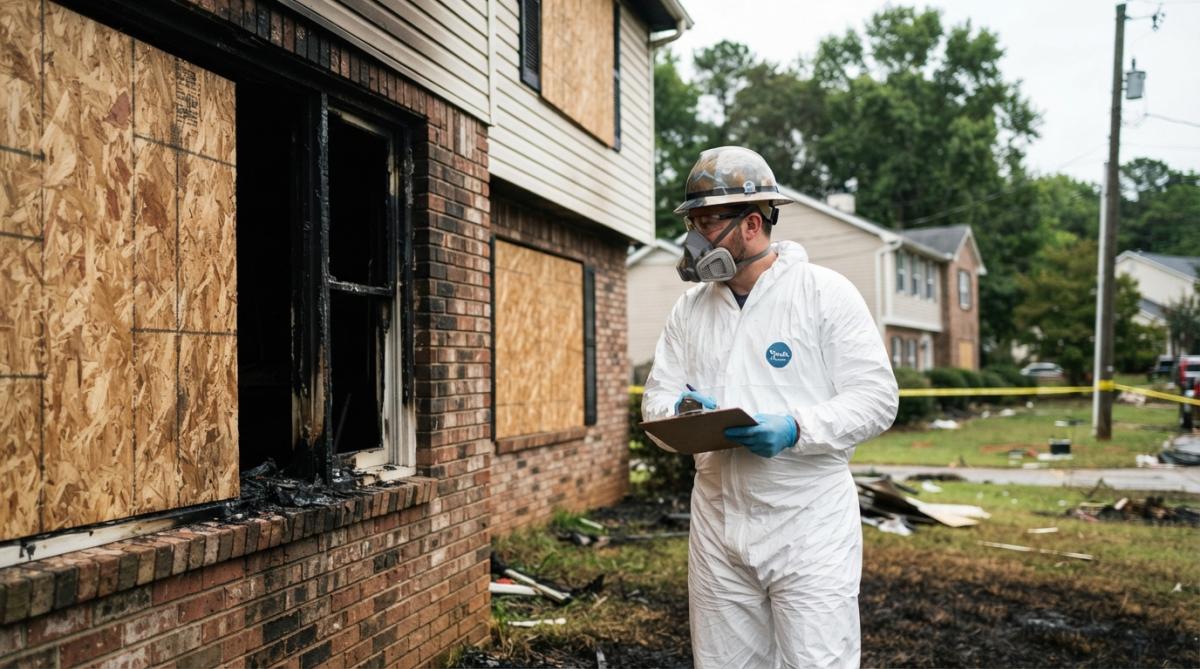
Before entering the damaged home, have the utility company shut off gas at the meter. A gas leak in a fire-damaged structure is an explosion hazard. Shut off electricity at the main breaker if it’s safe to do so; if you’re uncertain, ask the fire department or utility company to handle it.
Board up windows and doors to prevent weather exposure, unauthorized entry, and further property damage. Water intrusion through broken windows and open doors causes mold growth and structural deterioration. Use plywood sheets secured with bolts or heavy-duty fasteners and document the boarding process with photos showing the date.
Hire a Restoration Company for Mitigation Services
A professional restoration company handles mitigation more effectively than DIY efforts. They assess structural integrity, identify hazardous materials, remove water from the property, and begin the drying process. Aquaflame Restores it provides 24/7 emergency mitigation services with a 30-minute arrival guarantee across metro Atlanta.
Professional mitigation includes water extraction using industrial-grade equipment, dehumidification to prevent mold growth, and specialized cleaning of soot and smoke damage. These services prevent exponentially larger losses, and a restoration company’s involvement strengthens your insurance claim because insurers recognize professional mitigation as evidence of good-faith loss prevention.
Ask your restoration company if they handle direct insurance billing. This eliminates the burden of paying thousands upfront and waiting for reimbursement.
Finding Temporary Housing After a House Fire
Your home is uninhabitable after a significant fire. You need a place to stay immediately. Many homeowners don’t realize their insurance policy covers temporary housing costs.
Understand Your Coverage for Living Expenses
Most homeowners policies include additional living expenses (ALE) or loss of use coverage. This provision reimburses you for the reasonable cost of temporary housing, meals, and other necessary expenses while your home is being rebuilt. Coverage limits vary; typical policies provide $10,000 to $50,000 in ALE coverage.
ALE covers the difference between your normal housing costs and temporary housing costs. If you normally pay $1,500 monthly rent or mortgage and temporary housing costs $2,500 monthly, insurance covers the $1,000 difference. Keep all receipts for temporary housing, meals, and other fire-related expenses.
Contact your insurance company to confirm your ALE coverage limits and ask about approved temporary housing options.
Locate Pet-Friendly and Accessible Options
If you have pets, finding pet-friendly temporary housing becomes urgent. Many hotels and rental properties restrict pets or charge significant pet fees. Contact local hotels and ask specifically about their pet policies. Budget hotels and extended-stay properties are often more accommodating.
If you need accessibility accommodations, communicate this immediately to your insurance company and temporary housing providers. Reach out to local animal shelters, veterinary clinics, and pet rescue organizations, they often maintain lists of pet-friendly temporary housing.
Creating a House Fire Recovery Checklist and Salvaging Belongings
As the immediate crisis stabilizes, you shift focus to salvaging what you can and organizing the recovery process.
Salvaging Personal Belongings After Fire Damage
Not everything exposed to fire is destroyed. Items in less-damaged areas may be salvageable. However, salvage decisions require professional assessment. Smoke damage, soot, and heat damage aren’t always visible.
Hire a professional restoration company to assess salvageable contents. They determine what can be cleaned and restored versus what must be discarded. Create a prioritized salvage list: irreplaceable items (family photos, heirlooms, documents) first, then valuable items (jewelry, electronics, furniture), then standard household goods.
Document all salvaged items with photos before they’re packed and removed for cleaning or storage.
Digital Asset Recovery and Important Documents
Many critical documents and digital assets are stored in your home: birth certificates, marriage licenses, deeds, titles, insurance policies, tax returns, and financial records. Fire destroys paper documents instantly. Digital assets on computers, external hard drives, and phones may survive if they’re not directly exposed to fire.
If you have computers, external drives, or phones that survived the fire, don’t attempt recovery yourself. Professional data recovery specialists can often retrieve files from heat-damaged and water-damaged devices.
Immediately request replacement documents from issuing agencies: birth certificates from vital records offices, property deeds from the county recorder, tax returns from the IRS (Form 4506-C), and insurance policies from your agents. Scan and upload all recovered documents to a cloud storage service to create a backup.
Managing Restoration and Reconstruction After Fire Damage
Restoration and reconstruction represent the longest phase of recovery. This is where the property is cleaned, repaired, and rebuilt.
Vetting Contractors and Avoiding Restoration Fraud
Your restoration company should have IICRC (Institute of Inspection, Cleaning and Restoration Certification) credentials. Ask for proof of certification and verify it on the IICRC website.
Check licensing and insurance. Your contractor must be licensed to perform work in your state and carry liability insurance and workers’ compensation coverage. Request certificates of insurance and verify coverage with the insurance company directly.
Verify references from previous fire-loss jobs. Contact them and ask specific questions: Did the contractor finish on time? Did they handle insurance billing directly? Were there cost overruns? Did they clean up properly?
Get written estimates from multiple contractors. Estimates should itemize labor, materials, and timeline. Be suspicious of estimates significantly lower than others, as they often indicate cutting corners.
Never pay a contractor in full upfront. Reputable contractors ask for a deposit (typically 10-25% of the total project cost), then request payment in installments as work progresses.
Addressing Smoke Damage, Soot Removal, and Hazardous Materials
Smoke and soot penetrate deep into materials. Professional soot removal uses specialized equipment and cleaning agents that standard cleaning cannot achieve.
Hazardous materials in fire-damaged homes include asbestos (in older homes’ insulation, flooring, and roofing), lead paint (in homes built before 1978), and mold (from water used to fight the fire). These materials require professional remediation.
Hire an environmental assessment company to test for asbestos and lead before reconstruction begins. If hazardous materials are present, specialized contractors must handle removal under strict protocols.
Mold Growth Prevention and Structural Integrity Inspection
Water used to fight the fire creates ideal conditions for mold growth. Mold can begin growing within 24-48 hours in damp materials. Professional dehumidification and drying prevent mold before it starts.
After drying is complete, hire a structural engineer to inspect the home’s structural integrity. Fire weakens wood framing, and water damage compromises structural elements. A structural inspection identifies damage that’s not visible and determines what can be salvaged versus what must be replaced.
Your restoration company should provide a clearance report confirming that mold remediation is complete and the property is safe for occupancy.
Tax Relief, Government Assistance, and Long-Term Recovery
Beyond insurance, federal and state programs provide disaster relief for fire victims.
Federal Disaster Assistance and Tax Deductions
If your fire is declared a federal disaster, you may qualify for FEMA assistance. FEMA provides grants for temporary housing, home repairs, and other disaster-related expenses. Contact your local FEMA office or visit FEMA’s official disaster assistance resources to determine eligibility.
The IRS allows tax deductions for uninsured fire losses. If insurance doesn’t cover your entire loss, the difference may be deductible as a casualty loss on your tax return. This requires filing Form 4684 and meeting specific IRS requirements. Consult a tax professional to maximize available deductions.
Some states offer additional disaster relief programs. Contact your state’s emergency management agency or governor’s office to learn about available assistance.
Trauma Counseling and Emotional Recovery Support
House fires cause psychological trauma. Losing your home, possessions, and sense of security triggers grief, anxiety, and depression. Professional counseling helps process trauma and develop coping strategies.
Your homeowners insurance may cover mental health services related to the loss. Check your policy or ask your claims adjuster about covered counseling services. Many communities offer disaster counseling through nonprofit organizations at reduced or no cost.
Support groups for fire survivors provide community with others who understand the experience. Recovery from a house fire is a marathon, not a sprint. Be patient with yourself and your family as you rebuild.
Recovering from a house fire tests your resilience in ways you can’t anticipate until you’re living through it. The combination of physical property loss, financial stress, and emotional trauma creates a perfect storm that most people face alone. Professional guidance through this process, from initial mitigation through final reconstruction, transforms chaos into a manageable recovery timeline.
Aquaflame Restores it specializes in exactly this journey. With IICRC-trained technicians, 24/7 emergency response, and direct insurance billing, they handle the restoration complexity while you focus on recovery. Their 30-minute arrival guarantee across metro Atlanta means critical mitigation begins immediately, and their 5-star Google rating reflects years of helping families rebuild. Get started with Aquaflame Restores it and reclaim your home and your life.
| Recovery Phase | Timeline | Key Actions | Insurance Involvement |
|---|---|---|---|
| Immediate (0-24 hours) | First day | Evacuate safely, call 911, contact insurance, document damage | Claims adjuster assignment |
| Mitigation (1-7 days) | First week | Board up property, extract water, begin drying, remove hazardous materials | Direct billing coordination |
| Assessment (1-4 weeks) | Weeks 2-4 | Structural inspection, hazmat testing, inventory completion, proof of loss submission | Adjuster inspection and estimate |
| Restoration (1-6 months) | Months 2-7 | Contractor selection, debris removal, reconstruction, final inspections | Ongoing claim processing and payments |
| Completion (6-12 months) | Months 7-12 | Final walkthrough, remaining repairs, occupancy clearance, claim closure | Final payment and claim settlement |
Frequently Asked Questions
What is the first thing to do after a house fire?
First, ensure everyone has evacuated safely and call 911 if anyone is injured. Once you're in a safe location away from the property, contact your insurance company to report the fire damage and initiate your claim. Do not re-enter the home until first responders confirm it's safe. Your immediate priority is safety, followed by contacting your insurance company and documenting what happened for your proof of loss.
How do I file an insurance claim after a house fire?
Contact your insurance company within 24-48 hours of the fire to report the damage. Provide your policy number, the date and time of the fire, and a brief description of what occurred. Your claims adjuster will schedule a property inspection. Prepare an inventory list of damaged items with photos and receipts if available. Submit your proof of loss documentation, which details all damage and estimated replacement costs. Keep records of all communications and expenses related to the fire for your claim file.
What can be salvaged after a house fire?
Many items can be salvaged depending on fire, smoke, and water damage severity. Metal items, some ceramics, and certain furniture may be restored through professional cleaning. Books, documents, and photos can sometimes be recovered and digitized. However, heavily charred items, certain electronics, and items exposed to extreme heat are typically not salvageable. A professional restoration company can assess what's worth salvaging. Prioritize irreplaceable items like family photos and important documents, digital asset recovery services can help restore data from damaged devices.
Does insurance cover temporary housing after a house fire?
Yes, most homeowners insurance policies include coverage for living expenses and temporary housing under the policy's Additional Living Expenses (ALE) or Loss of Use provision. This typically covers hotel costs, rental housing, and increased food expenses while your home is being restored. Coverage limits and duration vary by policy, so review your specific policy details. Your claims adjuster will explain your coverage limits. Keep all receipts for temporary housing and related expenses to submit with your claim for reimbursement.
How long does it take to recover from a house fire?
Recovery timelines vary significantly based on fire severity, structural damage, and insurance claim processing speed. Minor fires may take weeks to months, while extensive structural damage can require 6 months to over a year for full reconstruction. The claims adjustment process typically takes 2-4 weeks. Mitigation and cleanup may take 1-2 weeks, followed by repairs and reconstruction. Emotional recovery is separate and often takes longer, consider trauma counseling or support groups to process the experience alongside the physical restoration process.
What documents do I need after a house fire?
Gather your homeowners insurance policy, proof of loss documentation, and an inventory list of damaged items with photos. Collect receipts, credit card statements, or bank records showing purchase prices for claimed items. Obtain the fire marshal's report and any official documentation from first responders. Keep records of all restoration quotes, contractor invoices, and temporary housing receipts. For tax relief purposes, document all disaster-related expenses. If you have a mortgage, notify your lender. Digital asset recovery may require device serial numbers and purchase documentation.
How do I prevent mold growth after fire damage?
Mold growth often results from water used to extinguish the fire and high humidity. Ensure proper drying by opening windows, using dehumidifiers, and improving ventilation. Remove wet materials and debris promptly, don't let items sit damp for extended periods. Have a professional restoration company assess structural integrity and perform thorough drying. They'll identify hidden moisture in walls and crawlspaces that can lead to mold. If mold does develop, professional remediation is essential to prevent health hazards and ensure proper clearance documentation for insurance and future property sales.
This article was written using GrandRanker