Table of Contents
- What to Do Immediately After Water Damage
- Emergency Water Damage Restoration: Why Speed Matters
- The Water Damage Restoration Process Explained
- Mold Removal Services Near Me: Prevention and Remediation
- Understanding Water Damage Restoration Cost Factors
- Choosing a Water Damage Company: What Sets Professionals Apart
- Residential vs. Commercial Water Damage: Different Needs
- Conclusion: Your Path to Full Restoration
Water Damage Restoration Near Me: Emergency Response Guide
Last Updated: July 28, 2026
When water damage strikes your home, the first 24 hours determine whether you’ll face straightforward recovery or months of complications with mold, structural decay, and insurance disputes. At Aquaflame Restores it, we’ve responded to thousands of water damage emergencies across metro Atlanta. Speed and proper documentation separate homeowners who recover quickly from those facing ongoing problems. This guide walks you through immediate actions after water damage, how professional restoration works, and how to avoid costly mistakes with claims and cleanup.
Water intrusion penetrates walls, crawlspaces, and subflooring where mold grows invisibly for weeks. Many homeowners attempt DIY cleanup, only to discover months later that hidden moisture has spawned mold colonies, tripling remediation costs.
What to Do Immediately After Water Damage
The first hours after water damage are critical. Your immediate actions determine whether you contain the problem or allow it to spread deeper into your structure.
Stop the water source. If water is still flowing, shut off the main water supply if the leak is from a burst pipe. If water is entering from outside, stop it if possible. Do not attempt to fix electrical issues near water, call an electrician or utility company instead.
Document everything with photos and video. Before touching anything, photograph every wet surface, stained wall, soggy carpet, and visible damage. Shoot video pans of entire rooms. This documentation becomes your insurance claim evidence.
Move valuable items to dry areas. Relocate documents, electronics, furniture, and personal items away from wet zones if safe. Place items on elevated surfaces to keep them out of standing water.
Do not enter standing water if contaminated. If water came from sewage backup, flooded rivers, or unknown sources, treat it as hazardous. Category 3 water (contaminated sewage) poses serious health risks.
Safety First: Health and Hazard Assessment
Water damage creates immediate health hazards. Contaminated water, mold spores, and structural instability cause respiratory infections, allergies, and serious illness.
Identify the water source and category. Clean water from a burst supply line is Category 1 (lowest-risk). Gray water from appliances or toilet overflow is Category 2 (requires caution). Sewage backup or floodwater is Category 3 (hazardous, do not touch without professional protective equipment).
Watch for electrical hazards. Water conducts electricity. If water has reached outlets, breaker panels, or appliances, do not touch them. Turn off the circuit breaker to affected rooms if safe, or call an electrician.
Check for structural damage. Water-saturated drywall, insulation, and wood lose structural integrity quickly. Ceilings can collapse. Do not lean on visibly wet walls or ceilings. If you see sagging drywall or water dripping from above, evacuate and call a professional immediately.
Wear protective gear if entering wet areas. Use N95 masks to avoid mold spores. Wear rubber gloves and long sleeves. If you have respiratory conditions, asthma, or compromised immunity, let professionals handle cleanup.
Documenting Damage for Insurance Claims
Insurance claims succeed or fail based on documentation. Adjusters need proof of what was damaged, when, and repair costs.
Create a detailed damage inventory. List every damaged item: flooring, drywall, insulation, appliances, furniture, belongings. For each, note the room, description, approximate age, and estimated replacement cost.
Photograph damage at multiple stages. Take initial photos immediately after water stops. Take follow-up photos as water recedes and damage becomes visible. Photograph water lines on walls, wet carpet, soggy drywall, and damaged belongings.
Get a professional water damage assessment. Before hiring a restoration contractor, obtain a written assessment from a licensed professional documenting extent of damage, affected areas, and recommended remediation. Aquaflame Restores it provides detailed assessments that insurance companies recognize.
Keep all receipts and invoices. Every dollar spent on water removal, drying, mold remediation, and repairs needs documentation. Insurance reimburses based on documented expenses.
Notify your insurance company within 24-48 hours. Most policies require prompt notification. Provide your policy number, brief description of what happened, date and time, and extent of observed damage.
Emergency Water Damage Restoration: Why Speed Matters
Every hour water sits in your home, it penetrates deeper into materials and creates conditions for mold growth. Mold can begin colonizing wet materials within 24-48 hours. Structural materials weaken as they absorb water.
Professional water damage restoration is essential for large-scale damage. DIY drying with fans and dehumidifiers works for small spills, a few gallons from a burst hose in one room. It fails for flood situations, sewage backups, or water soaked into walls and subflooring. You cannot dry hidden moisture with consumer equipment. You cannot safely handle contaminated water. You cannot detect moisture deep in walls without thermal imaging.
Aquaflame Restores it offers 24/7 emergency response with a 30-minute arrival guarantee across metro Atlanta. A trained technician arrives with moisture detection equipment, extraction tools, and a plan. Fast professional response costs far less than waiting. A $2,000 emergency extraction and drying job today prevents a $15,000 mold remediation and structural repair project three months later.
The Water Damage Restoration Process Explained
Professional water damage restoration follows a structured process designed to stop damage, dry the structure, and prevent mold growth.
Water Extraction and Structural Drying
The first phase is aggressive water removal. Standing water must be extracted before drying begins. Professionals use industrial-grade pumps and vacuums that remove hundreds of gallons per hour.
Water extraction removes standing water. Submersible pumps pull water from basements and low areas. Truck-mounted extraction systems vacuum water from carpets and absorbent materials. This phase typically takes 4-12 hours depending on water volume.
Structural drying removes moisture from materials. After standing water is gone, moisture remains trapped in drywall, wood, insulation, and subflooring. Air movers blow air across wet surfaces to evaporate moisture. Dehumidifiers pull that moisture from the air and condense it. Professional-grade dehumidifiers remove 50-100 gallons of water per day; consumer units remove 20-30 gallons.
Subfloor drying requires specialized equipment. Water under flooring doesn’t dry with surface air movement. Professionals inject air under the subfloor to force moisture out, preventing hidden mold growth.
Drying times vary by material, humidity, and water volume. Typical drying takes 3-7 days for moderate water damage. Moisture detection equipment confirms when materials have dried to acceptable levels, typically below 20% moisture content.
Dehumidification and Moisture Detection
Dehumidification is essential to prevent mold. A wet environment without dehumidification will grow mold. A dehumidified environment will not.
Dehumidifiers remove moisture from the air and materials. As air movers evaporate water from wet surfaces, that moisture enters the air. Dehumidifiers pull that humidity out, maintaining low relative humidity so evaporation continues. Professional contractors run dehumidifiers continuously during the drying phase, typically 7-14 days.
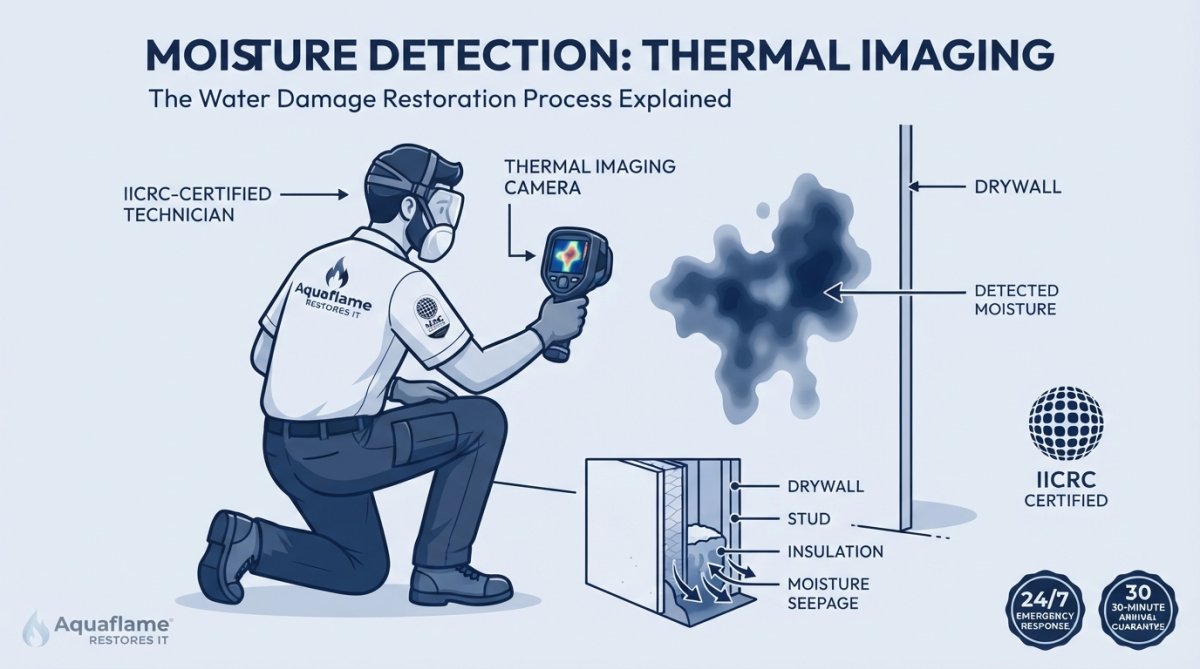
Moisture detection uses thermal imaging and meters. Professionals don’t guess when materials are dry. They use thermal imaging cameras to detect moisture behind walls, under flooring, and in insulation. This prevents the "looks dry" mistake that leads to hidden mold growth weeks later.
IICRC certification requires proper moisture monitoring. IICRC (Institute of Inspection, Cleaning and Restoration Certification) standards require technicians to document moisture readings before, during, and after drying. Aquaflame Restores it’s technicians are IICRC certified and follow these standards on every job.
Mold Removal Services Near Me: Prevention and Remediation
Mold is the most common consequence of incomplete water damage restoration. It grows in damp environments, spreads through spores, and causes respiratory problems and allergies.
Prevention is far cheaper than remediation. The way to avoid mold removal services is to dry materials completely and quickly. Mold cannot grow in dry environments. If you remove standing water within 24 hours and run dehumidifiers for 7-14 days until materials reach acceptable moisture levels, mold will not develop.
Mold remediation requires professional containment and removal. If mold has begun growing, you cannot clean it away with bleach. Mold remediation requires identifying the mold source, containing the affected area so spores don’t spread, removing contaminated materials, and addressing the moisture problem.
HVAC cleaning prevents mold from spreading through your ductwork. If mold has grown in your home, spores have likely entered your HVAC system. Professional HVAC cleaning removes mold from ducts and equipment.
Mold clearance testing proves remediation is complete. After mold removal, professional testing confirms that mold levels have returned to normal background levels. Aquaflame Restores it provides mold clearance testing and documentation that lenders and insurance companies recognize.
Understanding Water Damage Restoration Cost Factors
Cost varies based on water volume, affected area, contamination level, and how quickly you respond.
Water volume determines extraction and drying time. A burst pipe flooding one room costs far less than a basement flood or sewage backup affecting multiple rooms.
Contamination level affects remediation complexity. Clean water from a supply line is lowest-cost. Gray water from appliances requires sanitization. Sewage backup requires hazmat-level decontamination and is significantly more expensive.
Material type determines drying difficulty and replacement cost. Carpet dries slower than hard flooring and often requires replacement. Saturated drywall usually requires removal and replacement. Insulation typically cannot be dried and must be replaced.
Speed of response affects total cost. Responding within 24 hours typically means you can dry materials in place. Waiting 48+ hours often means materials have deteriorated and require replacement.
Insurance coverage determines your out-of-pocket cost. Most homeowners insurance policies cover water damage from sudden, accidental causes. They do NOT cover damage from neglect or gradual leaks. Flood damage requires separate flood insurance.
DIY vs. Professional Restoration: When to Call an Expert
Not all water damage requires professional help, but most does.
DIY works for small, clean-water incidents. If a supply line leaked in your kitchen and you caught it within an hour, with water confined to one small area and no standing water, you can likely handle it yourself.
Call professionals immediately for:
- Standing water (more than a few inches anywhere)
- Water from sewage, flooding, or contaminated sources
- Water affecting multiple rooms or your basement
- Water sitting for more than a few hours
- Water near electrical systems or in crawlspaces
- Visible or suspected mold
- Water affecting structural materials (walls, subflooring, insulation)
Professional response in these scenarios costs far less than DIY mistakes. Aquaflame Restores it charges for emergency extraction and drying based on square footage and water volume, typically $1,500-$5,000 for residential water damage. This cost is almost always covered by insurance.
Insurance companies often require professional documentation. If you attempt DIY cleanup and then file a claim, adjusters will ask for proof the job was done correctly. Professional contractors provide this documentation automatically.
Choosing a Water Damage Company: What Sets Professionals Apart
Not all water damage contractors are equal. Some are legitimate, IICRC-trained professionals with proper equipment. Others are one-person operations with consumer-grade equipment and no expertise.
Speed of response matters more than price. The cheapest contractor is not the best if they arrive 24 hours after you call. By then, mold has likely begun growing. Aquaflame Restores it’s 30-minute arrival guarantee means you don’t wait.
Equipment quality determines drying effectiveness. Professional-grade air movers and dehumidifiers dry materials far faster than consumer equipment. A contractor with proper equipment finishes drying in 5-7 days. Ask contractors what equipment they use and how many units they’ll deploy.
Transparency about costs prevents surprise bills. Legitimate contractors provide written estimates breaking down labor, equipment, materials, and timeline. Aquaflame Restores it provides detailed estimates upfront and manages direct insurance billing so you’re not surprised by out-of-pocket costs.
References and ratings reveal real performance. Check Google reviews, Better Business Bureau ratings, and ask for references from recent jobs. Call those references and ask specific questions: Did the contractor arrive on time? Did they communicate clearly? Did the job take the estimated time?
IICRC Certification and Technician Training Standards
IICRC certification is the gold standard in water damage restoration. It means technicians have passed rigorous training and testing on proper restoration techniques, safety protocols, and documentation standards.
IICRC certification requires specific training and testing. The Institute of Inspection, Cleaning and Restoration Certification (IICRC) certifies professionals in water damage restoration and mold remediation. To earn certification, technicians must complete classroom training, pass written exams, and demonstrate competency in specific techniques.
IICRC standards define proper restoration procedures. The IICRC publishes the S500 Standard for Professional Water Damage Restoration, which defines industry best practices for extraction, drying, documentation, and mold prevention. IICRC-certified contractors follow these standards on every job.
Certification protects you if problems arise later. If a contractor follows IICRC standards and documents their work properly, they have a defense if mold appears after restoration. IICRC-certified contractors provide this protection automatically.
Not all contractors are IICRC certified. Before you hire, ask: Are you IICRC certified? Can you provide your certification number? How long have you held certification?
Direct Insurance Billing and Claims Support
Insurance billing is a major source of frustration. You want the contractor to bill your insurance company directly so you’re not stuck paying upfront.
Direct insurance billing eliminates out-of-pocket costs. When a contractor bills your insurance company directly, you don’t pay anything upfront (except your deductible). The contractor bills the insurance company, the insurance company pays the contractor, and you’re done.
Insurance claim support means the contractor helps you navigate the process. Your contractor should help you document damage, prepare your claim, and communicate with your insurance adjuster. Aquaflame Restores it manages direct insurance billing and provides full claims support.
Disputes over coverage require contractor support. Sometimes insurance companies deny claims or offer settlements lower than actual repair costs. Your contractor can provide documentation that supports your position and help you appeal.
Residential vs. Commercial Water Damage: Different Needs
Residential and commercial water damage restoration differ significantly in scale, complexity, and downtime management.
Residential water damage is typically smaller in scale. Your home is smaller than a commercial building, and damage is usually confined to one or two areas. Restoration takes days to a couple weeks.
Commercial water damage affects business operations and multiple tenants. A flooded office building, retail space, or apartment complex involves much larger square footage, complex HVAC systems, and multiple parties. Downtime directly costs money.
Commercial restoration requires faster response and larger crews. A commercial project needing weeks requires completion in days to minimize business disruption. This requires multiple crews working simultaneously and 24/7 coordination.
Insurance and liability are more complex in commercial settings. Commercial policies have different coverage terms. Multiple parties may have insurance claims. Liability questions arise if water damage affects adjacent spaces.
Aquaflame Restores it handles both residential and commercial water damage restoration. For commercial clients, they coordinate 24/7 emergency response, manage multiple insurance claims, and work around tenant schedules to minimize disruption.
When water damage strikes, your response in the first hours determines your outcome. Stop the water source, document everything, and call a professional immediately if water is standing, contaminated, or affecting multiple areas. Aquaflame Restores it’s 24/7 emergency response team arrives within 30 minutes across metro Atlanta with IICRC-certified technicians, professional-grade extraction and drying equipment, and direct insurance billing support. Get started with Aquaflame Restores it today and stop water damage before it becomes a structural and health crisis.
| Situation | Response | Timeline |
|---|---|---|
| Small clean-water spill, caught within 1 hour | DIY: shut off water, run fans and dehumidifiers | 1-3 days |
| Standing water, multiple affected areas | Call professionals immediately | 4-24 hours to arrival |
| Sewage backup or contaminated water | Call professionals, do not enter | 2-4 hours to arrival |
| Water in crawlspace or affecting subflooring | Call professionals for moisture detection | 5-10 days drying time |
| Mold visible or suspected after water damage | Call mold remediation specialists | 7-21 days remediation |
Frequently Asked Questions
How quickly should I call a water damage restoration company after discovering damage?
Contact a water damage restoration service immediately, ideally within the first 24-48 hours. Rapid response prevents mold growth, structural damage, and costly secondary issues. Many restoration contractors offer 24/7 emergency response to minimize water intrusion and property damage. The faster mitigation begins, the better your chances of preserving materials and reducing overall restoration costs.
What's the difference between water damage mitigation and full water damage restoration?
Water mitigation focuses on emergency response: water extraction, dehumidification, and preventing further damage. Water restoration includes the complete process, mitigation plus repairs, reconstruction, and returning your property to pre-loss condition. Professional restoration contractors handle both phases, using IICRC-certified protocols for moisture detection, structural drying, and sanitization to ensure complete recovery.
Will a water damage restoration company handle my insurance claim directly?
Many professional restoration contractors offer direct insurance billing and claims support, managing communication with your insurance adjuster on your behalf. This reduces your out-of-pocket costs and simplifies the process. However, coverage depends on your policy and the damage category. Always confirm the restoration company's insurance billing practices before hiring, and ask for documentation supporting their assessment for your claim.
How do I know if I need professional mold removal services after water damage?
If water damage occurred more than 24-48 hours ago, mold remediation is likely necessary. Professional mold removal services include inspection, containment, decontamination, and clearance documentation. IICRC-certified technicians use moisture detection tools to identify hidden mold in subfloors, crawlspaces, and walls. If you see visible mold, smell musty odors, or have health concerns, hire a licensed contractor rather than attempting DIY cleanup, which can spread spores.
This article was written using GrandRanker