Table of Contents
- What Is Water Remediation?
- Understanding Water Damage Categories and Health Risks
- The Water Damage Restoration Process
- Water Damage Cleanup Process and Timeline
- Mold Remediation and Prevention After Water Damage
- Cost of Water Damage Restoration and Insurance Claims
- Professional Water Remediation vs. DIY: When to Call Experts
- Post-Remediation Indoor Air Quality and Long-Term Monitoring
Last Updated: July 29, 2026
What Is Water Remediation?
Water remediation is the comprehensive process of removing water intrusion, drying structures, and restoring properties to their pre-loss condition after flooding, burst pipes, or other water damage events. At Aquaflame Restores it, we understand that water damage extends far beyond visible moisture, it involves extracting standing water, controlling humidity levels, preventing mold growth, and restoring both structural integrity and indoor air quality. The process typically begins within hours of water intrusion and can span weeks or months depending on damage severity, water category, and structural complexity.
Most property owners underestimate the scope of water damage. What appears as surface wetness often masks deeper moisture penetration into drywall, insulation, subflooring, and structural framing. According to research from the Insurance Information Institute, water damage and freezing account for a significant portion of homeowner insurance claims annually. Without proper remediation, hidden moisture creates conditions for mold proliferation, structural decay, and health hazards that compound over time.
The distinction between emergency water extraction and complete remediation is critical. Extraction removes standing water quickly; remediation addresses the aftermath, dehumidification, sanitization, decontamination, and reconstruction. This guide covers the full scope of water remediation, from understanding water damage categories and health risks to navigating insurance claims and deciding when professional intervention is essential.
Understanding Water Damage Categories and Health Risks
Category 1, 2, and 3 Water Damage
Water damage classification determines remediation strategy and health risk level. Category 1 water originates from clean sources, burst supply lines, overflowing sinks, or rainwater from intact roofs, and poses minimal health risk if remediated promptly. However, Category 1 water becomes Category 2 or 3 if left standing for 24-48 hours, as bacterial growth accelerates rapidly.
Category 2 water, or "gray water," contains significant contamination from appliances, partial toilet overflow, or aquarium ruptures. This water carries bacteria, viruses, and chemical residues requiring protective equipment and careful handling, with thorough sanitization of all affected surfaces.
Category 3 water, classified as "black water," is severely contaminated with sewage, saltwater intrusion, or outside water carrying pathogens and biohazards. Black water remediation requires specialized protocols, full-body protective equipment, and professional-grade decontamination. Porous materials exposed to Category 3 water are typically non-salvageable and must be removed and replaced.
Health Risks by Water Category
Category 1 water presents minimal acute health risk if dried within 48 hours, though mold growth becomes a concern if moisture persists. Category 2 water exposure creates moderate health risks including gastrointestinal illness, respiratory infections, and skin irritation. Individuals with compromised immune systems, young children, and elderly occupants face elevated risk.
Category 3 water poses severe hazards. Black water contains pathogens including E. coli and hepatitis A virus that cause serious illness or death if ingested or absorbed through open wounds. Inhalation of aerosolized pathogens during black water remediation requires respiratory protection and professional containment protocols.
Mold growth represents a delayed but significant health risk across all categories. Within 24-72 hours of moisture exposure, mold spores germinate and spread throughout affected materials and air systems. Mold exposure triggers allergic reactions, asthma exacerbation, and respiratory infections in sensitive individuals. Certain mold species produce mycotoxins causing neurological symptoms and chronic health effects with prolonged exposure.
The Water Damage Restoration Process
Emergency Response and Water Extraction
The first 24 hours after water intrusion are critical. Rapid response prevents secondary damage, limits mold colonization, and improves salvage rates for personal property and building materials. Aquaflame Restores it maintains a 30-minute arrival guarantee across metro Atlanta to begin extraction and assessment immediately.
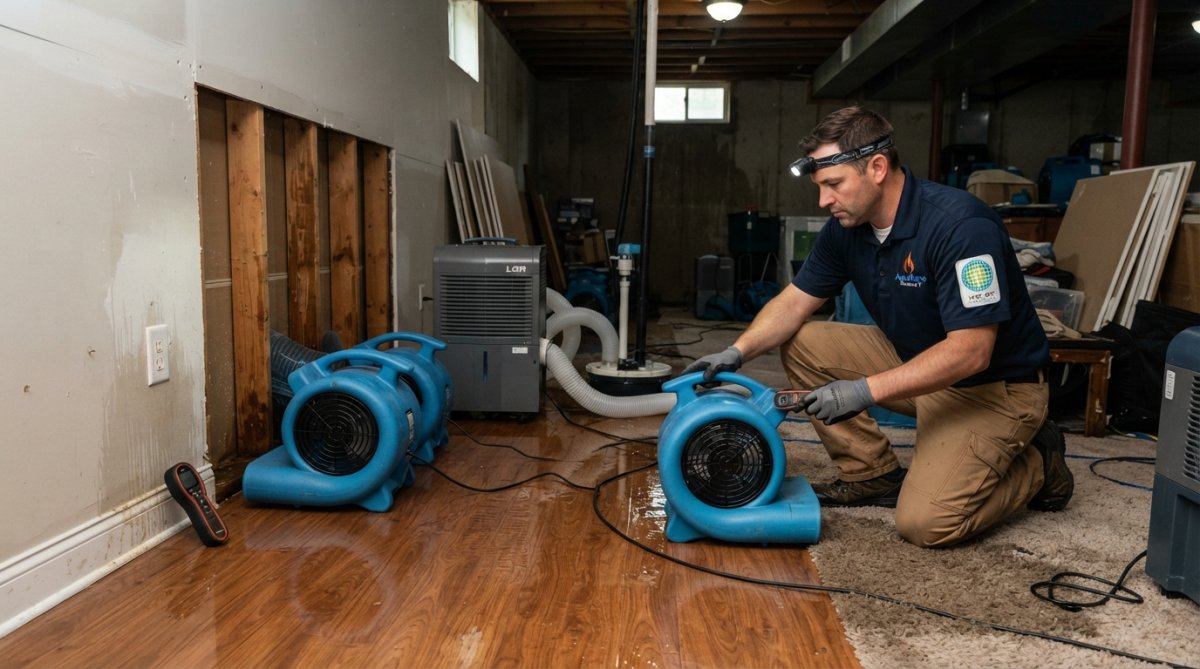
Emergency response begins with safety assessment. Restoration contractors verify electrical hazards, structural stability, and contamination levels before personnel enter the affected space. Once safety is confirmed, water extraction begins using submersible pumps, wet vacuums, and portable extraction equipment. Industrial-grade extraction removes standing water from floors, carpeting, and structural cavities within hours.
Moisture mapping follows extraction. Restoration professionals use moisture meters and thermal imaging to identify water penetration into walls, subflooring, and structural framing. These tools reveal hidden moisture that visual inspection alone cannot detect, guiding targeted drying efforts and identifying areas requiring material removal.
Dehumidification and Structural Drying
After water extraction, dehumidification becomes the primary focus. Air movers, high-velocity fans positioned to maximize air circulation, accelerate evaporation from surfaces. Dehumidifiers then remove moisture from the air, maintaining humidity levels below 50% to inhibit mold growth. Professional restoration teams use hygrometer readings to monitor humidity continuously and adjust equipment placement as drying progresses.
Drying duration varies significantly. Drywall typically dries within 3-5 days; structural wood framing may require 7-14 days. Materials with high water absorption capacity, carpet padding, insulation, subflooring, often require removal rather than drying, as complete moisture removal becomes impractical.
Sanitization and Decontamination
Once structural drying is underway, sanitization and decontamination address biological and chemical contamination. Category 1 water remediation typically requires surface cleaning with detergent and disinfectant solutions. Category 2 water demands more thorough decontamination, including encapsulation or removal of porous materials. Category 3 black water remediation requires professional-grade biohazard decontamination with hospital-strength disinfectants.
HEPA filtration systems remove airborne particles and mold spores during decontamination, preventing cross-contamination to unaffected areas. Deodorization treatments eliminate odors caused by microbial growth and decomposing organic matter.
Water Damage Cleanup Process and Timeline
The complete water damage cleanup and restoration process unfolds across distinct phases:
Hours 0-24: Emergency response, water extraction, safety assessment, moisture mapping, and initial equipment deployment.
Days 2-7: Structural drying phase. Humidity levels decline as air movers and dehumidifiers operate continuously. Daily moisture readings guide equipment adjustments. Contaminated porous materials are identified and removed.
Days 5-10: Decontamination and sanitization intensify. Affected surfaces receive appropriate disinfection based on water category. HEPA filtration runs continuously.
Days 7-14: Mold prevention measures are implemented. Final moisture readings confirm structural drying is complete.
Weeks 2-4: Reconstruction begins. Damaged drywall, flooring, insulation, and other building materials are replaced.
Complete restoration timelines vary dramatically based on damage extent. Minor water damage from a contained pipe burst may resolve in 7-10 days. Extensive flooding affecting multiple rooms may require 4-8 weeks or longer.
| Phase | Duration | Key Activities | Success Indicator |
|---|---|---|---|
| Emergency Response | 0-24 hours | Water extraction, safety assessment, equipment deployment | All standing water removed |
| Structural Drying | 2-7 days | Air movement, dehumidification, moisture monitoring | Humidity below 50% |
| Decontamination | 5-10 days | Sanitization, disinfection, HEPA filtration | No visible contamination |
| Reconstruction | 2-8 weeks | Material replacement, painting, finishing | Property restored to pre-loss condition |
Mold Remediation and Prevention After Water Damage
Identifying Mold Growth and Preventing Recurrence
Mold growth begins within 24-72 hours of moisture exposure if humidity remains above 60% and temperatures stay between 40-100°F. Early identification and remediation prevent widespread colonization and health hazards.
Visual mold appears as black, green, or white discoloration on surfaces. However, mold also grows inside walls, under carpeting, and in HVAC systems where it remains invisible until contamination becomes severe. Musty odors often signal hidden mold growth before visual evidence appears.
Professional mold remediation follows specific protocols based on contamination extent. Small mold areas (less than 10 square feet) may be cleaned with detergent and HEPA vacuuming. Larger contamination requires containment barriers, negative air pressure, and removal of affected materials.
Preventing mold recurrence requires maintaining humidity below 50% and ensuring complete structural drying. Proper ventilation in bathrooms, kitchens, and crawlspaces reduces ambient humidity. Vapor barriers in crawlspaces and under slab-on-grade foundations prevent ground moisture from rising into structures. Gutters and downspouts should direct water away from foundations.
Post-remediation mold testing confirms successful remediation. Air quality testing measures airborne spore counts; surface testing verifies no viable mold remains on treated materials.
Cost of Water Damage Restoration and Insurance Claims
Insurance Claim Negotiation Strategies
Water damage restoration costs vary dramatically based on contamination category, affected area, and structural complexity. Small water damage from contained pipe bursts may cost several thousand dollars; extensive flooding can reach tens of thousands or more.
Insurance coverage depends on policy language and loss cause. Sudden, accidental water damage from burst pipes or failed appliances is typically covered. Gradual water intrusion, flooding from external water sources, and damage from lack of maintenance are usually excluded.
Negotiating insurance claims requires documentation and professional assessment. Restoration contractors provide detailed damage reports, photos, moisture readings, and itemized repair estimates. Working with restoration contractors who manage direct insurance billing simplifies the claims process. These contractors communicate directly with insurers, submit required documentation, and coordinate payment arrangements. Aquaflame Restores it handles direct insurance billing for all water damage restoration, removing the administrative burden from property owners and ensuring prompt claim resolution.
Homeowners should document all damage with photos and video before cleanup begins. Keeping receipts for emergency mitigation costs supports claims for additional living expenses covered under most policies.
Professional Water Remediation vs. DIY: When to Call Experts
Why IICRC Certification Matters
The Institute of Inspection, Cleaning and Restoration Certification (IICRC) establishes industry standards for water damage restoration, mold remediation, and related services. IICRC certification requires technicians to complete rigorous training in water damage assessment, extraction, drying, decontamination, and mold prevention.
Certified technicians understand moisture dynamics, structural drying science, and health hazards associated with contaminated water. They use appropriate equipment, follow established protocols, and document remediation progress with industry-standard measurements. Many insurance companies prefer or require IICRC-certified contractors for claim approval.
Small water damage from contained sources may be manageable through DIY cleanup. However, Category 2 or 3 water damage, extensive structural saturation, or mold growth requires professional intervention. Attempting to remediate contaminated water without proper equipment, protective gear, and decontamination protocols creates health risks and often fails to prevent mold recurrence.
Professional restoration contractors have industrial-grade equipment unavailable to homeowners, submersible pumps, commercial dehumidifiers, thermal imaging, moisture meters, and HEPA filtration systems. These tools dry structures faster and more thoroughly than consumer equipment, reducing mold risk and restoration timelines.
Post-Remediation Indoor Air Quality and Long-Term Monitoring
After structural drying and decontamination, indoor air quality assessment confirms remediation success and identifies any remaining contamination. Professional testing uses standardized protocols and equipment calibrated to industry standards. Air samples are collected from affected rooms and unaffected baseline areas to compare contamination levels. Laboratory analysis identifies mold species, spore concentrations, and any unusual contaminants.
Successful remediation produces air quality equivalent to or better than baseline pre-damage conditions. If testing reveals elevated contamination, additional decontamination or material removal may be necessary. Some mortgage lenders and property insurance companies require clearance testing before approving final claim payment.
Long-term monitoring prevents mold recurrence. Humidity monitoring in basements, crawlspaces, and bathrooms identifies developing moisture problems before mold growth occurs. Annual HVAC system inspections ensure ductwork and filters remain clean. Moisture barriers and ventilation improvements maintain conditions unfavorable to mold growth.
Water intrusion prevention represents the final remediation phase. Identifying and repairing the water source, roof leaks, foundation cracks, failed seals, or poor drainage, prevents recurrence. Without addressing the source, water damage remediation becomes a temporary fix rather than permanent restoration.
Water damage remediation demands immediate professional response, thorough drying, and meticulous decontamination to restore your property safely and completely. When water intrusion threatens your home or business, the speed and expertise of your restoration contractor determine whether damage remains contained or escalates into structural failure and health hazards. Aquaflame Restores it provides 24/7 emergency response with IICRC-trained technicians who manage complete restoration from water extraction through reconstruction, handling insurance coordination directly so you can focus on recovery. Contact Aquaflame Restores it immediately after water damage occurs; their 30-minute arrival guarantee and comprehensive restoration services ensure your property returns to pre-loss condition with minimal disruption.
Frequently Asked Questions
What is the difference between water remediation and water restoration?
Water remediation focuses on the scientific and technical process of removing water, drying structures, and preventing secondary damage like mold growth through dehumidification and moisture mapping. Water restoration is the broader term encompassing remediation plus reconstruction, rebuilding damaged materials and returning your property to pre-loss condition. Both are essential; remediation stops the damage, restoration returns your home to normal.
How much does water damage restoration typically cost?
Water damage restoration costs vary significantly based on damage severity, affected area size, water category (clean vs. contaminated), and required structural drying. Pricing depends on the scope of water extraction, dehumidification equipment duration, sanitization needs, and reconstruction work. Contact a professional for a detailed assessment and quote. Most restoration contractors offer free evaluations to determine exact costs for your situation.
What are the main steps in the water damage cleanup process?
The water damage cleanup process typically includes: (1) emergency response and water extraction using pumps and vacuums, (2) moisture assessment with hygrometers and thermal imaging, (3) dehumidification and structural drying with air movers, (4) sanitization and decontamination of affected surfaces, (5) mold prevention and remediation if needed, and (6) reconstruction of damaged materials. Professional restoration contractors handle all steps to ensure complete water mitigation and prevent pathogens or mold growth.
When should I hire a professional restoration contractor instead of handling water remediation myself?
Hire a professional immediately for Category 2 or 3 water (contaminated or black water), large-scale flooding, structural damage, or suspected mold. Even Category 1 (clean) water damage benefits from professional assessment, improper drying leads to hidden moisture, mold growth, and costly repairs. IICRC-certified technicians use specialized equipment like moisture mapping, thermal imaging, and HEPA filtration to prevent secondary damage. DIY cleanup risks health hazards, insurance claim denial, and incomplete remediation.
This article was written using GrandRanker