Table of Contents
- Steps to Take Immediately After a Flood
- Alternatives to Full Floor Replacement After Flood Damage
- How to Dry Out Subfloor After Flood Without Full Removal
- When to Replace vs Repair Flooded Floors
- Water Damaged Floor Repair Cost: DIY vs Professional Restoration
- Health and Mold Remediation Protocols After Flooding
- Why Avoid Laminate and Carpet After Flooding
- Eco-Friendly Flood-Resistant Flooring Materials
Last Updated: July 13, 2026
When a flood damages your home, complete demolition isn’t always necessary. According to the Institute of Inspection, Cleaning and Restoration Certification (IICRC), many flood-damaged properties recover through strategic drying and targeted restoration. This guide covers practical alternatives to full floor replacement that actually work, when they’re viable, and how to execute them properly.
Steps to Take Immediately After a Flood
The first 24-48 hours are critical and determine whether you’ll need full replacement or can salvage the structure.
Turn off electricity to affected areas immediately, as standing water conducts current. Document everything with photos and video for insurance purposes, capturing both wide shots and close-ups of water lines on walls and flooring materials.
Extract standing water immediately using pumps or wet vacuums. Open all windows and doors to begin air circulation. Remove wet materials that cannot be salvaged, saturated carpet, damaged drywall, and compromised insulation, but don’t remove hardwood floors or subfloors yet, as these may be salvageable with professional drying equipment. Call a restoration company immediately; professional teams have moisture detection equipment that determines exactly what’s wet and how deeply water has penetrated.
Waiting more than 72 hours to begin structural drying dramatically increases mold risk. Mold colonies can become visible and toxic within 48-72 hours of moisture exposure.
Alternatives to Full Floor Replacement After Flood Damage
Not every flooded floor needs complete removal. The decision depends on water depth, contamination level, duration of exposure, and what’s underneath.
Professional Structural Drying and Moisture Extraction
Professional drying uses specialized equipment to remove moisture from materials without demolition. Systems like the Dri-Eaz DriForce XL push conditioned air into wall cavities and under flooring while dehumidifiers extract moisture-laden air. This dual approach removes water from deep within layered floor constructions without cutting into the structure.
Drying typically takes 7-14 days depending on material thickness. Technicians monitor moisture content continuously using calcium chloride testing and wood moisture meters. When readings drop below safe thresholds (typically 15-17% moisture content for wood), drying is complete.
The advantage is obvious: you keep your original flooring, preserving aesthetic value and avoiding demolition costs.
Concrete subfloors dry faster than wood-based assemblies. A concrete slab may be dry enough for new flooring in 5-7 days, while engineered wood subfloors might take 10-14 days.
Waterproof Luxury Vinyl Plank (LVP) Over Existing Subfloor
Once the subfloor is dry, waterproof luxury vinyl plank offers a practical, attractive alternative to full replacement. LVP is completely waterproof, affordable, and visually indistinguishable from hardwood or stone.
After confirming the subfloor is dry and structurally sound, installers apply a moisture barrier membrane like LiquiDam EZ. Then LVP planks click together over the barrier. High-end LVP is nearly impossible to distinguish from real wood. Installation is faster than traditional hardwood, most rooms finish in 1-2 days, and costs 40-60% less than solid hardwood.
Porcelain Tile Installation on Sealed Concrete
If your subfloor is concrete, porcelain tile is an excellent permanent solution. Porcelain is non-porous, completely waterproof, and extremely durable in flood-prone areas.
Seal the concrete first using products like LiquiDam EZ to prevent moisture migration. Once sealed, porcelain tile installs directly over the concrete using modified thinset mortar. Large-format tiles (24×24 inches or larger) minimize grout lines where water can accumulate. Use sealed grout (epoxy or urethane-based) to prevent water penetration at joints.
Porcelain tile costs more upfront than LVP but lasts indefinitely. In flood-prone basements or ground-level spaces, this longevity justifies the investment.
Porcelain tile is the single best flooring choice for spaces that flood regularly. It requires no special maintenance and provides a permanent solution that eliminates future flooring replacement costs.
Sealed or Stained Concrete Finishes
If your concrete subfloor is structurally sound, a sealed or stained concrete finish eliminates flooring concerns entirely. Penetrating sealers like acrylic or polyurethane work best for basements because they allow the concrete to breathe while blocking water ingress from above.
Staining adds color and visual interest. The cost is minimal, typically $1-3 per square foot for materials, and the process takes 3-5 days total. The trade-off is that sealed concrete is harder underfoot and can be slippery when wet.
How to Dry Out Subfloor After Flood Without Full Removal
Subfloor drying is the technical heart of avoiding replacement.
Professional Drying Equipment and Techniques
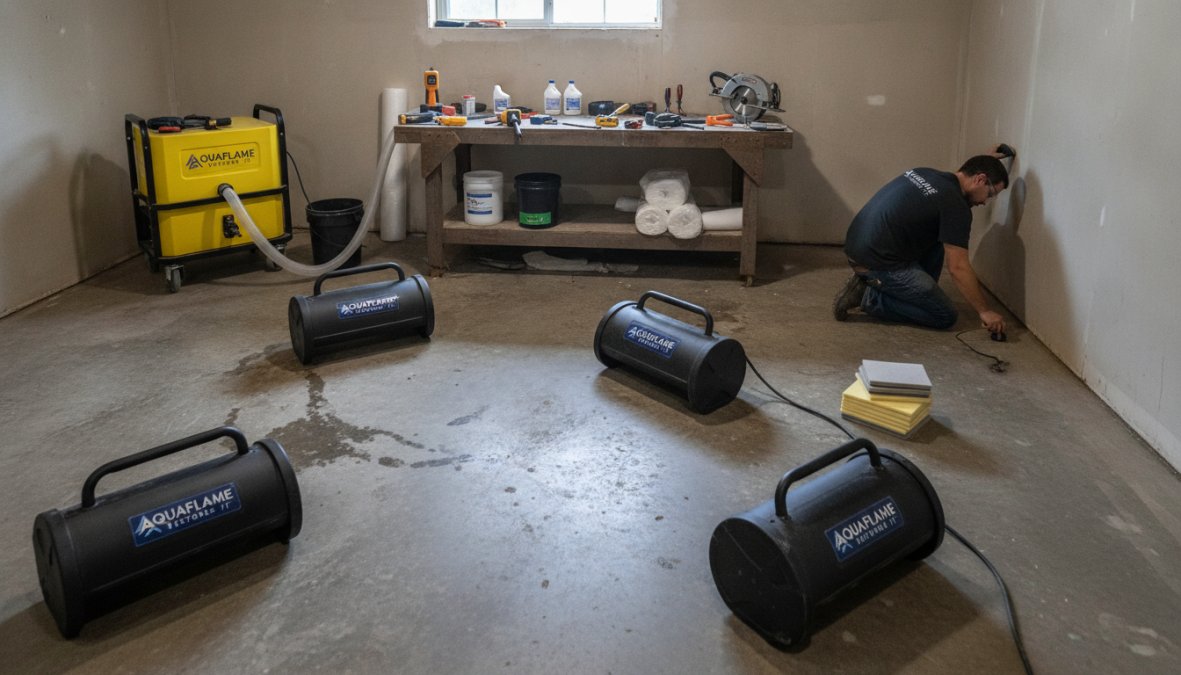
Modern restoration equipment includes air movers (high-velocity fans that create evaporation), dehumidifiers (which remove moisture-laden air), and injection systems that force dry air directly under flooring.
Air movers push large volumes of air to move moisture away from wet surfaces. A typical basement needs 4-6 air movers positioned for cross-ventilation. Dehumidifiers remove the moisture that air movers evaporate; desiccant units work better in cold environments and extract moisture more aggressively.
Injection systems like the Dri-Eaz Rescue Mat attach to standard air movers and pull moisture directly from wood without cutting into it. This technique has saved countless hardwood floors.
The restoration company monitors progress using calcium chloride testing and wood moisture meters. When wood drops below 15% moisture content and concrete below 3% moisture vapor emission rate (MVER), the space is dry enough for new flooring.
Drying times vary dramatically based on subfloor material. Concrete slabs dry in 5-7 days. Engineered wood subfloors take 10-14 days. Solid wood subfloors can take 21+ days.
Monitoring Moisture Content and Relative Humidity
Proper monitoring prevents the expensive mistake of installing new flooring before the subfloor is truly dry.
For wood, safe installation happens at 12-15% moisture content. For concrete, the metric is moisture vapor emission rate (MVER), measured in pounds per 1,000 square feet per 24 hours. Safe installation requires MVER below 3 lbs. Relative humidity in the room should be below 50% before flooring installation.
Professional restoration teams use calcium chloride testing for concrete and wood moisture meters for subfloors, testing at multiple locations and depths to ensure complete drying.
When to Replace vs Repair Flooded Floors
Understanding decision criteria helps you work with professionals to determine what’s actually necessary.
Signs of Water Damage That Require Full Replacement
If water sat for more than 72 hours before extraction, mold colonization is likely. Once mold penetrates wood fibers, removal is the only safe option.
Structural damage is another replacement trigger. If the subfloor shows soft spots, visible rot, or buckling that doesn’t flatten as moisture is removed, structural integrity is compromised.
Contamination level matters significantly. If floodwater came from sewage backup, chemical spills, or industrial sources, materials must be removed as biohazard waste. Clean water from burst pipes or rising groundwater is salvageable; contaminated water is not.
Conditions Where Repair and Restoration Are Viable
Most flood situations fall into the salvageable category. Clean water flooding is almost always salvageable if addressed within 48-72 hours. Shallow water (less than 12 inches) is easier to dry than deep flooding. Engineered wood and laminate subfloors dry faster than solid hardwood. If existing flooring is relatively new (less than 15 years old), restoration is almost always worth pursuing.
Water Damaged Floor Repair Cost: DIY vs Professional Restoration
The decision between DIY mitigation and professional services hinges on equipment access, expertise, and insurance coverage.
Cost-Benefit Analysis of Professional Services
Professional restoration companies bring specialized equipment, moisture monitoring expertise, and insurance claim management. Renting drying equipment costs $150-300 per day per unit. A typical basement needs 4-6 air movers plus 1-2 dehumidifiers, running $600-1,500 daily. A 10-day drying cycle costs $6,000-15,000 in equipment alone.
Professional services typically cost $2,000-8,000 depending on square footage and complexity, 20-40% of full flooring replacement cost. Insurance coverage is the hidden advantage; most homeowners insurance policies cover water damage restoration when performed by licensed professionals.
Insurance and Claim Documentation for Flooring Damage
Start with photographs immediately after the flood, before any mitigation begins. Professional restoration companies provide detailed reports including initial moisture readings, daily drying progress with timestamped photos, final moisture readings, and itemized cost estimates.
Insurance adjusters use these reports to determine claim validity and coverage amounts. Be specific about what’s damaged: "Standing water 18 inches deep for 36 hours in 800 sq ft basement with engineered wood subfloor" gives the adjuster the information needed to evaluate coverage.
Health and Mold Remediation Protocols After Flooding
Mold growth begins within 24-48 hours of moisture exposure. Professional mold remediation follows IICRC protocols and includes containment of affected areas, removal of affected materials, HEPA vacuuming and surface sanitization, and post-remediation verification using air quality testing.
The cost of mold remediation ranges from $2,000 for small affected areas to $25,000+ for extensive contamination. Rapid water extraction and drying prevent the mold problem that makes remediation necessary.
Never attempt mold remediation yourself if the affected area exceeds 10 square feet. Professional remediation is required by most insurance policies for larger areas.
Why Avoid Laminate and Carpet After Flooding
Laminate flooring swells irreversibly when water reaches its high-density fiberboard core. Even after drying, the planks remain warped and buckled. Laminate cannot be salvaged after flooding.
Carpet traps moisture in the backing and padding, creating the perfect environment for mold and bacterial growth. Contaminated water cannot be cleaned out. For any space with flood risk, waterproof LVP, porcelain tile, sealed concrete, or engineered wood are the only sensible options.
Eco-Friendly Flood-Resistant Flooring Materials
Reclaimed hardwood, salvaged from old buildings, has already survived decades or centuries. When sealed properly, it resists water as well as new hardwood while offering environmental and aesthetic benefits.
Cork flooring, made from cork oak bark, is naturally water-resistant when sealed and is renewable. Strand-woven bamboo is harder and more water-resistant than traditional bamboo flooring. Recycled rubber flooring made from reclaimed tires is completely waterproof and environmentally responsible.
| Material | Water Resistance | Cost per Sq Ft | Durability | Best For |
|---|---|---|---|---|
| Waterproof LVP | Excellent | $2-5 | 15-20 years | Most flood-prone spaces |
| Porcelain Tile | Excellent | $4-8 | 30+ years | Basements, ground level |
| Sealed Concrete | Excellent | $1-3 | Indefinite | Industrial aesthetics |
| Reclaimed Hardwood | Good (when sealed) | $6-12 | 20+ years | Upscale residential |
| Cork (sealed) | Good | $4-8 | 15-25 years | Eco-conscious homeowners |
| Bamboo (strand-woven) | Good | $3-7 | 15-20 years | Modern spaces |
Choosing alternatives to full floor replacement after flood isn’t just about saving money, it’s about making informed decisions based on your specific situation. If water damage occurred within the last 48-72 hours and the water was clean, salvage is almost certainly possible. Professional structural drying followed by waterproof flooring installation will restore your space at a fraction of replacement cost. The key is acting quickly and getting professional assessment. With direct insurance billing and expert guidance, professional restoration eliminates the stress of managing recovery yourself.
Frequently Asked Questions
Can water-damaged hardwood floors be saved without full floor replacement?
Yes, in many cases. If hardwood flooring has experienced minor to moderate water damage and the subfloor is properly dried using professional drying equipment, the original boards may be salvageable. Specialized systems like moisture extraction mats can pull water from wood without removal. However, if structural integrity is compromised, cupping is severe, or mold has penetrated deeply, full replacement becomes necessary. Assessment by a professional restoration company is essential to determine viability.
How long does it take to dry out a subfloor after flood damage?
Drying time varies based on moisture content, relative humidity, and the drying method used. Passive air drying typically takes 7-14 days or longer, while professional structural drying with specialized equipment can reduce this to 3-7 days. Concrete subfloors generally dry faster than wood. Continuous monitoring with moisture meters ensures the subfloor reaches acceptable moisture levels before new flooring installation. Your restoration company can provide a timeline after assessment.
What are the best alternatives to full floor replacement after flooding?
Top alternatives include: professional structural drying to preserve existing materials, installing waterproof luxury vinyl plank over a sealed subfloor, laying porcelain tile on properly sealed concrete, applying sealed or stained concrete finishes, and using moisture barrier systems like subfloor protection tiles. The best choice depends on flood severity, subfloor condition, budget, and your home's layout. A professional assessment determines which alternatives are viable for your specific situation.
How much does water damaged floor repair cost compared to replacement?
Repair and restoration costs depend on damage extent, chosen alternative, and whether you hire professionals. Professional drying services, moisture barriers, and selective flooring installation are generally less expensive than full floor replacement, though pricing varies by region and project scope. Insurance may cover portions of restoration if documented properly. Contact a local restoration company for a detailed quote, as costs depend on specific conditions, materials selected, and labor requirements for your property.
Should I get professional help or attempt DIY restoration after flood damage?
Professional restoration is strongly recommended for flood damage. IICRC-trained technicians have specialized equipment like dehumidifiers, air movers, and moisture meters to properly assess and dry subfloors, preventing long-term structural damage and mold growth. DIY efforts often miss hidden moisture in subfloor cavities, leading to costly secondary damage. Professionals also handle insurance documentation and can respond quickly, many offer 24/7 emergency service. The investment in professional service typically prevents far more expensive problems later.
This article was written using GrandRanker