Last Updated: November 20, 2026
Quick Summary
To dry out wet carpet after flooding, first stop the water source and shut off power to wet areas, then extract standing water with a wet vacuum or towels and pressure. Lift a corner to check the padding, set up fans at a low angle plus a dehumidifier, and keep them running until a moisture meter reads dry. Most wet carpet dries in 24 to 72 hours.
- Category 3 water from toilets or outdoor flooding means carpet and padding are generally discarded, not dried.
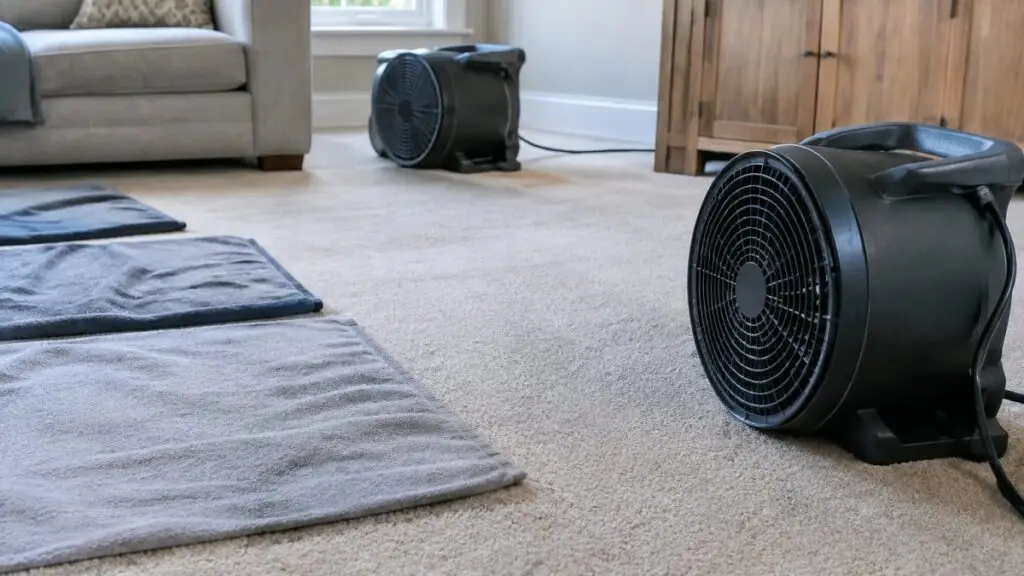
- Point fans across the carpet at a low angle and run a dehumidifier in the same room until readings match a dry baseline.
- Carpet can feel dry within a day while padding and subfloor stay wet another day or two, which is where mold starts.
- Call a professional for a musty odor, visible mold, a soaked subfloor, or a room larger than about 10 square feet that stayed wet.
- Baking soda only absorbs surface moisture and odor as a finishing step after extraction and airflow, never as a drying method.
Table of Contents
- Step 1: Stop the Water Source and Check for Safety
- Step 2: Remove Standing Water and Extract Wet Carpet
- How to Dry Wet Carpet Without a Vacuum
- Step 3: Lift Carpet, Check Padding, and Set Up Airflow
- How Long Does It Take for Carpet to Dry After Flooding?
- Carpet Wet for 3 Days: What Changes and When to Call a Pro
- Drying Wet Carpet With Baking Soda: What It Can and Cannot Do
- Call Aquaflame Restores It for a Free Damage Assessment
- Frequently Asked Questions
Step 1: Stop the Water Source and Check for Safety
The first move in how to dry out wet carpet after flooding is to stop the water and make the room safe. Everything else waits. Wet carpet is a symptom. The source is the problem.
Shut off the water. For a burst supply line or a failed washing machine hose, turn the main valve. For an overflowing fixture, close the fixture valve.
Then check for danger before you walk in:
- Power. If water reaches outlets, cords, or the panel, cut the breaker first. Never stand in standing water near live current. If the panel itself is wet or sparking, do not touch it, call the utility.
- Gas. A rotten-egg smell means leave the building and call the gas utility from outside.
- Structure. Sagging ceilings, soft or bouncy floors, and cracked drywall mean stay out and get an assessment before anyone walks on it.
Classify the water before you touch the carpet
Not all floodwater is the same, and the category determines whether the carpet can be dried at all:
- Category 1 (clean): A supply-line break, a failed ice maker line, or rainwater that entered through a closed window. Carpet and padding can often be dried and saved if you act quickly.
- Category 2 (gray): Washing machine discharge, dishwasher overflow, or water that has sat long enough to pick up soap, soil, or bacteria. Drying is possible but the carpet needs cleaning and the padding usually does not survive.
- Category 3 (black): Toilet backups, sewage, and outdoor floodwater that crossed soil or pavement. This water carries bacteria and other pathogens. Carpet and padding in Category 3 are generally discarded rather than dried, because no amount of fanning makes them safe again.
If you cannot tell where the water came from, common in older Decatur and DeKalb homes where a crawl space hides the plumbing, treat it as the worse category until someone confirms otherwise.
Protect yourself before you start
For any water beyond a small clean spill, wear rubber boots, nitrile or rubber gloves, and eye protection. Keep cuts and scrapes covered. Wash hands and forearms with soap and water after handling wet materials, and keep children and pets out of the room until it is dry and cleaned.
Georgia summer storms and frozen-pipe bursts in January both send water into older metro Atlanta homes with crawl spaces, and the two arrive with very different contamination profiles. A January pipe burst in a Cobb County ranch house is usually clean water. A July thunderstorm that pushes water under a door in Clayton County is usually not.
Watch out: a room that looks dry on top can still be holding Category 3 water in the padding and tack strip, so never judge safety by the surface.
Step 2: Remove Standing Water and Extract Wet Carpet
Standing water comes out before anything else. Use a wet vacuum or a shop vacuum rated for liquids, and work in passes.
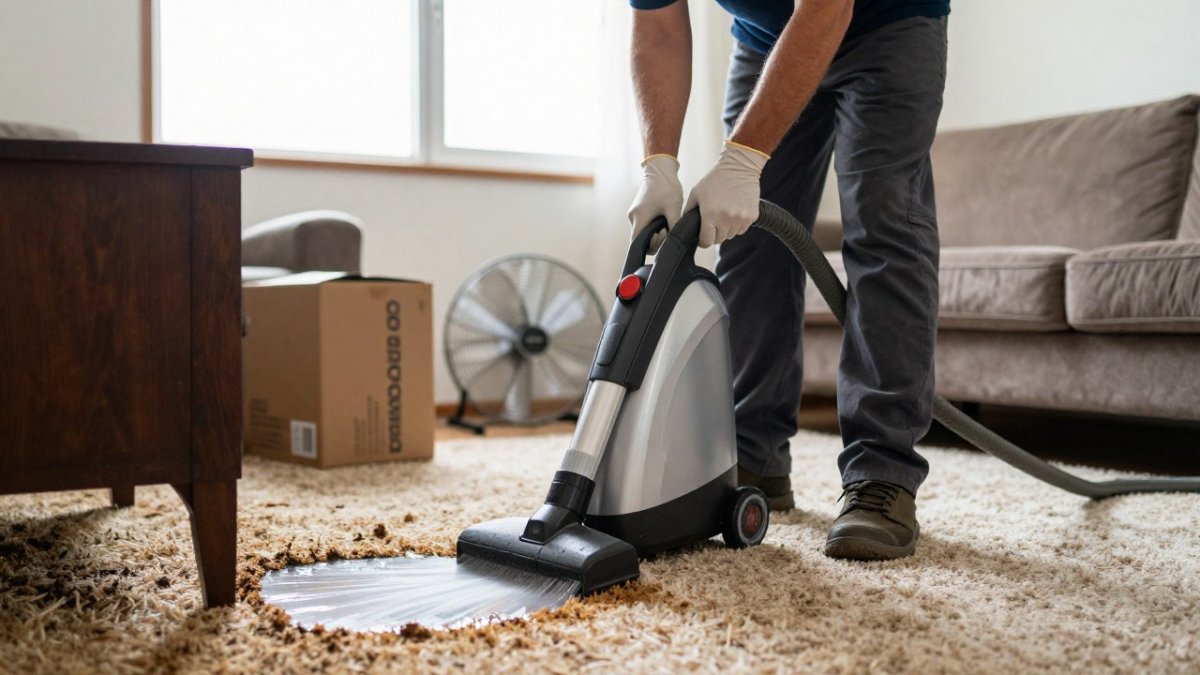
For a soaked carpet, a carpet extractor does more than a vacuum.
Move furniture and protect belongings first. Wood legs stain wet carpet, and heavy pieces trap moisture underneath.
If the carpet is holding a lot of water, our guide on how to remove water from carpet walks through extraction methods step by step.
How to Dry Wet Carpet Without a Vacuum
No wet vacuum? You can still pull a surprising amount of water out with towels and pressure. This is how to dry wet carpet without a vacuum when the flooding is shallow.
- Lay clean towels over the wet area.
- Stand on them and press down with your full weight.
- Swap in dry towels as they soak through.
- Repeat until the towels come up damp, not dripping.
- Blot from the edges inward so water does not spread.
Then open windows if the outdoor air is drier than the room. Georgia humidity works against you in summer, so run fans and a dehumidifier alongside open windows, not instead of them.
Step 3: Lift Carpet, Check Padding, and Set Up Airflow
Water hides in the padding and the subfloor, and a carpet that feels dry to the touch can still be wet underneath. This is the step where most DIY drying jobs fail, because the surface dries first and the moisture below it keeps feeding mold.
Lift a corner and read the padding
Pull back a corner of the carpet in the wettest area and look at the padding:
- Damp but intact, clean water: The padding may be salvageable if you can get air to it. Peel it back, prop it up, and aim airflow underneath.
- Soaked through, compressed, or disintegrating: The padding has lost its structure and will hold moisture against the subfloor. It needs to come out. A soaked pad rarely dries fast enough to matter.
- Discolored, smelly, or from Category 3 water: Discard it. Do not try to dry it.
While the corner is up, check the subfloor. Soft spots, dark staining, or a spongy feel underfoot mean water has reached the structure and the drying job is bigger than the carpet.
Set up airflow the right way
- Point fans across the carpet surface at a low angle, not straight down, so air moves over the fibers and under the lifted edge.
- Run a dehumidifier in the same room. Fans alone move moisture around; the dehumidifier is what removes it from the air so the carpet can keep releasing water. For help choosing and running one, see how to dry wet carpet with the best dehumidifiers.
- Keep air moving continuously until the carpet is dry. Turning equipment off overnight lets moisture settle back into the fibers.
Georgia humidity changes the math. In a humid Atlanta summer, open windows can pull more moisture in than they let out, so rely on the dehumidifier and keep windows closed during the hottest, stickiest part of the day. In a dry winter cold snap, cross-ventilation helps, but only if the outdoor air is genuinely drier than the room.
Verify the dry, don’t guess it
A dry-feeling carpet is not proof of a dry carpet. Use a moisture meter and take readings in several spots: the wettest corner, the center of the room, and near the walls where water wicks up.
A common pattern is that the carpet reads dry within a day while the padding and subfloor still read wet for another day or two.
How Long Does It Take for Carpet to Dry After Flooding?
Most wet carpet dries in 24 to 72 hours with strong airflow and a dehumidifier running. Thin carpet over a solid subfloor dries fastest. Thick carpet with soaked padding takes longer and often needs the padding replaced.
Timing depends on four things:
- How much water the carpet absorbed
- Whether the padding got wet
- Airflow and dehumidification
In a humid Atlanta summer, drying takes longer than in a dry winter week. Renters and landlords in apartments face the same timeline, and our guide on how to dry wet carpet in an apartment before mold starts covers the tighter constraints of shared buildings.
Here is the drying timeline the article gives, along with the factors that move it.
| Item | Value | Note |
|---|---|---|
| Most wet carpet | 24 to 72 hours | With strong airflow and a dehumidifier running |
| Thin carpet over solid subfloor | Dries fastest | , |
| Thick carpet with soaked padding | Takes longer | Often needs the padding replaced |
| Mold growth on damp materials | Within a day or two | Musty odor is the first sign |
| Carpet wet for 3 days | A different problem | Call a pro if signs appear |
| Room larger than about 10 square feet | Stayed wet | One of the signs to call a professional |
Carpet Wet for 3 Days: What Changes and When to Call a Pro
Carpet wet for 3 days is a different problem than carpet wet for 3 hours. Mold can start growing on damp materials within a day or two, and a musty odor is the first sign it has begun.
Call a professional when you see any of these:
- A musty odor that will not clear
- Visible mold on carpet, tack strip, or baseboard
- Water that came from a toilet or outdoor flood
Our team handles odor and mold concerns, and our guide on how to get smell out of wet carpet before it spreads explains what you can safely do on a small spot.
Drying Wet Carpet With Baking Soda: What It Can and Cannot Do
Baking soda absorbs a little surface moisture and fights odor. It does not dry a flooded carpet. Drying wet carpet with baking soda works only as a finishing step after extraction and airflow have done the real work.
Use it like this:
- Extract and blot as much water as you can first.
- Let fans and a dehumidifier run until the carpet is nearly dry.
- Sprinkle a thin layer of baking soda over the damp area.
- Let it sit for several hours to pull odor and surface moisture.
- Vacuum it up once the carpet is dry.
Baking soda cannot reach water in the padding or subfloor, and it will not stop mold that has already started. For anything beyond a small spill, professional drying is the safer call.
Call Aquaflame Restores It for a Free Damage Assessment
Flooded carpet in a metro Atlanta home or business rarely dries as fast as people hope, and hidden moisture in padding and subfloor is where mold takes hold.
For water damage restoration in Decatur and across metro Atlanta, our local water damage restoration service is one call away.
If your carpet has been wet for more than a day, do not wait for the smell. Call Aquaflame Restores It at 678-379-8000 for a free assessment.
Frequently Asked Questions
Will a wet carpet dry on its own?
Rarely, and not safely. Carpet padding holds water like a sponge, and in Georgia’s humid air the surface may feel dry while the backing and pad stay damp for days. That trapped moisture feeds mold and creates a musty odor within 24 to 48 hours. Even a small spill should be extracted, lifted, and dried with fans and a dehumidifier. If the carpet has been soaked by a flood or standing water, treat it as contaminated and call a professional for anything beyond a small area.
How long does it take for carpet to dry after flooding?
With proper extraction, airflow, and dehumidification, most wet carpet dries in 24 to 72 hours. Thick padding, poor ventilation, or high humidity across metro Atlanta can push that closer to three days. If the carpet is still damp after 72 hours, mold risk climbs sharply. A moisture meter reading, not touch alone, tells you whether the carpet and subfloor are actually dry.
Can I dry wet carpet without a vacuum?
Yes, for small spills. Blot with clean towels, press down firmly, and repeat until no more water transfers. Then lift the carpet edge, prop it up, and run fans plus a dehumidifier with windows closed. Baking soda can absorb surface moisture and odor but will not dry padding or subfloor. For anything larger than a few square feet, a wet vacuum or professional extraction is far faster and prevents mold growth.
When should I call a professional after carpet flooding?
Call a professional when the water came from a flood, sewage, or outdoor source, when the carpet has been wet for 3 days or more, when padding or subfloor is soaked, or when mold or a musty odor appears. Aquaflame Restores It serves Decatur, DeKalb, Clayton, Cobb, and Henry counties with IICRC-certified technicians, direct insurance billing, and free damage assessments. Call 678-379-8000 any time, day or night.