
Last Updated: October 29, 2026
Quick Summary
To dry wet carpet, extract standing water first, then run a compressor dehumidifier sized to the room with a drain hose connected, alongside at least two air movers, with doors and windows closed. This combination dries most residential carpet faster than a bigger machine running alone.
- Match the pint rating to the wet area: 20-30 pints/day for a small bedroom, 50-70 for a large living area.
- Place the dehumidifier centrally in the wettest area, at least a foot from walls and furniture.
- Run the unit on continuous mode or a low humidistat setting so it never cycles off before the carpet is dry.
- Test dryness with a moisture meter, a paper towel, or by squeezing the padding for a crackle.
- Call a professional when the wet area is larger than about 10 square feet or the carpet has been wet over 48 hours.
Table of Contents
- Choosing the Best Dehumidifiers for Drying Wet Carpet
- How to Dry Wet Carpet With a Dehumidifier
- Air Movers for Wet Carpet: Why Airflow Speeds Drying
- How Long to Dry Carpet After Water Damage
- When Padding or the Subfloor Is Still Wet
- Mold Risk and When to Stop Drying and Call a Pro
- Get a Free Assessment Before You Start Drying
- Frequently Asked Questions
Choosing the Best Dehumidifiers for Drying Wet Carpet
The best dehumidifiers for drying wet carpet are sized to the room, built to run continuously, and matched to the moisture load in front of them. Water removal and drying are only one part of the job, and the dehumidifier is only one part of the drying equation.
Here is the short version before the details: a compressor dehumidifier with a drain hose, rated for the square footage of the room, running alongside at least two air movers, will dry most residential carpet faster than a bigger machine running alone. The rest of this guide explains why, how to set it up, and when to stop and call for help.
Compressor vs. Desiccant: Which Type Dries Carpet Faster
Compressor dehumidifiers win for carpet drying in most Atlanta homes. They pull moisture the way a refrigerator cools, using a cold coil to condense water out of the air, and they perform best in the warm, humid conditions a water-damaged room usually sits in.
- Compressor: best for living rooms, bedrooms, and finished basements above roughly 65°F
- Desiccant: best for cold crawl spaces, garages, and unheated rooms
- Both: need continuous drainage for a multi-day job
For most wet carpet in Decatur, DeKalb, or Cobb County, a compressor unit is the practical pick. If the room is cold, a desiccant model keeps removing moisture when a compressor unit would stall.
Sizing by Pints Per Day and Room Coverage
Pints per day is the number that matters, and it should match the size of the wet area, not the size of the house.
As a working rule, match the pint rating to the space and the severity of the water:
| Wet Area | Typical Pint Rating | Drain Setup |
|---|---|---|
| Small bedroom or closet | 20-30 pints/day | Tank or short hose |
| Standard bedroom or office | 30-50 pints/day | Continuous drain hose |
| Large living area or open basement | 50-70 pints/day | Drain hose or built-in pump |
| Whole floor, Category 2 or 3 water | 70+ pints/day, professional equipment | Built-in pump |
Coverage area on the box assumes a standard ceiling height and moderate humidity. A soaked carpet under a low ceiling in a closed room is a heavier load than the label suggests, so size up rather than down.
How to Dry Wet Carpet With a Dehumidifier
To dry wet carpet with a dehumidifier, extract the standing water first, then run the dehumidifier with fans on high, doors closed, and the drain hose connected so the machine never shuts off. If you are not sure where to begin, see what to do after water damage for the immediate first steps.
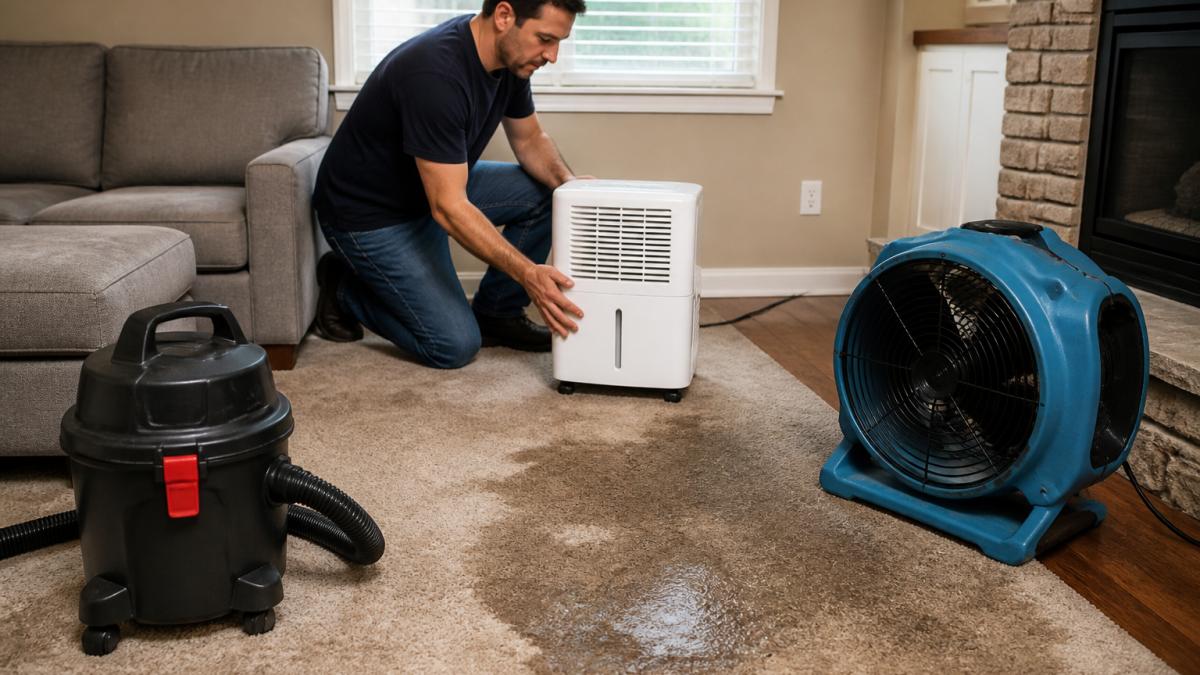
A step-by-step protocol that works:
- Stop the source. Shut off the supply line, the leaking appliance, or the irrigation that caused the flooding. If you cannot find the source, stop here and call for help, drying a room while water is still entering is wasted effort.
- Extract standing water. A wet/dry shop vacuum pulls surface water out of the pile far faster than any dehumidifier can. Work in overlapping passes, then make a second pass with the vacuum’s squeegee attachment to pull water out of the backing.
- Pull up a corner. Lift the carpet at one edge to check whether the padding underneath is soaked. If the pad is dark, dripping, or spongy, the dehumidifier alone will not fix it, see the padding section below.
- Set the dehumidifier. Place it centrally in the wettest area, at least a foot from walls and furniture, with nothing blocking the intake or exhaust. Close windows and doors, and connect the drain hose so the tank never fills and shuts the unit down overnight.
- Add air movers. Angle fans to sweep across the carpet surface, not straight down into it. Two air movers in a standard bedroom, three or more in an open living area, is a common starting point.
- Check and reset. Feel the carpet and padding twice a day and move the fans to any soft spots. Reposition the dehumidifier toward the dampest zone as the room dries unevenly.
Watch out: running a dehumidifier in a room with the windows open is the most common mistake we see. You are paying to dry the whole neighborhood.
How to Know When the Carpet Is Actually Dry
Touch is a poor test. Carpet pile can feel dry on top while the backing and pad stay damp for another day or two, which is exactly how a musty smell starts. Use measurable criteria instead:
- Moisture meter readings. A pin-type moisture meter pressed into the carpet backing and the pad should read close to the readings you get from a known-dry carpet in another room.
- Humidity readings. A hygrometer in the room should show relative humidity holding steady or falling while the equipment runs. If humidity climbs after you shut the dehumidifier off, moisture is still coming out of the carpet.
- The paper-towel test. Press a dry paper towel into the carpet at several spots and hold it for a few seconds. If it comes up damp, keep drying.
Placement and Operating Setup
Placement decides how fast the job goes.
Set the humidistat low, or run the unit on continuous mode if it has one. A dehumidifier that cycles off at a comfortable humidity level will stop before the carpet is dry.
Aim at least one air mover along the baseboard where carpet meets wall, and keep fans on the floor rather than on a table.
Air Movers for Wet Carpet: Why Airflow Speeds Drying
Air movers for wet carpet do the job a dehumidifier cannot: they evaporate moisture out of the carpet and padding and push it into the air.
The setup that works is a loop.
- Angle fans to sweep along the carpet surface rather than blowing straight down
- Use at least two air movers in a standard room, more in an open plan
- Keep interior doors closed to concentrate the dry air
If you are coming from a single box fan in the corner, expect the job to take far longer. Airflow is the difference between drying a room and merely airing it out.
How Long to Dry Carpet After Water Damage
Drying time depends on the water, the padding, and the conditions in the room. For the full water damage restoration process and when to switch from DIY to professionals, see the complete recovery guide.
What slows it down:
- Padding left in place and saturated
- Windows and doors left open
- A dehumidifier too small for the room
You can measure progress without a meter. Press a dry paper towel into the carpet at several spots. If it comes up damp, keep drying. If the carpet feels cool and the padding crackles when you lift a corner, there is still water underneath.
When Padding or the Subfloor Is Still Wet
Wet padding is a common reason drying jobs take longer than expected. Carpet padding acts like a sponge and holds water against the subfloor long after the carpet surface feels dry.
The practical fix is to pull the carpet back far enough to remove the wet padding, dry the subfloor, and replace the pad. To keep moisture from spreading deeper into the floor and structure, follow these steps to stop water damage spreading.
Watch out: carpet that has sat wet for more than a couple of days, or that was soaked by toilet or outdoor water, can become a contamination problem, not just a moisture problem.
Mold Risk and When to Stop Drying and Call a Pro
Mold can begin growing on wet carpet and padding within a day or two, and humid conditions can speed that up. Learn how to clean up mold safely after water damage before you handle anything.
Call a professional when:
- The wet area is larger than about 10 square feet
- The water came from a toilet, sewer backup, or outdoor flooding
- Mold is visible or there is a musty smell
- The padding or subfloor is still wet after two days of drying
For small areas, careful cleanup can be appropriate. For anything beyond that, professional help is the safer path, and Aquaflame Restores It can assess the damage and handle extraction for you.
Get a Free Assessment Before You Start Drying
Before you rent a machine or buy anything, get an assessment. If you would rather have it handled for you, book wet carpet water removal with certified technicians and insurance claim assistance. Aquaflame Restores It is a locally owned emergency restoration company based in Decatur, Georgia, serving metro Atlanta including DeKalb, Clayton, Cobb, and Henry counties.
We handle water damage restoration, mold remediation, plumbing repairs, and contents pack-out, and we work directly with insurance companies and bill them directly. Rated 5.0 on Google.
Frequently Asked Questions
Will a dehumidifier pull moisture out of a carpet?
Yes, a dehumidifier removes moisture from the air, and that pulls trapped moisture out of carpet fibers over time. It works best when combined with strong airflow from fans or air movers and after you have extracted standing water with a wet/dry vacuum. A dehumidifier alone will not dry a soaked carpet quickly, and it cannot reach water that has soaked into padding or the subfloor. If the carpet has been wet for more than 24 to 48 hours or covers more than about 10 square feet, call a professional to assess for hidden moisture and mold.
How long does it take a dehumidifier to dry wet carpet?
Most surface-level dampness dries in 24 to 48 hours with a properly sized dehumidifier and good airflow. Heavily soaked carpet or carpet with wet padding can take 3 to 5 days, and padding often needs to be removed and replaced. Drying time depends on how much water was absorbed, the room’s humidity, and whether you are running air movers. Check for dryness by pressing a dry paper towel into the carpet and feeling for cool, damp spots. If the carpet still feels wet after 48 hours, call a professional.
Should I use fans with a dehumidifier to dry carpet?
Yes. Fans and air movers for wet carpet dramatically speed up drying by moving air across the surface and lifting moisture into the air where the dehumidifier can capture it. Place air movers angled toward the wet area and run the dehumidifier in the same room with doors and windows closed. Together they can noticeably shorten drying time compared to using a dehumidifier alone. For large areas or water that has soaked into padding, professional-grade air movers and dehumidifiers make a bigger difference than household fans.
Can a dehumidifier dry carpet padding as well as the carpet surface?
A dehumidifier can help dry padding, but padding is thick and holds water longer than the carpet surface. In many cases, soaked padding must be pulled up, dried separately, or replaced because it traps moisture and becomes a mold risk. If you can lift a corner of the carpet and the padding underneath is still wet after 24 hours, or if you smell a musty odor, call a professional. Hidden moisture in padding and subfloor can contribute to mold growth after water damage.
Wet carpet rarely dries as fast as homeowners expect, and the gap between a damp carpet and a mold problem is shorter than most people think. If the water came from a burst pipe, a failed water heater, or a storm that pushed water under a door, our team can assess it, dry it, and deal with your insurance company directly. Call Aquaflame Restores It at 678-379-8000 for a free assessment and get the drying started the right way.

