Table of Contents
- Why a Single Team Beats Multiple Contractors for Commercial Restoration
- The True Cost of Juggling Separate Vendors After Property Damage
- What Emergency Commercial Restoration Response Time Really Means for Your Business
- Managing Insurance Claims for Commercial Property Damage Without the Headache
- Why IICRC Certified Restoration Technicians Matter for Complex Commercial Sites
- The Step-by-Step Complete Restoration Process from One Team
- Conclusion: Making Complete Restoration a Business Continuity Strategy
- Frequently Asked Questions
Last Updated: September 7, 2026
When a commercial property suffers water, fire, or storm damage, the instinct is to call the first mitigation crew available and sort out the rest later. That fragmented approach often leads to finger-pointing between vendors, unbudgeted change orders, and weeks of added downtime. Complete restoration from one team for commercial real estate consolidates emergency mitigation, structural drying, reconstruction, and insurance documentation under a single accountable partner, which is why property managers increasingly treat it as a business continuity strategy rather than a repair transaction. Below, we break down what that accountability actually costs, why response speed matters more than most realize, and how to evaluate a restoration partner before you need one.
Why a Single Team Beats Multiple Contractors for Commercial Restoration
The core advantage of complete restoration from one team is simple: one contract, one schedule, one point of accountability. When you hire separate firms for water extraction, structural drying, mold abatement, and reconstruction, each vendor protects its own scope of work. Disputes over who caused a delay or which trade is responsible for a defect become your problem to mediate.
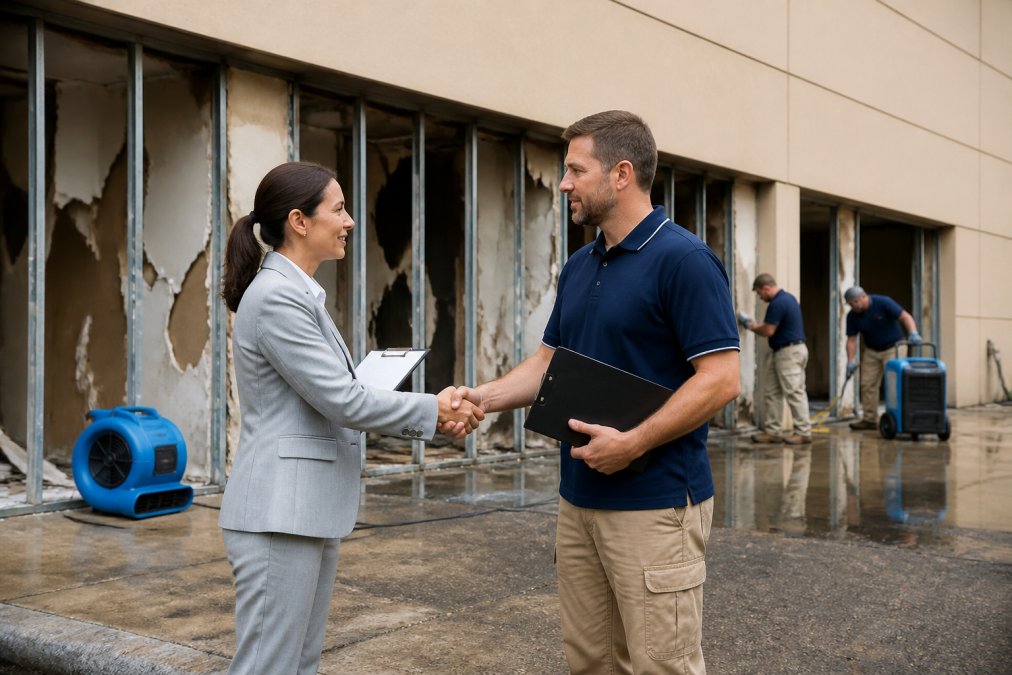
A unified team eliminates those handoffs entirely. The same project manager who supervises emergency mitigation also oversees the rebuild, which means site conditions discovered during drying are communicated directly to the reconstruction crew rather than lost between contractors. This matters most for commercial buildings, where the building envelope, HVAC systems, and electrical infrastructure create interdependencies that a generalist crew may miss.
Single-source restoration collapses the timeline because demolition, drying, and rebuild planning happen in parallel rather than sequentially. The project manager holds the full picture from day one.
The True Cost of Juggling Separate Vendors After Property Damage
The visible line items on separate vendor invoices tell only part of the story. The hidden costs of multi-vendor restoration include repeated mobilization fees, redundant equipment rentals, and the administrative burden of coordinating schedules across companies that do not answer to each other. But the most significant cost is rarely itemized: the cost of delay itself.
Every extra day a commercial space sits unusable carries a financial weight that often exceeds the restoration bill. Consider a 10,000-square-foot office leased at $30 per square foot annually. That space generates roughly $822 per day in rent. A two-week delay in re-occupancy due to sequential vendor handoffs costs over $11,500 in lost rent alone, before you add temporary relocation costs, lost productivity, or tenant concessions to retain the occupant. A single team that can move from emergency mitigation into full-service reconstruction without bidding the rebuild to a third party shortens that gap substantially.
A common mistake is assuming you can hire a cheap mitigation crew and then shop around for the best rebuild price later. In practice, the second contractor will need to re-inspect, re-document, and re-plan work the first crew already completed, often charging for that duplication. They also carry no liability for the first crew’s drying results, which means if hidden moisture is discovered after the rebuild begins, you face a dispute over who pays for the correction.
Run the soft-cost calculation before comparing bids. A turnkey provider that costs 10% more on paper often delivers a lower total cost of restoration once lost rent, coordination labor, and duplicated work are factored in.
Beyond the immediate project, consider the operational efficiency of a single-source model. With one vendor, you maintain one contract, one insurance certificate, one safety program, and one set of warranties. Multi-vendor projects generate a patchwork of warranties that expire on different schedules and cover different scopes, tracking and enforcing them becomes an administrative burden that falls on your facilities team long after the crews have left.
A single team also eliminates the procurement cycle between phases. When mitigation ends and reconstruction begins, a multi-vendor approach requires a new request for proposals, bid review, and contract execution. That process alone typically adds five to ten business days to a project timeline, days during which the property generates no revenue. A unified team moves directly from mitigation into reconstruction because the scope was already developed during the assessment phase, not after the drying equipment is removed.
What Emergency Commercial Restoration Response Time Really Means for Your Business
Emergency commercial restoration response time is measured in how quickly water extraction and site stabilization begin, not how fast a salesperson returns your call. The window between the damage event and active mitigation determines whether porous materials like drywall and insulation can be saved or must be demolished. maintaining commercial exteriors.
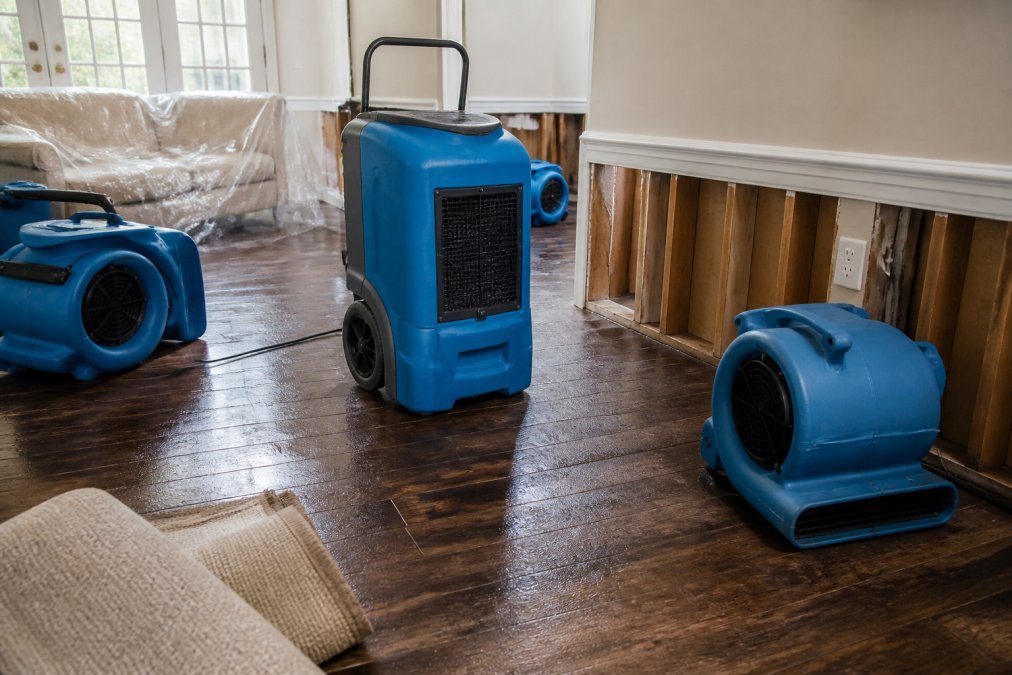
For a leaking sprinkler system flooding a tenant space, every hour of standing water pushes water damage remediation deeper into structural components. A team that guarantees a 30-minute arrival window and operates 24/7 can begin dehumidification and water extraction before moisture wicks up walls and into the ceiling cavity. In practice, this is the difference between a contained drying job and a full demolition of affected assemblies.
Waiting for regular business hours to start mitigation is the most expensive decision a property manager can make. By morning, water damage has migrated into subfloors and wall cavities, multiplying the scope of structural restoration required.
Managing Insurance Claims for Commercial Property Damage Without the Headache
Managing insurance claims for commercial property damage becomes dramatically simpler when your restoration contractor handles direct billing with your carrier. Instead of submitting separate invoices from four vendors and reconciling overlapping line items, you review a single documentation package that traces the full restoration lifecycle.
A restoration team that works directly with insurers understands what adjusters require for property loss documentation. They document moisture readings, drying curves, and demolition decisions in real time, creating an evidence trail that supports your claim rather than forcing you to reconstruct it weeks later. This documentation is also what protects you if the carrier questions whether certain work was necessary.
Guidance on documenting property damage claims from the Federal Emergency Management Agency emphasizes the importance of contemporaneous records and photographs when substantiating a loss. A restoration partner that builds this documentation into their workflow removes a major administrative burden from your team.
Why IICRC Certified Restoration Technicians Matter for Complex Commercial Sites
IICRC certified restoration technicians bring more than a credential to the job; they bring a standardized methodology for assessment, mitigation, and verification. For complex commercial sites, that methodology translates into defensible decisions about what can be dried and what must be replaced.
Certification means the technician follows established protocols for structural drying, dehumidification, and mold abatement rather than improvising based on what looks dry. This matters for commercial properties because the stakes of incomplete drying include hidden mold growth behind finished walls and long-term liability for indoor air quality. A certified team also knows when to bring in a structural engineer to evaluate load-bearing elements after fire or water damage, rather than guessing at structural integrity.
The IICRC standards and reference guides define what proper water damage remediation and fire and smoke restoration actually look like. Asking a potential restoration partner directly about their technicians’ certifications and their experience with commercial building systems is a reasonable diligence step before signing a contract.
The Step-by-Step Complete Restoration Process from One Team
Understanding the restoration lifecycle helps you evaluate whether a provider can genuinely deliver complete restoration from one team or is simply subcontracting the phases they cannot handle. A full-service process follows this sequence:
- Emergency response and site stabilization: 24/7 dispatch, water extraction, board-up, and hazard mitigation to stop further damage.
- Damage assessment: Documenting the loss, identifying affected materials, and determining what can be restored versus replaced.
- Water and fire mitigation: Structural drying, dehumidification, soot and smoke cleanup, and mold abatement where needed.
- Reconstruction planning: Developing the scope for structural restoration, including any necessary engineering review.
- Full-service reconstruction: Rebuilding affected assemblies, restoring HVAC and electrical systems, and completing finish work.
- Verification and closeout: Final inspection, clearance documentation, and handover.
The advantage of a single team is that steps three through five happen under one project manager. When the drying crew discovers that baseboards and cabinetry must be removed, that information flows directly into the reconstruction scope.
| Restoration Phase | Multi-Vendor Approach | Single Team Approach |
|---|---|---|
| Mitigation | Hired separately, limited scope | Included, full documentation |
| Rebuild | Requires new bid and contractor | Already scoped by project manager |
| Coordination | Property owner mediates disputes | One accountable point of contact |
| Timeline | Sequential handoffs add weeks | Parallel planning compresses schedule |
| Insurance | Multiple invoices to reconcile | Single documentation package |
Conclusion: Making Complete Restoration a Business Continuity Strategy
Every day a commercial property sits out of service carries a measurable cost, and the restoration approach you choose directly controls how many days that becomes. The Business continuity planning resources from the Small Business Administration treat disaster recovery as an operational priority, not an afterthought. Complete restoration from one team for commercial real estate aligns with that priority by compressing the timeline from damage to occupancy and removing the coordination burden that slows multi-vendor projects.
But the strategic value of a single-source partner extends beyond the emergency itself. Property managers who treat restoration as a business continuity function build relationships with a restoration team before damage occurs, not in the middle of a crisis. That relationship includes a pre-incident walkthrough to identify shutoff locations, document baseline building conditions, and establish a communication protocol for after-hours emergencies. When damage does occur, the team already understands your building’s systems and your tenants’ sensitivity to disruption.
For property managers who cannot afford downtime, the decision comes down to accountability. A single team that handles emergency mitigation, insurance documentation, and full reconstruction gives you one throat to choke and one timeline to track. Aquaflame Restores it brings IICRC-trained technicians, a 30-minute arrival guarantee, and direct insurance billing to commercial properties across metro Atlanta, coordinating the entire restoration lifecycle from first call to final walkthrough. Get started with Aquaflame Restores it and turn property damage from a crisis into a managed process.
Frequently Asked Questions
What are the benefits of using one company for commercial restoration?
A single company for commercial restoration provides single-source accountability, which means one team manages everything from the initial damage assessment and emergency mitigation to the final reconstruction. This eliminates the coordination gaps that often occur between separate vendors, reduces the risk of schedule delays, and simplifies communication. You have one project manager, one contract, and one point of contact. This direct approach often leads to a faster restoration lifecycle and less downtime for your business, tenants, and operations.
How does a single-source restoration team handle insurance billing?
A single-source team manages the entire insurance claim documentation process. They handle the initial property assessment, prepare a detailed scope of work, and provide the documentation your adjuster needs. Teams experienced in managing insurance claims for commercial property damage often bill the insurance company directly, which reduces your administrative burden. This means you avoid managing multiple invoices from different contractors and have a better chance of the final settlement covering the complete scope of work, from structural drying to final rebuild.
How quickly can a restoration team respond to commercial property damage?
Emergency commercial restoration response time is critical to limiting secondary damage like mold growth or structural weakening. Professional teams offer 24/7 emergency service and aim to have technicians on site within hours of your call. Some local providers, like Aquaflame Restores it, guarantee arrival within 30 minutes for metro Atlanta properties. A faster response allows the team to begin water extraction, site stabilization, and dehumidification immediately, which minimizes business interruption and helps keep the overall restoration project on schedule.
Why is IICRC certification important for commercial restoration teams?
IICRC certified restoration technicians have completed formal training and passed exams in specific restoration disciplines like water damage remediation, fire and smoke restoration, and mold abatement. Certification ensures the crew follows industry standards for drying, cleaning, and safety procedures, which matters for complex commercial sites with building envelope concerns or HVAC systems. It also provides a level of assurance to your insurance company and stakeholders that the work is performed by qualified professionals, helping prevent incomplete work that could lead to future property loss.