
Last Updated: November 11, 2026
Quick Summary
You can tell a carpet pad needs replacing when you find soft flat spots in walkways, faint grid lines at pad seams, loose carpet near walls, a musty smell that returns after vacuuming, resurfacing stains, fine dust puffing up, or sagging edges along tack strips. Two or more of these signs means the pad is likely done.
- Inspecting carpet padding takes about 15 minutes and one small corner loosened from the tack strip.
- Press the pad with your thumb: good pad springs back fast, while crushed pad stays flat.
- Density matters more than thickness, so ask for the density rating when comparing a replacement pad.
- Call a professional for mold when the affected area is larger than about 10 square feet or mold is hidden.
- Replace the pad when it is wet, musty after drying, crushed in high-traffic areas, or soaked by sewage.
Table of Contents
- 7 Signs Your Carpet Pad Needs Replacing
- Signs of Water Damaged Carpet Pad
- How to Inspect Carpet Padding: A Step-by-Step Check
- Pad Density, Material Types and What They Tell You
- Carpet Ripples, Wear Patterns and Pad Failure
- When to Call a Professional for Mold
- Repair or Replace: Deciding What to Do Next
- Book a Free Carpet Pad Assessment at 678-379-8000
- Frequently Asked Questions
7 Signs Your Carpet Pad Needs Replacing
Knowing how to tell if carpet pad needs replacing starts with one fact: the pad under your carpet does most of the work. It absorbs foot traffic, cushions the backing, and blocks moisture from reaching the subfloor. When it fails, the carpet above it fails too, even if the fibers still look fine.
Here are seven signs that a carpet pad may need replacing.
- Soft, flat spots in walkways where the padding no longer springs back
- Faint grid lines on the carpet where pad seams have collapsed
- Loose carpet that ripples or bunches near walls
- A musty smell that returns after vacuuming
- Visible stains that keep resurfacing from below
- Fine dust puffing up when you walk across the room
- Sagging edges along tack strips
Any one of these is worth a closer look. Two or more means the pad is likely done.
Signs of Water Damaged Carpet Pad
Water damaged carpet pad can show signs long before the carpet looks bad.
Watch for these signals:
- A damp, cool feeling underfoot in one spot
- Stains that reappear after cleaning
- A musty or earthy smell that gets stronger on humid days
- Carpet that squishes or squelches when pressed
- Dark rings spreading outward from a wall or fixture
Georgia humidity makes this worse. If you suspect a wet pad, learn how to remove water from carpet before the damage spreads, and read our guide on how to prevent mold after water damage to understand the drying window.
Watch out: drying a soaked pad with household fans alone may not be enough. Water trapped beneath the carpet backing can keep feeding mold even when the surface feels dry.
How to Inspect Carpet Padding: A Step-by-Step Check
Inspecting carpet padding takes about 15 minutes and one small corner. The goal is to check for moisture, crushing, and delamination without pulling up the whole room.
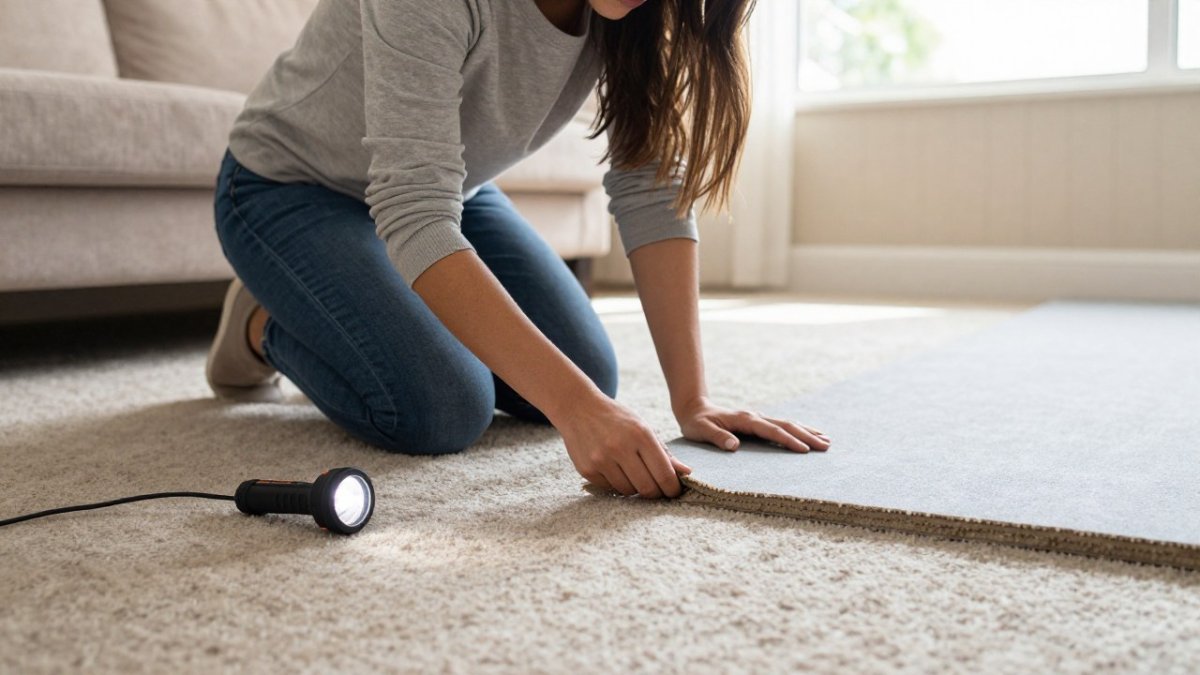
- Pick a corner near a wall. Loosen the carpet from the tack strip with a putty knife.
- Peel back the carpet just enough to expose the pad. Do not force it.
- Press the pad with your thumb. Good pad springs back fast. Crushed pad stays flat.
- Check for moisture. A pin-type moisture meter gives a reading; a dry paper towel pressed for 30 seconds shows dampness.
- Look for delamination. If the pad separates from its backing or crumbles, it has failed.
- Smell the exposed area. A musty odor means moisture has been sitting there.
- Photograph what you find. Useful for an insurance claim.
What to Look For: A Visual Diagnostic Checklist
Use this look-for list on the exposed corner and along any seams you can reach:
- Peaked or ridged padding. The pad has bunched into a raised ridge, usually along a seam or where two pieces meet. This is a sign the adhesive or backing has let go and the pad is no longer lying flat under tension.
- Crumbled or powdery edges. Rub the edge between your fingers. If it sheds crumbs or turns to powder, the foam has broken down and will not recover.
- Compressed flat spots. Press a walkway and a low-traffic corner. If the walkway stays flat after you lift your thumb while the corner springs back, the pad has lost resilience where it matters most.
- Delaminated layers. The top film or scrim separates from the foam body, or the pad peels apart in sheets. Once the layers split, the pad cannot support the carpet evenly.
- Dark or stained patches. Discoloration that spreads outward from a wall, fixture, or seam points to moisture wicking through the pad.
- Rust or tack bleed. Orange or brown staining near the tack strip suggests long-term dampness at the perimeter.
- Compression under furniture. Four flat dents under a sofa or bed that never fill back in are a classic sign of foam fatigue rather than a spill.
Reading the Results
A single soft spot in a doorway is often just traffic wear. A pattern of peaked seams, powdery edges, and flat walkways together means the pad is past its service life and the carpet above it is taking the strain.
During the check, also watch for related clues. Our guide to the signs of hidden water damage covers warped floors and musty odors that often show up alongside pad problems.
Watch out: do not pull the carpet back farther than a corner or a seam. Over-lifting can break the tack strip grip and leave a ripple that was not there before you started.
Pad Density, Material Types and What They Tell You
Pad density and material generally affect how long a carpet pad lasts and how it fails. Density is the weight of foam packed into a given volume; denser pad resists crushing longer. Most residential pad falls into three families, and each one shows failure in a different way.
| Pad Type | Feel | Best For | How It Fails |
|---|---|---|---|
| Rebond foam | Firm, dense | High-traffic areas, hallways | Soaks up water and holds it; edges crumble when saturated |
| Felt padding | Heavy, flat | Living rooms, low moisture rooms | Slow to dry once wet; compacts into a hard mat |
| Prime foam | Soft, light | Bedrooms, low traffic | Crushes fast under furniture; turns powdery at edges |
How Each Material Fails
Rebond foam is made from bonded foam scraps and is the workhorse of most homes. It resists crushing well in dry rooms, but it is a sponge.
Felt padding is dense and heavy and lasts well in dry rooms. Its weakness is water: felt compacts into a hard, flat mat when it gets wet and dries slowly, especially in Georgia humidity.
Prime foam feels plush on day one and flattens under a sofa within a couple of years. It shows failure as deep, permanent dents under furniture and as powdery edges where the foam has oxidized.
Density Beats Thickness
Density often matters more than thickness. A dense pad can spread the load in a hallway better than a soft, thicker pad that compresses under it. When you are comparing a replacement pad, ask for the density rating rather than the thickness, and match the pad to the room: firmer and denser in hallways and doorways, softer in bedrooms.
Matching Failure Signs to Material
Use the material to interpret what you see. Crumbled edges and a spongy feel point to rebond that has been wet. A stiff, flat, heavy pad points to felt that soaked and dried. Deep furniture dents and powdery edges point to prime foam that has simply worn out. In older metro Atlanta homes with crawl spaces, damp air from below can shorten the life of any pad, so check the perimeter first.
If the pad is wet or musty, the material question comes second, dry the space and fix the source before deciding on replacement.
Carpet Ripples, Wear Patterns and Pad Failure
Carpet ripples are usually blamed on bad installation. In practice, ripples and wear patterns are two of the clearest signs of pad failure. When padding compresses unevenly, the carpet above loses its support and starts to shift.
Look for these patterns:
- Ripples running parallel to walls where pad seams have flattened
- Matting in doorways where traffic crushes the pad fastest
- Crushing under furniture legs that never recovers
- Delamination where the carpet backing separates from the pad
Stretch-in installation depends on a firm pad to hold tension. Once the pad gives way, the carpet loosens and the tack strips take the strain. In older metro Atlanta homes, this often shows up in hallways first.
When to Call a Professional for Mold
Call a professional for mold when the affected area is larger than about 10 square feet, when mold is hidden under carpet or inside a wall cavity, or when the water came from a sewage backup. Those cases need containment and proper removal, not a spray bottle.
Small surface spots on a dry pad can sometimes be handled with a mild detergent and thorough drying. Anything beyond that is a job for trained technicians. Our step-by-step mold remediation guide explains what safe removal involves and where DIY should stop.
If the pad has been wet for more than a day or two, treat it as a mold risk.
Repair or Replace: Deciding What to Do Next
Repair makes sense for a small, dry, recently damaged area. Replace when the pad is soaked, crushed, moldy, or more than a few years into heavy traffic. Use this checklist to decide:
- Is the pad wet right now? → Replace
- Does it smell musty after drying? → Replace
- Is the damage under 10 square feet and dry? → Possible repair
- Is the pad crushed in high-traffic areas? → Replace
- Did the water come from a sewage backup? → Replace and call a pro
- Is the carpet itself still in good shape? → Pad-only replacement may work
Replacing pad without replacing carpet may be possible when the carpet backing is intact. A restoration professional can advise on whether the existing carpet can be re-stretched over new pad.
Book a Free Carpet Pad Assessment at 678-379-8000
A wet or crushed pad is a small problem now and an expensive one later. Mold, subfloor damage, and ruined carpet all start here.
Aquaflame Restores It is a locally owned emergency restoration company based in Decatur, serving metro Atlanta. See our full range of restoration services to know what to expect.
Call 678-379-8000 for a free assessment and a straight answer on whether your pad can be saved.
If your carpet feels soft, smells musty, or squishes underfoot, don’t wait for the damage to spread. Call Aquaflame Restores It at 678-379-8000 for a free assessment. Our IICRC-certified technicians respond 24/7, arrive within one hour, and bill your insurance directly.
Frequently Asked Questions
How often should you replace your carpet pad?
Carpet pad life varies with density, material and foot traffic. High-traffic areas, pet accidents and Georgia’s humid summers shorten that window. Check for compression, odors and moisture at the 7 to 8 year mark. If the pad no longer springs back after you press it, it is time to replace it even if the carpet fibers still look fine.
Can you just replace a carpet pad without replacing the carpet?
Sometimes yes. If the carpet backing is intact and the carpet can be lifted without damage, a technician can pull it back, remove the old pad and install new padding. This works best when the carpet is relatively new and has no delamination. If the backing is crumbling or the carpet is heavily worn, replacing the pad alone will not fix the problem. A free assessment can tell you which situation you have.
What are the signs of water damaged carpet pad?
Look for a musty or mildew smell, dark staining visible when you lift a corner, a damp or spongy feel underfoot, and carpet that stays wet long after a spill or leak. Water damaged carpet pad loses its resilience, and damp pad can grow mold quickly in humid conditions. If you find these signs, keep the area dry and call a restoration professional before the damage spreads.
How does Georgia humidity affect carpet pad longevity?
Atlanta’s summer humidity keeps indoor air moist, and carpet pad absorbs that moisture over time. High humidity combined with crawl space dampness or a slow leak creates ideal conditions for mold and mildew in the pad. Running a dehumidifier and fixing leaks quickly helps, but once the pad stays damp for days, it usually needs replacing. Homes with older crawl spaces can be especially vulnerable.
