Table of Contents
- Reconstruction vs Restoration for Property Damage: What’s the Difference?
- Water Damage Mitigation vs Restoration: Where Each Fits
- Restoration vs Reconstruction: Side-by-Side Comparison
- Signs a Home Needs Reconstruction After Water Damage
- Water Damage Restoration Timeline: What to Expect at Each Stage
- Water Damage Insurance Claim and Reconstruction: Coverage and Documentation
- When to Call a Professional Restoration Team
- Frequently Asked Questions
Last Updated: October 12, 2026
Reconstruction vs Restoration for Property Damage: What’s the Difference?
Reconstruction vs restoration for property damage comes down to one question: can the damaged materials be saved, or do they have to be rebuilt? At Aquaflame Restores it, our IICRC-trained technicians make that call on every job, and it shapes everything that follows: the scope of work, the insurance claim, and the timeline.
Here is the part most homeowners miss. The two aren’t rivals. They’re phases of the same recovery, and the damage assessment decides where one ends and the other begins.
Defining restoration and reconstruction
Restoration is the process of returning a damaged property to its pre-loss condition using the original structure wherever possible.
Reconstruction is the rebuilding phase that follows when materials are too damaged to save. It involves demolition, debris removal, and replacement of structural components, drywall, and flooring.
A wet hardwood floor can often be dried and refinished. A floor that has cupped, buckled, and soaked into the subfloor usually cannot.
How the two approaches work together
Mitigation, restoration, and reconstruction form one continuous sequence, not three separate projects. Water mitigation stops the damage from spreading. Restoration repairs what survived. Reconstruction rebuilds what didn’t.
The handoff matters more than most people expect. When one team manages all three phases, nothing gets lost between contractors, and the insurance adjuster deals with a single scope of work instead of three competing estimates.
Water Damage Mitigation vs Restoration: Where Each Fits
Water damage mitigation vs restoration describes two different jobs. Mitigation is emergency damage control: extraction, drying, and stopping moisture from spreading. Restoration is the repair work that happens after the structure is dry.
Mitigation: stopping the damage from spreading
Mitigation happens first, and speed decides how much of your home survives. Technicians extract standing water, set drying equipment, and monitor moisture levels until the structure meets dry standards.
Skip this step and the consequences compound. The EPA guidance on mold cleanup is clear that fixing the moisture source comes before any mold treatment, because remediation without drying just invites the problem back.
Restoration vs Reconstruction: Side-by-Side Comparison
Restoration and reconstruction differ in scope, cost, timeline, and insurance treatment. The table below summarizes how each phase compares, followed by the decision framework most homeowners actually need.
| Factor | Restoration | Reconstruction |
|---|---|---|
| Goal | Return materials to pre-loss condition | Rebuild what cannot be saved |
| Typical work | Cleaning, drying, repairs, refinishing | Demolition, debris removal, replacement |
| Materials | Salvaged and reused | Removed and replaced |
| Timeline | Days to a few weeks | Weeks to several months |
| Insurance | Often covered as mitigation and repair | Covered when damage is documented |
| Trigger | Materials are salvageable | Structural damage or hidden damage |
| Permits | Usually none | Often required for structural, electrical, or plumbing work |
| Disruption | Partial, you can often stay in the home | Major, occupants frequently relocate during structural work |
A damage-severity decision framework
Most guides stop at the table. The more useful question is: at what point does restoration stop being realistic? Use this checklist, moving top to bottom. The first “yes” generally pushes the project toward reconstruction.
- Is the structure itself compromised? Sagging ceilings, bowed or cracked framing, a floor that flexes underfoot, or a foundation crack that has widened since the loss. Structural movement is a reconstruction trigger, not a repair.
- Has water or smoke reached concealed cavities? Moisture behind drywall, inside wall cavities, under subfloor, or in attic insulation usually means removal and replacement rather than drying in place.
- Are porous materials saturated beyond drying? Carpet padding, cellulose insulation, particleboard, and oriented strand board (OSB) generally cannot be dried and reused once saturated.
- Is there microbial growth? Visible mold, a persistent musty odor after drying, or growth that returned after a previous treatment points to a moisture source that was never corrected.
- Does the damage cross multiple systems? When framing, electrical, plumbing, and finishes are all affected, the scope shifts from repair to rebuild.
- Will current building codes allow a like-for-like repair? Older homes sometimes cannot be repaired to pre-loss condition because current code requires upgrades during permitted work.
If you answer “no” to every item, restoration is usually the right path. If you answer “yes” to one or more, get a professional assessment before authorizing repairs, the cost of a second opinion is trivial next to rebuilding a wall twice.
What actually drives cost and timeline
Cost in both paths is driven by the same variables, not by the label on the invoice:
- Square footage affected, the single largest cost driver in either path.
- Materials involved, refinishing hardwood is a different line item than replacing it; matching discontinued flooring, tile, or cabinetry adds cost in reconstruction.
- Access and containment, second-story work, crawlspaces, and asbestos or lead-containing materials in older homes add labor and abatement steps.
A common pattern is that restoration looks cheaper on the estimate but grows if hidden damage is found once walls are opened. Reconstruction looks more expensive up front but has fewer unknowns, because the damaged material is being removed anyway.
Restoration is the default when materials are salvageable and the structure is sound. Reconstruction becomes necessary when the structure, concealed cavities, or code requirements make a like-for-like repair impossible. The decision framework above is the fastest way to tell which side of that line you are on.
Signs a Home Needs Reconstruction After Water Damage
The clearest signs a home needs reconstruction are structural: sagging ceilings, soft or crumbling drywall, warped framing, and floors that flex underfoot. When these appear, drying alone will not fix the problem.
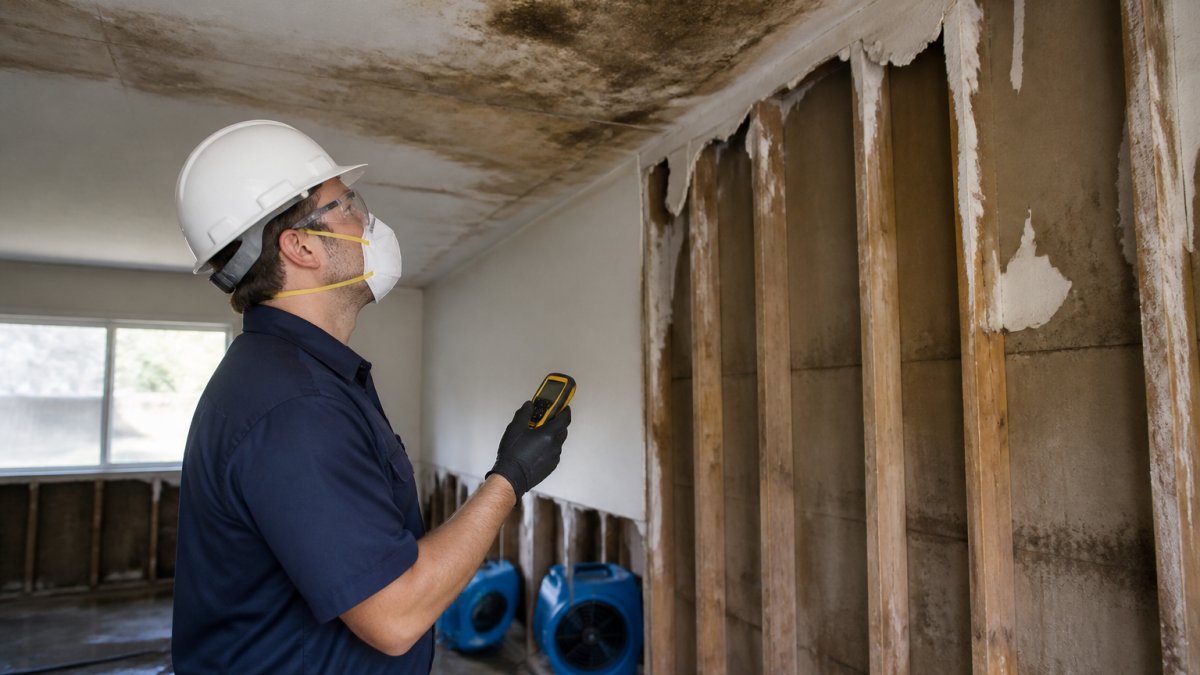
Other signals are easy to miss:
- A ceiling that stays wet after drying equipment runs for days
- Baseboards that pull away from the wall
- A persistent musty smell after cleanup
That last one deserves attention. If mold returns after treatment, the moisture source was never found. Treating the visible growth without fixing the leak is the most common mistake we see, and it’s why the problem keeps coming back.
Never assume a stain is just cosmetic. Water travels along framing and pools far from the original leak. Hidden damage behind walls is one of the most frequent reasons a “small” repair turns into a reconstruction project.
::: Documenting these concealed structural vulnerabilities requires rigorous project tracking methods to ensure that every stage of the remediation process maintains the integrity of the building.
Water Damage Restoration Timeline: What to Expect at Each Stage
A water damage restoration timeline runs from emergency response through final reconstruction, and each stage has its own clock. Here’s the typical sequence.
| Stage | What Happens | Typical Duration |
|---|---|---|
| Emergency response | Water extraction, safety check, damage assessment | Same day |
| Mitigation | Drying, dehumidification, moisture monitoring | 3-5 days |
| Restoration | Repairs, drywall, flooring, painting | 1-3 weeks |
| Reconstruction | Demolition, structural rebuild, finishes | Several weeks to months |
Drying is the stage people underestimate. Equipment runs around the clock for days, and stopping early traps moisture inside walls. The IICRC standards for water damage restoration set the drying benchmarks professionals work to, which is why moisture readings, not appearance, decide when drying is finished.
Water Damage Insurance Claim and Reconstruction: Coverage and Documentation
A water damage insurance claim and reconstruction go hand in hand, because insurers pay based on documentation and policy language, not on what the damage looks like. Two claims for identical damage can be handled differently depending on how the loss is classified and how well it is documented.
What typically is and is not covered
Most homeowners policies treat sudden and accidental discharge as covered, a burst supply line, a failed water heater, an overflowing appliance, or a roof breach from a storm. Flood from rising water is generally excluded from homeowners policies and handled through a separate flood policy (Buy a Flood Insurance Policy).
That distinction matters for the restoration-versus-reconstruction decision, because the classification of the loss can determine whether the insurer pays to repair or to replace.
How adjuster estimates and depreciation affect the scope
When you file a claim, the insurer sends an adjuster to inspect and produce an estimate. That estimate drives the scope of work, and it is not the same as a contractor’s estimate. A few mechanics are worth understanding:
- Replacement cost value (RCV) vs. actual cash value (ACV). RCV pays to replace damaged materials at today’s prices. ACV pays replacement cost minus depreciation for age and wear. Many policies pay ACV up front and release the depreciation portion, called recoverable depreciation, once the work is completed and invoiced.
- Line-item scope. Adjuster estimates are written line by line. If a line is missing, say, removal of saturated insulation or drying equipment for a concealed cavity, the contractor has to document and request it. This is one of the most common reasons a claim stalls.
- Matching and code upgrades. If your flooring or siding is discontinued, matching the undamaged portion can push a repair into a partial replacement. Similarly, code-required upgrades triggered by permitted reconstruction may or may not be covered depending on your policy’s ordinance or law coverage.
Documentation that supports the claim
Documentation is where claims are won or lost. Photograph everything before cleanup begins, keep damaged materials until the adjuster has seen them, and get the scope of work in writing. A few specifics that make the difference:
- Date-stamped photos and video of standing water, affected rooms, and the source of the loss.
- A written moisture log showing readings over time, this is the evidence that drying was necessary and that it was completed to standard.
- Receipts and records for any emergency measures you took, such as a plumber’s after-hours visit or a hotel stay if the home was uninhabitable.
Ask your restoration company whether they bill your insurer directly. Direct insurance billing means the contractor documents the loss, submits the estimate, and communicates with your adjuster, so you’re not stuck relaying messages between two parties. It also means the same team that performed the mitigation is documenting the reconstruction scope, which reduces the chance of a gap between the two.
Where the coverage decision meets the restoration decision
Coverage and scope are not the same thing. A policy may cover reconstruction in principle while the adjuster’s initial estimate only authorizes restoration. If hidden damage is found once walls are opened, the contractor documents it and the adjuster issues a supplement. This is normal, but it is also why the initial assessment matters. A thorough assessment before the claim is filed reduces the number of supplements and the delays that come with them.
Temporary housing and additional living expenses
If the home is uninhabitable during reconstruction, many policies include additional living expenses (ALE) or loss-of-use coverage, which can pay for a hotel, rental, or increased food costs while you are displaced. ALE is typically subject to a dollar limit and a time limit, and it usually requires receipts. If reconstruction is likely to run weeks or months, confirm your ALE limits before work begins so you are not surprised mid-project.
When to Call a Professional Restoration Team
Call a professional the moment water reaches building materials, not just the floor. Standing water in a room is a cleanup job. Water inside walls, under flooring, or above a ceiling is a restoration project.
The signs that you need help now:
- Water has been sitting for more than 24 hours
- The ceiling is sagging or dripping
- You smell musty odors after drying
At Aquaflame Restores it, we handle extraction, drying, and full reconstruction under one roof, with 24/7 emergency response and a 30-minute arrival guarantee. One team means one scope of work and one point of contact for your adjuster, which matters when every day of delay adds to the damage.
Frequently Asked Questions
When does water damage require reconstruction instead of restoration?
Reconstruction becomes necessary when structural components like load-bearing walls, floor joists, or the foundation are compromised, or when damage is so severe that materials cannot be dried and saved. Signs include sagging ceilings, cracked foundation walls, and persistent mold growth after previous repairs. A professional damage assessment determines whether the structure can be returned to its pre-loss condition through restoration or requires a full rebuild.
How long does water damage restoration take?
The water damage restoration timeline depends on the category and class of water loss. Drying typically takes 3 to 5 days with professional equipment. Light restoration like drywall patching and painting may add 1 to 2 weeks. If reconstruction is needed, the project can extend from several weeks to several months based on the scope of work, material availability, and permit approvals.
Does homeowners insurance cover reconstruction after water damage?
Most homeowners insurance policies cover sudden and accidental water damage, including reconstruction if the damage is deemed covered. However, damage from neglected maintenance or gradual leaks may be excluded. Document everything with photos, keep receipts, and work with a restoration company that offers direct insurance billing to help streamline your water damage insurance claim and reconstruction process.
What is the difference between water damage mitigation and restoration?
Water damage mitigation stops the damage from getting worse. It includes emergency water extraction, drying, and preventing mold growth. Restoration, on the other hand, returns the property to its pre-loss condition by repairing or replacing damaged materials like drywall, flooring, and trim. Mitigation comes first; restoration follows once the structure is dry and stable.
Can a damaged home be restored without rebuilding?
Yes, if the structural components are intact and the damage is limited to cosmetic or non-structural elements. Restoration can repair drywall, flooring, and cabinetry without a full rebuild. However, if the damage assessment reveals compromised load-bearing elements or widespread mold, reconstruction may be the safer and more cost-effective long-term solution.
Water damage rarely stays the size it starts. The longer moisture sits in walls and framing, the more likely a repair becomes a rebuild, and the bigger your claim grows. Aquaflame Restores it responds 24/7 with IICRC-trained technicians, direct insurance billing, and full reconstruction services, so one team takes your property from emergency extraction to the final coat of paint. Get started with Aquaflame Restores it and get your home back to its original condition.