Table of Contents
- What Is Emergency Water Removal and Why Speed Matters
- Understanding Water Damage Restoration and Assessment
- Water Extraction Equipment: How Professionals Remove Water Fast
- Health and Safety Hazards During Water Removal
- What to Do While Waiting for Emergency Water Removal Services
- How Much Does Emergency Water Removal Cost and What Affects Pricing
- DIY vs. Professional Water Removal: When to Call the Experts
- Insurance Documentation Guide for Water Damage Claims
Emergency Water Removal: A 2026 Guide to Fast Response
Last Updated: July 24, 2026
When water floods your home or business, every minute counts. Emergency water removal is the process of rapidly extracting standing water and beginning mitigation before structural damage, mold growth, and contamination spread beyond control. According to the National Flood Insurance Program, water damage claims represent the largest portion of homeowner insurance claims annually. The difference between a $5,000 recovery and a $50,000 disaster often comes down to what happens in the first 24 hours.
What Is Emergency Water Removal and Why Speed Matters
Emergency water removal is the immediate extraction of water from a property following flooding, burst pipes, failed appliances, or weather events. It’s the coordinated first step of water damage restoration that prevents secondary damage like mold, structural rot, and electrical hazards.
Water begins absorbing into drywall, insulation, subflooring, and foundation materials within hours. Mold colonies can germinate in as little as 48 hours. Professional emergency water removal teams arrive with industrial-grade equipment, moisture detection tools, and systematic protocols to remove water faster than standard pumps can handle. Speed is the difference between saving your property and losing it.
Document everything with photos and video before cleanup begins. Insurance adjusters need to see the extent of damage, and you’ll need this documentation for your claim.
Understanding Water Damage Restoration and Assessment
Proper water damage restoration starts with understanding what you’re dealing with. Not all water is the same, and the restoration approach depends entirely on the water’s source and contamination level.
Category 1, 2, and 3 Water: What You’re Dealing With
Category 1 water (clean water) comes from sanitary sources: burst supply lines, melted snow, or rainwater from intact roofs. It poses minimal health risk initially but becomes contaminated as it sits and absorbs bacteria from flooring and drywall. Category 1 water must be removed quickly because it will degrade into Category 2 within 24-48 hours.
Category 2 water (gray water) contains significant contamination from washing machine discharge, dishwasher overflow, or toilet overflow. It contains microorganisms and chemical residues that cause illness if ingested or absorbed through skin. Category 2 water damage requires professional-grade sanitation beyond simple extraction.
Category 3 water (black water) is highly contaminated sewage, floodwater from rivers or storm drains, or water that has contacted fecal matter. It contains dangerous pathogens including E. coli, hepatitis A, and cryptosporidium. Category 3 situations require hazmat-level protocols and specialized disposal procedures. Property owners should never attempt Category 3 cleanup themselves.
If you’re uncertain about water source or suspect sewage contamination, treat it as Category 3. Exposure to black water can cause serious infections. Call a professional immediately.
Professional Water Damage Assessment vs. DIY Inspection
A professional water damage assessment determines the water category, measures moisture levels in walls and subflooring, identifies hidden water pockets, and creates a restoration plan. Professionals use thermal imaging cameras and moisture meters to quantify saturation levels.
DIY inspection has severe limitations. You can see standing water, but cannot see moisture inside walls, saturated insulation, or penetrated subflooring. Many homeowners think they’ve removed all water after pumping out the visible portion, only to discover mold growing behind walls weeks later. Professional assessment also protects your insurance claim by providing documented moisture readings and thermal imaging reports.
Water Extraction Equipment: How Professionals Remove Water Fast
Industrial water extraction removes water 10-50 times faster than household wet vacuums, and speed directly translates to less secondary damage.
Submersible Pumps, Wet Vacuums, and Extraction Trucks
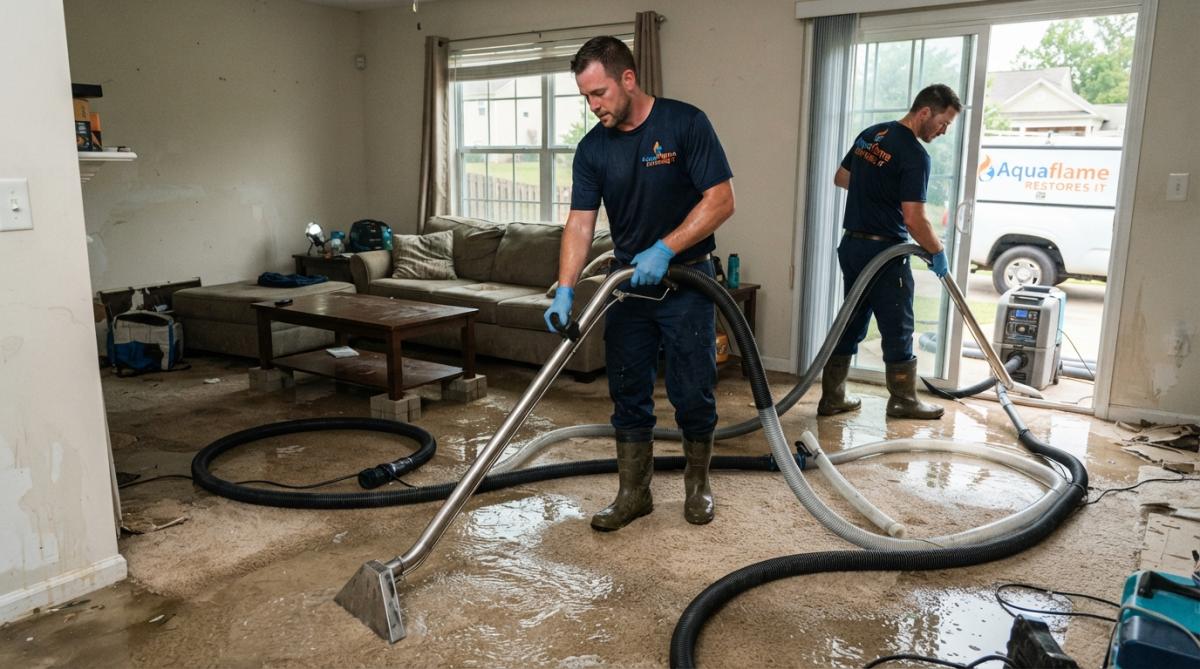
Submersible pumps are the workhorse of emergency water removal for large volumes. These electric or gas-powered pumps push hundreds of gallons per minute through discharge hoses. A submersible pump can empty a basement in hours, a task that would take a household wet vacuum days.
Wet vacuums (shop vacuums) handle smaller volumes and water trapped in carpet or tight spaces. Professional-grade wet vacuums have much larger capacity and stronger suction than consumer models.
Extraction trucks are specialized vehicles with massive onboard pumps and collection tanks. They pull water directly from the property into their tank, then transport it off-site for proper disposal. This is the fastest method for catastrophic flooding.
Dehumidification and Structural Drying Systems
Water removal is only half the battle. Remaining moisture in walls, subflooring, and structural materials must be dried to prevent mold and decay.
Dehumidifiers pull moisture from the air, reducing relative humidity. Industrial-grade dehumidifiers remove far more moisture per hour than household units.
Structural drying systems use air movers (high-velocity fans) and dehumidifiers in concert to force air circulation through walls, under flooring, and through insulation. This accelerates evaporation of water trapped deep in materials. The drying phase typically lasts 5-14 days depending on humidity levels, material saturation, and ambient conditions.
The most expensive water damage claims involve mold that developed because structural drying was skipped or done improperly. Proper drying takes time and equipment, but it’s far cheaper than mold remediation later.
Health and Safety Hazards During Water Removal
Water damage creates serious health and safety risks that go far beyond the visible water.
Mold, Bacteria, and Contamination Risks
Mold begins growing within 48 hours in wet materials. Certain mold species, particularly Stachybotrys (black mold), produce mycotoxins that cause respiratory illness, allergic reactions, and immunosuppression. Mold exposure is especially dangerous for children, elderly people, and those with compromised immune systems.
Bacterial contamination depends on water source. Category 1 water becomes contaminated as it sits. Category 2 and Category 3 water carry immediate pathogenic risk from sewage and fecal bacteria. Professional water mitigation includes sanitization and disinfection protocols using EPA-approved antimicrobial agents.
Electrical and Structural Safety Concerns
Standing water conducts electricity. Any water that has contacted electrical outlets, appliances, or wiring poses electrocution risk. Professional restoration teams shut off power to affected areas and verify electrical safety before allowing occupants to re-enter.
Structural damage develops as water weakens wood framing, foundation concrete, and load-bearing walls. Saturated wood loses strength and begins rotting. Professional assessment is essential, not something to skip.
What to Do While Waiting for Emergency Water Removal Services
Actions you take in the first hour after discovering water can meaningfully reduce final damage and restoration costs.
Immediate Steps to Minimize Damage
Stop the water source immediately. If the water is from a burst pipe, shut off the main water supply. If it’s from an appliance, unplug it and close supply valves.
Turn off power to affected areas at the breaker panel if safe to do so. If the electrical panel is in the flooded area, call an electrician rather than risk electrocution.
Remove valuable items from the water if safe to do so. Grab documents, photos, electronics, and heirlooms that can’t be replaced.
Open windows and doors to increase air circulation if outdoor air is drier than indoor air and if safe to do so.
Do not enter standing water if you don’t know its source. If there’s any possibility it’s sewage or contaminated floodwater, stay out.
Call your insurance company before calling a restoration company. Report the loss immediately, most policies require prompt notification.
Documentation for Insurance Claims
Photograph and video record everything before cleanup begins. Take wide shots showing the full extent of water damage and close-ups of saturated materials.
Make a list of damaged items with descriptions and approximate values. Include furniture, electronics, clothing, and anything else damaged by water.
Keep receipts for any emergency mitigation you do yourself. These may be reimbursable under your policy.
Preserve damaged materials when possible. Don’t throw away drywall, flooring, or other materials until your adjuster has seen them.
Get written estimates from restoration companies before work begins. Insurance adjusters need to see the scope of work and estimated costs.
How Much Does Emergency Water Removal Cost and What Affects Pricing
Emergency water removal pricing depends on several factors, and understanding what drives costs helps you evaluate quotes.
Factors That Determine Your Final Bill
Water volume is the primary cost driver. Removing 500 gallons from a basement costs far less than removing 50,000 gallons from a flooded first floor.
Water category affects pricing significantly. Category 1 water removal is straightforward extraction and dehumidification. Category 2 water requires sanitization and disinfection protocols. Category 3 water (sewage) requires hazmat protocols and specialized disposal, costs can be 3-5 times higher than Category 1.
Affected area size determines equipment needs and labor hours. Accessibility affects labor intensity. Easy-access basements cost less than crawlspaces or attics requiring manual water removal.
Drying timeline depends on material saturation and ambient humidity. Rapid drying in summer might take 5-7 days. Winter drying might extend to 14+ days.
For accurate pricing on your specific situation, contact a local restoration company for an in-person assessment.
Get multiple quotes from different restoration companies before committing. Compare what’s included in each quote (extraction, drying, sanitization, mold treatment) rather than just comparing total price.
DIY vs. Professional Water Removal: When to Call the Experts
Not every water situation requires professional intervention, but most do.
Small Spills You Can Handle Yourself
Small water spills from accidents, a burst water line affecting only a small closet, or a washing machine leak in a laundry room can sometimes be handled with household equipment if you act immediately.
For small spills, use household wet vacuums and towels to remove water within the first 2-4 hours. Open windows and doors to increase air circulation. Run portable fans to accelerate drying. Monitor the area over the next week for mold growth or musty odors. If the area dries completely within 5-7 days without mold developing, you’ve likely prevented secondary damage.
When Professional Emergency Water Removal Is Non-Negotiable
Large water volumes (more than a few hundred gallons) require professional extraction. Household wet vacuums cannot handle basement flooding or multi-room water damage.
Category 2 or Category 3 water requires professional intervention without exception. Sewage contamination or floodwater from outdoor sources carries health risks that DIY cleanup cannot safely address.
Structural materials like drywall, insulation, subflooring, or foundation concrete that have absorbed water require professional assessment and drying. Improper drying leads to mold inside walls and structural decay.
Uncertainty about water source means you should call professionals. If you don’t know whether the water is clean, gray, or black, treat it as contaminated and call a professional immediately.
Insurance claims almost always require professional documentation. Your insurance company will expect professional assessment and restoration reports.
Aquaflame Restores it provides 24/7 emergency water removal across metro Atlanta with a 30-minute arrival guarantee. Their IICRC-certified technicians handle everything from initial extraction through structural drying and reconstruction, managing insurance billing directly so you’re not juggling multiple contractors. When water damage strikes, professional response within the first hours is what separates a manageable recovery from a catastrophic loss.
Insurance Documentation Guide for Water Damage Claims
Insurance claims for water damage require specific documentation and follow particular procedures.
What to Document and How to File Your Claim
Notify your insurance company within 24 hours of discovering water damage. Most policies require prompt notification, delays can result in claim denial. Provide your policy number, the date and time the damage was discovered, the apparent cause, and an estimate of affected area size.
Document the damage thoroughly before cleanup begins. Take photographs and video of all affected areas, including close-ups of water stains and saturated materials.
Obtain written estimates from at least two restoration companies before authorizing work. Insurance adjusters use these estimates to determine claim coverage and payout amounts.
Keep all receipts for emergency mitigation supplies, equipment rental, and restoration services. These are reimbursable expenses under most policies.
Provide an inventory of damaged personal property with descriptions and approximate values. Be honest about values, inflated claims invite denial.
Request an adjuster inspection before final restoration work begins. The adjuster needs to see the damage, verify the cause, and approve the scope of work.
Working with Restoration Companies on Direct Insurance Billing
Direct billing means the restoration company bills your insurance company directly rather than billing you. This arrangement protects you from out-of-pocket costs while claims are being processed.
Verify direct billing capability before hiring a restoration company. Ask explicitly whether they can bill your insurance directly and what happens if the insurance payment is delayed.
Provide authorization documents to the restoration company. Your insurance adjuster will provide forms authorizing the company to bill directly.
Understand your deductible. Your policy deductible is your responsibility, not the insurance company’s. Most deductibles are $500-$2,500. You’ll pay this amount directly to the restoration company, and insurance covers the remainder (up to your policy limit).
Request detailed invoices that itemize all work performed, materials used, and labor hours. These invoices support your insurance claim and provide documentation for your records.
Water damage moves fast, and the decisions you make in the first hours determine whether you’re looking at a $5,000 mitigation or a $100,000 reconstruction. Professional emergency water removal isn’t a luxury, it’s the difference between saving your property and losing it to mold, structural decay, and contamination. Aquaflame Restores it responds 24/7 with IICRC-certified technicians who handle extraction, drying, sanitization, and reconstruction as one coordinated team, managing your insurance claim directly. When water strikes, call immediately, every hour matters.
Frequently Asked Questions
What is emergency water removal and how does it differ from standard water cleanup?
Emergency water removal is the rapid extraction of standing water from your property following a flood, burst pipe, or other water damage event. Unlike standard cleanup, emergency water removal prioritizes speed and mitigation within the first 24 hours to prevent mold, structural damage, and health hazards. Professional teams use industrial-grade water extraction equipment, dehumidification systems, and moisture detection technology to remove water and dry affected areas quickly. The goal is to stop secondary damage before it compounds your restoration costs.
How much does emergency water removal cost, and does homeowners insurance cover it?
Emergency water removal costs depend on water volume, affected area size, contamination level (category 1, 2, or 3 water), and equipment needed. Most homeowners insurance policies cover water damage from sudden, accidental events like burst pipes or storm flooding. However, coverage excludes gradual leaks, flooding from outside your property's perimeter, or maintenance failures. Direct insurance billing through your restoration company can eliminate out-of-pocket costs if your claim is approved. Always contact your insurer immediately and request a detailed estimate from a certified restoration company before proceeding.
What should I do while waiting for emergency water removal services to arrive?
First, turn off electricity to the affected area if it's safe to do so, and move valuables to higher ground. Document all damage with photos and video for your insurance claim, capture wet areas, damaged belongings, and water lines on walls. If the water is clean (category 1), you can begin removing standing water with buckets or a wet vacuum to speed up drying. Open windows and doors to improve airflow, and use fans if available. Never enter flooded areas with category 2 or 3 water (gray or black water) without protective equipment. Write down the exact time water damage began, as this timeline matters for insurance claims.
When should I hire a professional for emergency water removal versus handling it myself?
Call a professional immediately if water covers more than a small area (larger than 10 square feet), if it's gray or black water (sewage, contaminated), if it has affected structural elements like drywall or subflooring, or if mold is visible. Professionals have thermal imaging to detect hidden moisture, industrial dehumidifiers for structural drying, and IICRC certification to ensure proper mitigation and insurance compliance. DIY cleanup works only for minor spills on hard flooring. Professional water extraction equipment and mitigation services prevent costly secondary damage, mold remediation, and health hazards that DIY approaches cannot address.
What equipment do professionals use for emergency water removal?
Professional teams deploy submersible pumps for large volumes of standing water, industrial wet vacuums for carpets and smaller areas, and extraction trucks with powerful suction for basement flooding. After initial water removal, they use dehumidifiers and air movers for structural drying, moisture detection equipment (including thermal imaging) to locate hidden water in walls and subfloors, and sanitization systems for contaminated water. IICRC-trained technicians know which equipment suits each water damage category and property type, ensuring thorough extraction and preventing secondary damage like mold growth.
This article was written using GrandRanker